Question
Show that for a projectile the angle between the velocity and the x-axis as a function of time is given by,
$\theta(\text{t})=\tan^{-1}\Big(\frac{\text{u}_\text{oy}-\text{gt}}{\text{u}_\text{ox}}\Big)$
Answer

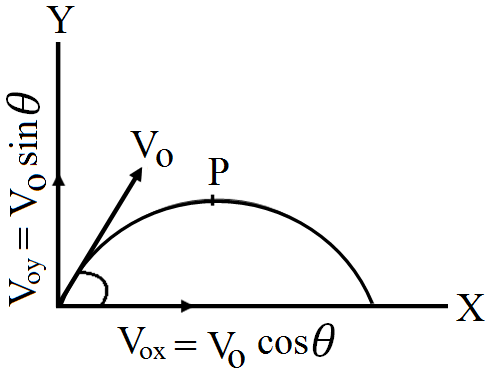
Let vox and v0y respectively be the initial components of the velocity of the projectile along horizontal (x) and vertical (y) directions.
Let vx and vy respectively be the horizontal and vertical components of velocity at a point P.

Time taken by the projectile to reach point P = t
Applying the first equation of motion along the vertical and horizontal directions, we get:
vy = voy = gt
And vx = vox
$\therefore\tan\theta=\frac{\text{v}_\text{y}}{\text{v}_\text{x}}=\frac{\text{v}_\text{oy}-\text{gt}}{\text{v}_\text{ox}}$
$\theta=\frac{\tan^{-1}(\text{v}_\text{oy}-\text{gt})}{\text{v}_\text{ox}}$

Need a full question paper?

Generate a complete, print-ready paper with questions like this in minutes — across 16+ boards, with answer keys.

Start Generating Free

Similar questions

The position, velocity and acceleration of a particle executing simple harmonic motion are found to have magnitudes 2cm, 1m/s and 10m/s2 at a certain instant. Find the amplitude and the time period of the motion.
Find the change in the internal energy of 2kg of water as it is heated from 0°C to 4°C. The specific heat capacity of water is 4200Jkg-1 K-1 and its densities at 0°C and 4°C are 999.9kgm-3 and 1000kgm-3 respectively. Atmospheric pressure = 10-6Pa.
What is projectile motion? Drive formula for time of flight and range of projectile fired from a point at an angle $\theta$ with the horizontal. Find value of $\theta$ for maximum horizontal range.
A particle A having a charge of 2.0 × 10-6C is held fixed on a horizontal table. A second charged particle of mass 80g stays in equilibrium on the table at a distance of 10cm from the first charge. The coefficient of friction between the table and this second particle is $\mu=0.2.$ Find the range within which the charge of this second particle may lie.
A convex lens has a focal length of 10cm. Find the location and nature of the image if a point object is placed on the principal axis at a distance of:
  1. 9.8cm
  2. 10.2cm from the lens.
A brass boiler has a base area of $0.15 m^2$ and thickness 1.0 cm . It boils water at the rate of $6.0 kg / min$ when placed on a gas stove. Estimate the temperature of the part of the flame in contact with the boiler.
Thermal conductivity of brass $=109 Js ^{-1} m^{-1}$ $K ^{-1}$, Heat of vaporisation of water $=2256 \times 10^3 J$ $k g ^{- 1 }$
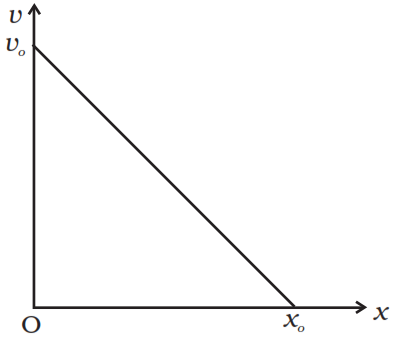
The velocity-displacement graph of a particle is shown in Fig.
  1. Write the relation between v and x.
  2. Obtain the relation between acceleration and displacement and plot it.
​​​​​​​
What is capillarity? Establish the formula for the height of water column rising in the capillary tube.
An adiabatic vessel of total volume V is divided into two equal parts by a conducting separator. The separator is fixed in this position. The part on the left contains one mole of an ideal gas (U = 1.5nRT) and the part on the right contains two moles of the same gas. Initially, the pressure on each side is p. The system is left for sufficient time so that a steady state is reached. Find,
  1. The work done by the gas in the left part during the process.
  2. The temperature on the two sides in the beginning.
  3. The final common temperature reached by the gases.
  4. The heat given to the gas in the right part.
  5. The increase in the internal energy of the gas in the left part.
Suppose the particle of the previous problem has a mass m and a speed v before the collision and it sticks to the rod after the collision. The rod has a mass M:
  1. Find the velocity of the centre of mass C of the system constituting ''The rod plus the particle''.
  2. Find the velocity of the particle with respect to C before the collision.
  3. Find the velocity of the rod with respect to C before the collision.
  4. Find the angular momentum of the particle and of the rod about the centre of mass C before the collision.
  5. Find the moment of inertia of the system about the vertical axis through the centre of mass C after the collision.
  6. Find the velocity of the centre of mass C and the angular velocity of the system about the centre of mass after the collision.