Question
Show that $\text{f(x)}=\tan^{-1}(\sin\text{x}+\cos\text{x})$ is an increasing function in $\Big(0,\frac{\pi}{4}\Big).$

Answer

We have, $\text{f(x)}=\tan^{-1}(\sin\text{x}+\cos\text{x})$
$\therefore\ \text{f}'(\text{x})=\frac{1}{1+(\sin\text{x}+\cos\text{x})^2}\cdot(\cos\text{x}-\sin\text{x})$
$=\frac{1}{1+\sin^2\text{x}+\cos^2\text{x}+2\sin\text{x}.\cos\text{x}}(\cos\text{x}-\sin\text{x})$
$=\frac{1}{(2+\sin2\text{x})}(\cos\text{x}-\sin\text{x})$
$\big[\because\sin2\text{x}=2\sin\text{x}\cos\text{x and }\sin^2\text{x}+\cos^2\text{x}=1\big]$
For $\text{f}'(\text{x})\geq0.$
$\frac{1}{(2+\sin2\text{x})}\cdot(\cos\text{x}-\sin\text{x})\geq0$
$\Rightarrow\ \cos\text{x}-\sin\text{x}\geq0$ $\Big[\because(2+\sin2\text{x})\geq0\text{ in }\Big(0,\frac{\pi}{4}\Big)\Big]$
$\Rightarrow\ \cos\text{x}\geq\sin\text{x}$
Which is true, if $\text{x}\in\Big(0,\frac{\pi}{4}\Big)$
Hence, f(x) is an increasing function in $\Big(0,\frac{\pi}{4}\Big).$

Need a full question paper?

Generate a complete, print-ready paper with questions like this in minutes — across 16+ boards, with answer keys.
Start Generating Free

Similar questions

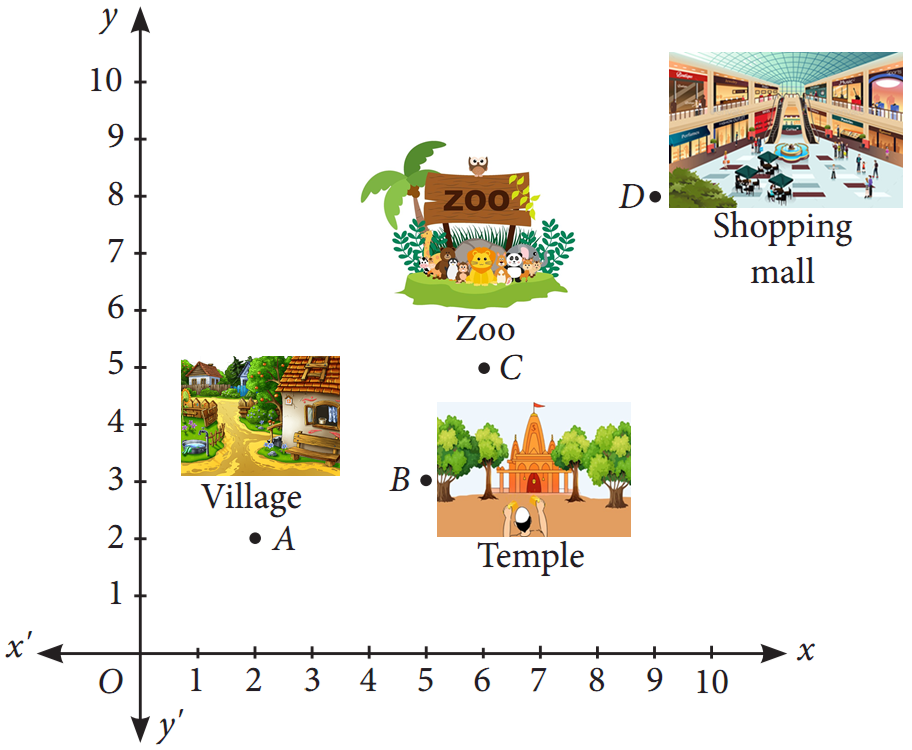
Ishaan left from his village on weekend. First, he travelled up to temple. After this, he left for the zoo. After this, he left for shopping in a mall. The positions of Jshaan at different places is given in the following graph.

Based on the above information, answer the following questions.
  1. Position vector of B is:
  1. $3\hat{\text{i}}+5\hat{\text{j}}$
  2. $5\hat{\text{i}}+3\hat{\text{j}}$
  3. $-5\hat{\text{i}}-3\hat{\text{j}}$
  4. $-5\hat{\text{i}}+3\hat{\text{j}}$
  1. Position vector of D is:
  1. $5\hat{\text{i}}+3\hat{\text{j}}$
  2. $3\hat{\text{i}}+5\hat{\text{j}}$
  3. $8\hat{\text{i}}+9\hat{\text{j}}$
  4. $9\hat{\text{i}}+8\hat{\text{j}}$
  1. Find the vector $\overline{\text{BC}}$ in terms of $\hat{\text{i}},\hat{\text{j}}.$
  1. $\hat{\text{i}}-2\hat{\text{j}}$
  2. $\hat{\text{i}}+2\hat{\text{j}}$
  3. $2\hat{\text{i}}+\hat{\text{j}}$
  4. $2\hat{\text{i}}-\hat{\text{j}}$
  1. Length of vector $\overline{\text{AB}}$ is:
  1. $\sqrt{67}\text{ units}$
  2. $\sqrt{85}\text{ units}$
  3. 90 units
  4. 100 units
  1. If $\vec{\text{M}}=4\hat{\text{j}}+3\hat{\text{k}},$ then its unit vector is:
  1. $\frac{4}{5}\hat{\text{j}}+\frac{3}{5}\hat{\text{k}}$
  2. $\frac{4}{5}\hat{\text{j}}-\frac{3}{5}\hat{\text{k}}$
  3. $-\frac{4}{5}\hat{\text{j}}+\frac{3}{5}\hat{\text{k}}$
  4. $-\frac{4}{5}\hat{\text{j}}-\frac{3}{5}\hat{\text{k}}$
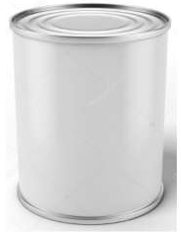
A tin can manufacturer designs a cylindrical tin can for a company making sanitizer and disinfectors. The tin can is made to hold 3 litres of sanitizer or disinfector. The cost of material used to manufacture the tin can is $₹ 100 / \mathrm{m}^2$.

Image

(i) If $\mathrm{r} \mathrm{cm}$ be the radius and $\mathrm{h} \mathrm{cm}$ be the height of the cylindrical tin can, then express the surface area as a function of radius (r)

(ii) Find the radius of the can that will minimize the cost of tin used for making can?

(iii) Find the height that will minimize the cost of tin used for making can ?

OR

Find the minimum cost of material used to manufacture the tin can.

In pre-board examination of class XII, commerce stream with Economics and Mathematics of a particular school, 50% of the students failed in Economics, 35% failed in Mathematics and 25% failed in both Economics and Mathematics. A student is selected at random from the class. Based on the above information, answer the following questions.
  1. The probability that the selected student has failed in Economics, if it is known that he has failed in Mathematics, is:
  1. $\frac{3}{10}$
  2. $\frac{12}{25}$
  3. $\frac{1}{4}$
  4. $\frac{5}{7}$
  1. The probability that the selected student has failed in Mathematics, if it is known that he has failed in Economics, is:
  1. $\frac{22}{25}$
  2. $\frac{12}{25}$
  3. $\frac{1}{2}$
  4. $\frac{3}{25}$
  1. The probability that the selected student has passed in at least one of the two subjects, is:
  1. $\frac{1}{4}$
  2. $\frac{1}{2}$
  3. $\frac{3}{4}$
  4. None of these.
  1. The probability that the selected student has failed in at least one of the two subjects, is:
  1. $\frac{3}{5}$
  2. $\frac{22}{25}$
  3. $\frac{2}{5}$
  4. $\frac{43}{100}$
  1. The probability that the selected student has passed in Mathematics, if it is known that he has failed in Economics, is:
  1. $\frac{2}{5}$
  2. $\frac{3}{4}$
  3. $\frac{1}{3}$
  4. $\frac{1}{2}$
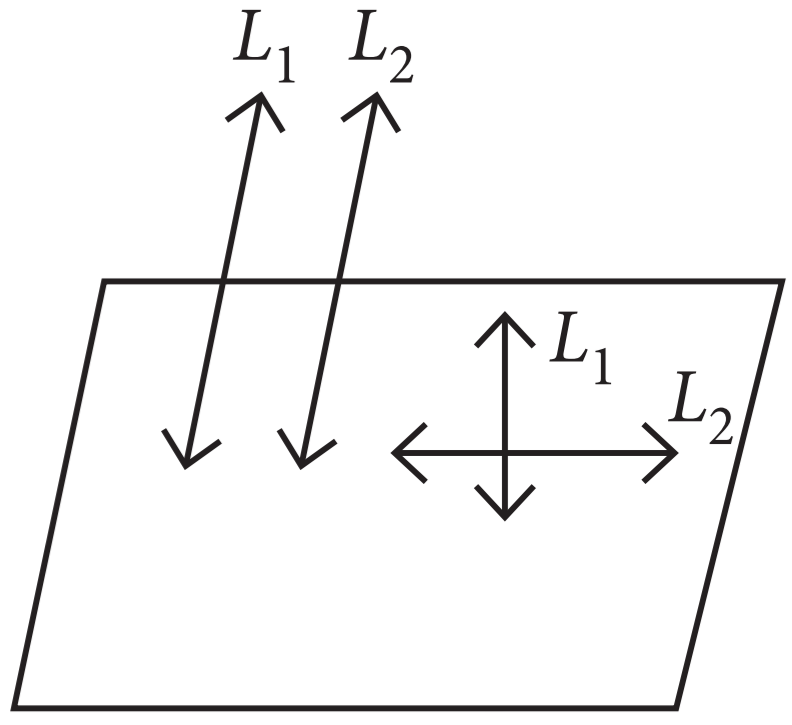
If $a_{1,} b_{1,} c_{1,}$ and $a_{2,}b_{2,} c_2$ are direction ratios of two lines say $L_1$ and $L_2$ respectively. Then $L_1 || L_2$ iff $\frac{\text{a}_1}{\text{a}_2}=\frac{\text{b}_1}{\text{b}_2}=\frac{\text{c}_1}{\text{c}_2}$ and $\text{L}_1\perp\text{L}_2$ iff $a_1a_2 + b_1b_2 + c_1c_2 = 0.$

Based on the above information, answer the following questions.

  1. If $l_{1,} m_1, n_{1,}$ and $l_2, m_2, n_2$ are the direction cosines of $L_1$ and $L_2$ respectively, then $L_1$ will be perpendicular to $L_2,$ iff:
  1. $l_1l_2 + m_1m_2 + n_1n_2 = 0$
  2. $l_1m_2 + m_1l_2 + n_1n_2 = 0$
  3. $\frac{\text{l}_1}{\text{l}_2}=\frac{\text{m}_1}{\text{m}_2}=\frac{\text{n}_1}{\text{n}_2}$
  4. None of these
  1. If $l_1, m_1, n_1$ and $l_2, m_2, n_2$ are direction cosines of $L_1$ and $L_2$ respectively, then $L_1$ will be parallel to $L_2,$ iff:
  1. $l_1l_2 + m_1m_2 + n_1n_2 = 0$
  2. $l_1m_2 + m_1l_2 + n_1n_2 = 0$
  3. $\frac{\text{l}_1}{\text{l}_2}=\frac{\text{m}_1}{\text{m}_2}=\frac{\text{n}_1}{\text{n}_2}$
  4. $m_1n_2 + m_2n_2 + l_1l_2 = 0$
  1. The coordinates of the foot of the perpendicular drawn from the point $A(1, 2, 1)$ to the line joining $B(1, 4, 6)$ and $C(5, 4, 4),$ are:
  1. $(1, 2, 1)$
  2. $(2, 4, 5)$
  3. $(3, 4, 5)$
  4. $(3, 4, 5)$
  1. The direction ratios of the line which is perpendicular to the lines with direction ratios proportional to $(1, -2, -2)$ and $(0, 2, 1)$ are:
  1. $< 1, 2, 1 >$
  2. $< 2,-1, 2 >$
  3. $< -1,2, 2 >$
  4. None of these
  1. The lines $\frac{\text{x}-2}{3}=\frac{\text{y}+1}{-2}=\frac{\text{z}-2}{0}$ and $\frac{\text{x}-1}{1}=\frac{\frac{\text{y}+3}{2}}{\frac{3}{2}}=\frac{\text{z}+5}{2}$ are:
  1. Parallel.
  2. Perpendicular.
  3. Skew lines.
  4. Non-intersecting.
Varun and Jsha decided to play with dice to keep themselves busy at home as their schools are closed due to coronavirus pandemic. Varun throw a dice repeatedly until a six is obtained. He denote the number of throws required by X.
Based on the above information, answer the following questions.
  1. The probability that X = 2 equals.
  1. $\frac{1}{6}$
  2. $\frac{5}{6^2}$
  3. $\frac{5}{3^6}$
  4. $\frac{1}{6^3}$
  1. The probability that X = 4 equals.
  1. $\frac{1}{6^4}$
  2. $\frac{1}{6^6}$
  3. $\frac{5^3}{6^4}$
  4. $\frac{5}{6^4}$
  1. The probability that $\text{X}\geq2$ equals.
  1. $\frac{25}{216}$
  2. $\frac{1}{36}$
  3. $\frac{5}{6}$
  4. $\frac{25}{36}$
  1. The value of $\text{P}(\text{X}\geq6)$ is:
  1. $\frac{5^5}{6^5}$
  2. $1-\frac{5^3}{6^5}$
  3. $\frac{5^3\times61}{6^5}$
  4. $\frac{5^3}{6^4}$
  1. The probability that X > 3 equals.
  1. $\frac{36}{25}$
  2. $\frac{5^2}{6^2}$
  3. $\frac{5}{6}$
  4. $\frac{5^3}{6^3}$
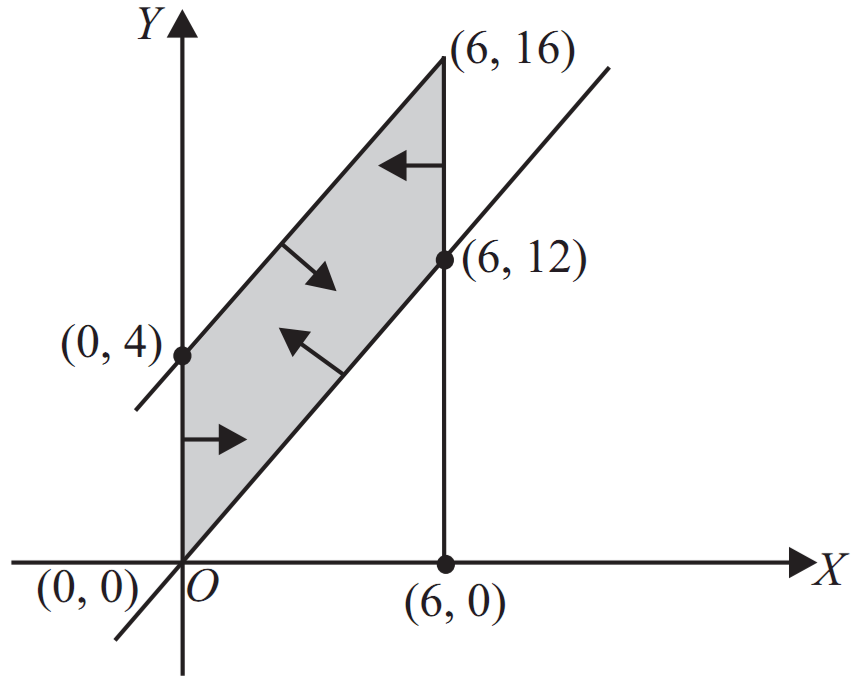
Let R be the feasible region (convex polygon) for a linear programming problem and let Z = ax + by be the objective function. When Z has an optimal value (maximum or minimum), where the variables x and y are subject to constraints described by linear inequalities, this optimal value must occur at a corner point (vertex) of the feasible region. Based on the above information, answer the following questions.
  1. Objective function of a L.P.P. is:
  1. A constant.
  2. A function to be optimised.
  3. A relation between the variables.
  4. None of these.
  1. Which of the following statement is correct?
  1. Every LPP has at least one optimal solution.
  2. Every LPP has a unique optimal solution.
  3. If an LPP has two optimal solutions, then it has infinitely many solutions.
  4. None of these.
  1. In solving the LPP: "minimize f = 6x + 10y subject to constraints $\text{x}\geq6,\text{ y}\geq2,\text{ 2x}+\text{y}\geq10,\text{ x}\geq0,\text{ y}\geq0"$ redundant constraints are:
  1. $\text{x}\geq6,\text{ y}\geq2$
  2. $\text{2x}+\text{y}\geq10,\text{ x}\geq0,\text{ y}\geq0$
  3. $\text{x}\geq6$
  4. None of these
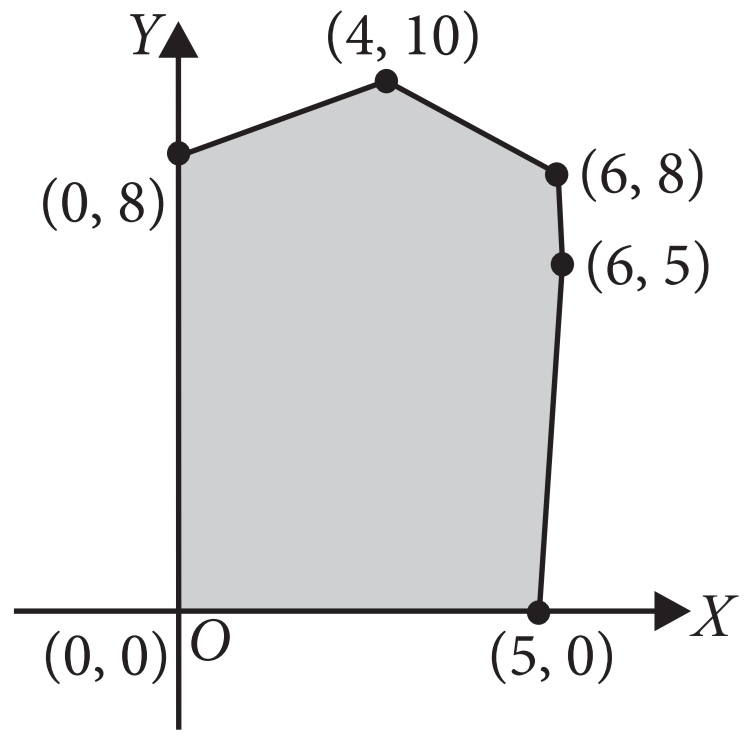
  1. The feasible region for a LPP is shown shaded in the figure. Let Z = 3x - 4y be the objective function. Minimum of Z occurs at:
  1. (0, 0)
  2. (0, 8)
  3. (5, 0)
  4. (4, 10)
  1. The feasible region for a LPP is shown shaded in the figure. Let F = 3x - 4y be the objective function. Maximum value of F is:
  1. 0
  2. 8
  3. 12
  4. -18
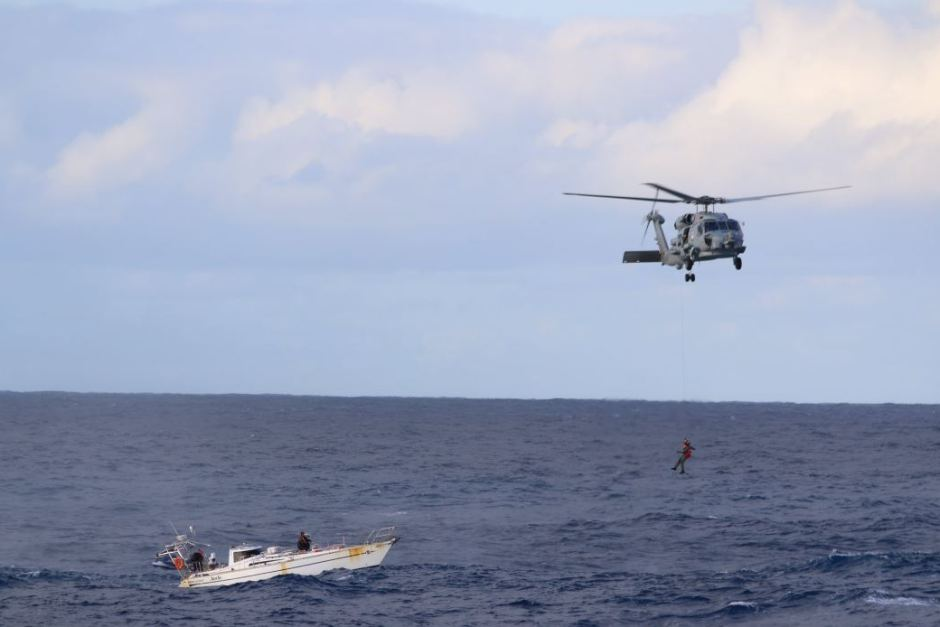
The Indian Coast Guard (ICG) while patrolling, saw a suspicious boat with four men. They were nowhere looking like fishermen. The soldiers were closely observing the movement of the boat for an opportunity to seize the boat. They observe that the boat is moving along a planar surface. At an instant of time, the coordinates of the position of coast guard helicopter and boat are (2, 3, 5) and (1, 4, 2) respectively. Based on the above information, answer the following questions.
  1. If the line joining the positions of the helicopter and boat is perpendicular to the plane in which boat moves, then equation of plane is:
  1. x - y + 3z = 2
  2. x + y + 3z = 2
  3. x - y + 3z = 3
  4. x + y + 3z = 3
  1. If the soldier decides to shoot the boat at given instant of time, where the distance measured in metres then what is the distance that bullet has to travel?
  1. $\sqrt{5}\text{m}$
  2. $\sqrt{8}\text{m}$
  3. $\sqrt{10}\text{m}$
  4. $\sqrt{11}\text{m}$
  1. If the speed of bullet is 30m/ sec, then how much time will the bullet take to hit the boat after the shot is fired?
  1. 30 seconds
  2. 1 second
  3. $\frac{1}{2}\text{second}$
  4. $\frac{\sqrt{11}}{30}\text{seconds}$
  1. At the given instant of time, the equation of line passing through the positions of helicopter and boat is:
  1. $\frac{\text{x}}{1}=\frac{\text{y}}{-1}=\frac{\text{z}}{3}$
  2. $\frac{\text{x}-1}{1}=\frac{\text{y}-4}{-1}=\frac{\text{z}-2}{3}$
  3. $\frac{\text{x}}{1}=\frac{\text{y}}{1}=\frac{\text{z}}{-3}$
  4. $\frac{\text{x}-1}{1}=\frac{\text{y}-4}{1}=\frac{\text{z}-2}{-3}$
  1. At a different instant of time, the boat moves to a different position along the planar surface. What should be the coordinates of the location of the boat for the bullet to hit the boat if soldier shoots the bullet along the line whose equation is $\frac{\text{x}-1}{1}=\frac{\text{y}-1}{-2}=\frac{\text{z}-2}{3}?$
  1. $\Big(\frac{1}{2},\frac{1}{2},\frac{1}{2}\Big)$
  2. $\Big(\frac{3}{4},\frac{3}{2},\frac{5}{4}\Big)$
  3. $\Big(\frac{1}{3},\frac{1}{4},\frac{1}{5}\Big)$
  4. None of these
Read the following text carefully and answer the questions that follow:
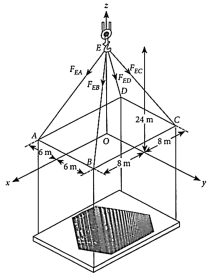
Consider the following diagram, where the forces in the cable are given.
Image
$i$. What is the cartesian equation of line along $EA$? $(1)\rightarrow$
$ii$. The vector $ED$ is $(1)$
$iii$. The length of the cable $EB$ is $(2)$
OR
What is the result of adding up all the vectors along the cables? $(2)$
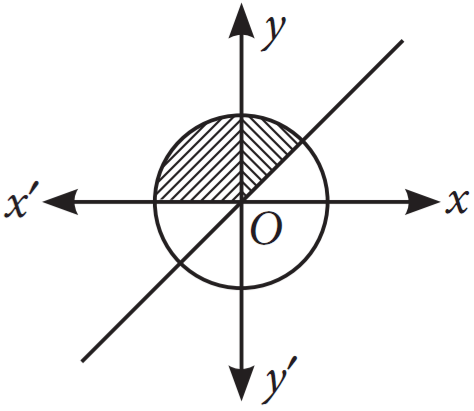
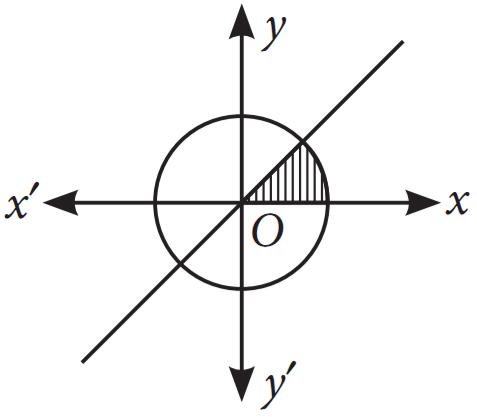
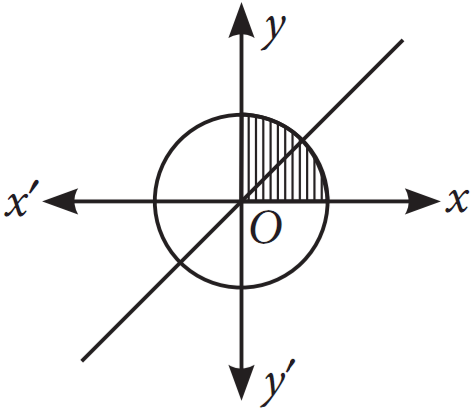
Consider the curve $x^2+y^2=16$ and line $y = x$ in the first quadrant. Based on the above information, answer the following questions.
  1. Point of intersection of both the given curves is.
  1. $(0, 4)$
  2. $(0, 2\sqrt{2})$
  3. $(2\sqrt{ 2},2\sqrt{2})$
  4. $(2,\sqrt{2},4)$
  1. Which of the following shaded portion represent the area bounded by given two curves?
  1. None of these
  1. The value of the integral $\int\limits_{0}^{2\sqrt{2}}\text{x}\text{dx}$ is.
  1. $0$
  2. $1$
  3. $2$
  4. $4$
  1. The value of the integral $\int\limits_{2\sqrt{2}}^{0}\sqrt{16-\text{x}^2}\text{ dx}$ is.
  1. $2(\pi-2)$
  2. $2(\pi-8)$
  3. $4(\pi-2)$
  4. $4(\pi+2)$
  1. Area bounded by the two given curves is.
  1. $3\pi\text{ sq.units}$
  2. $\frac{\pi}{2}\text{ sq.units}$
  3. $\pi\text{ sq.units}$
  4. $2\pi\text{ sq.units}$
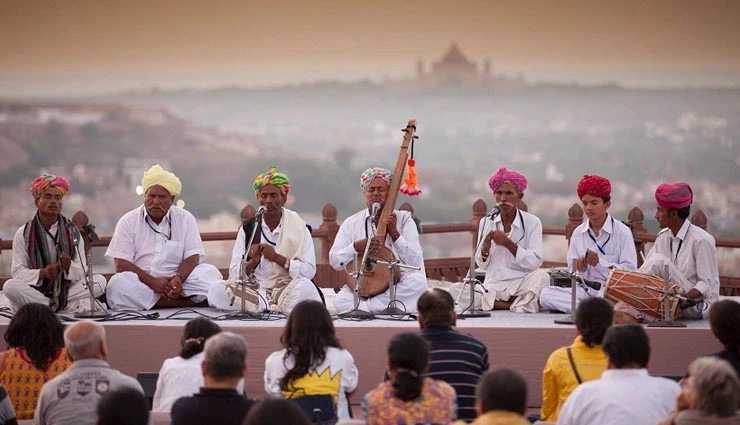
One day, a sangeet mahotsav is to be organised in an open area of Rajasthan. ln recent years, it has rained only 6 days each year. Also, it is given that when it actually rains, the weatherman correctly forecasts rain $80\%$ of the time. When it doesn't rain, he incorrectly forecasts rain $20\%$ of the time.

If leap year is considered, then answer the following questions.
  1. The probability that it rains on chosen day is:
  1. $\frac{1}{366}$
  2. $\frac{1}{73}$
  3. $\frac{1}{60}$
  4. $\frac{1}{61}$
  1. The probability that it does not rain on chosen day is:
  1. $\frac{1}{366}$
  2. $\frac{5}{366}$
  3. $\frac{360}{366}$
  4. None of these.
  1. The probability that the weatherman predicts correctly is:
  1. $\frac{5}{6}$
  2. $\frac{7}{8}$
  3. $\frac{4}{5}$
  4. $\frac{1}{5}$
  1. The probability that it will rain on the chosen day, if weatherman predict rain for that day, is:
  1. $0.0625$
  2. $0.0725$
  3. $0.0825$
  4. $0.0925$
  1. The probability that it will not rain on the chosen day, if weatherman predict rain for that day, is:
  1. $0.94$
  2. $0.84$
  3. $0.74$
  4. $0.64$