Question
Show that Newton's third law of motion is contained in the second law.

Need a full question paper?

Generate a complete, print-ready paper with questions like this in minutes — across 16+ boards, with answer keys.
Start Generating Free

Similar questions

A steel wire of 2.0mm2 cross-section is held straight (but under no tension) by attaching it firmly to two points a distance 1.50m apart at 30°C. If the temperature now decreases to 5°C and if the two points remain fixed, what will be the tension in the wire?
Given that Young's modulus of steel = 2 × 10¹¹Nm-2 and coefficient of thermal expansion of steel a = 1.1 × 10⁻⁵°C.
The sap in trees, which consists mainly of water in summer, rises in a system of capillaries of radius r = 2.5 × 10⁻⁵m. The surface tension of sap is T = 7.28 × 10⁻²N m-1 and the angle of contact is 0°. Does surface tension alone account for the supply of water to the top of all trees?
The maximum speed and acceleration of a particle executing simple harmonic motion are 10cm/s and 50cm/s2. Find the position(s) of the particle when the speed is 8cm/s.
The farthest objects in our Universe discovered by modern astronomers are so distant that light emitted by them takes billions of years to reach the Earth. These objects (known as quasars) have many puzzling features, which have not yet been satisfactorily explained. What is the distance in km of a quasar from which light takes 3.0 billion years to reach us?
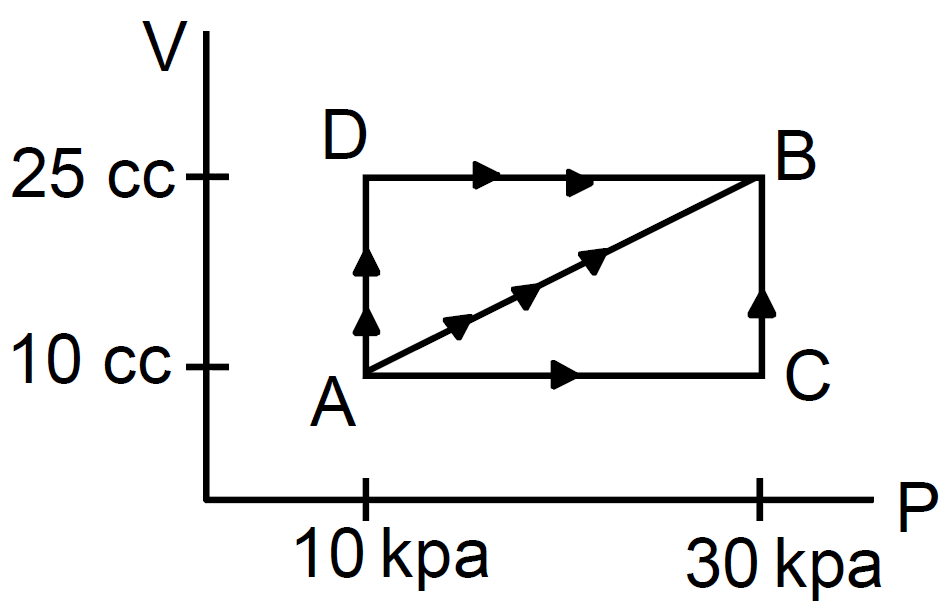
Figure. shows three paths through which a gas can be taken from the state A to the state B. Calculate the work done by the gas in each of the three paths.

A bat emits ultrasonic sound of frequency 100KHz in air. If this sound meets a water surface, what is the wave length of (a) the reflected sound, (b) transmitted sound? Speed of sound in air = 340ms-1 and in water = 1486ms-1.
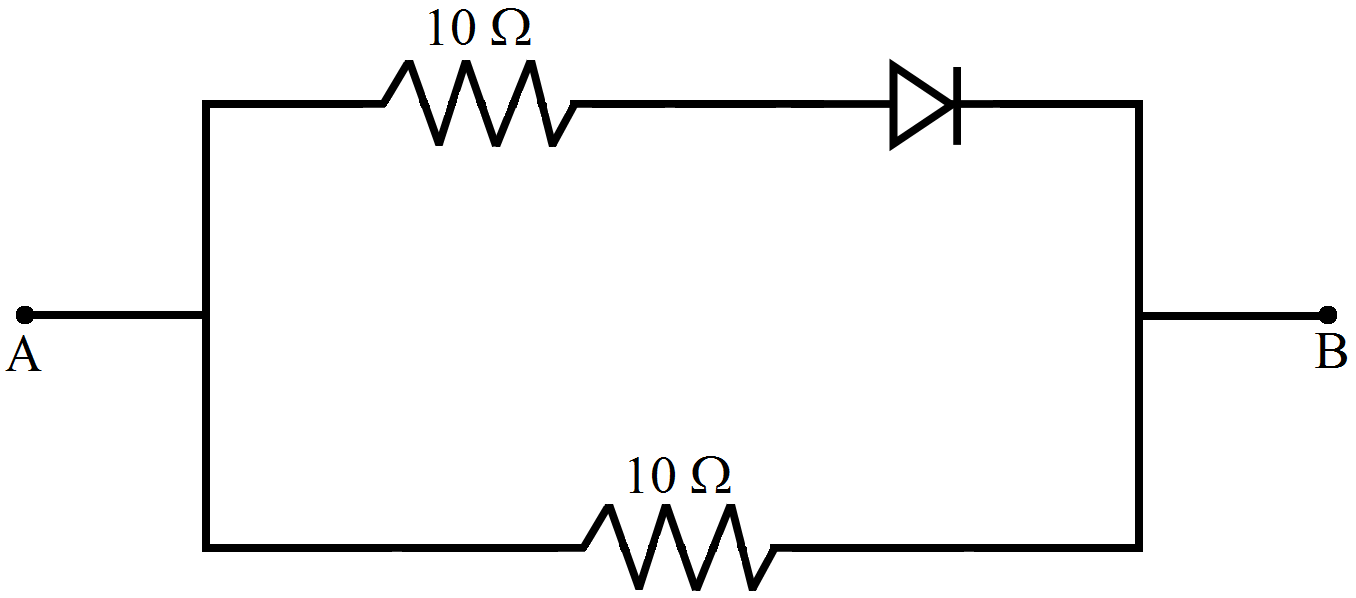
Find the equivalent resistance of the network shown in figure. between the points A and B.

How much should the pressure on a litre of water be changed to compress it by 0.10%?
The position of a particle is given by:
$\vec{\text{r}}=3.0\text{t}\hat{\text{i}}-2.0\text{t}^2\hat{\text{j}}+4\hat{\text{k}}\text{ m}$ 
where t is in seconds, r is in metres and the coefficients have the proper units.
  1. Find the velocity v and acceleration a.
  2. What is the magnitude of velocity of the particle at t = 2s?