Question types

Model Paper 3 question types

38 questions across 6 question groups — pick any mix to generate a Physics paper with step-by-step answer keys.

38
Questions
6
Question groups
5
Question types
Sample Questions

Model Paper 3 questions

One sample from each question group in this chapter. Select any group above to see the full set with answer keys.

Satellites orbiting the earth have a finite life and sometimes debris of satellites fall to the earth. This is because,
  • A
    of viscous forces causing the speed of the satellite and hence height to gradually decrease.
  • B
    the solar cells and batteries in satellites run out.
  • C
    of collisions with other satellites.
  • D
    the laws of gravitation predict a trajectory spiralling inwards.
View full solution
The phase difference between two waves, represented by
$
\begin{aligned}
& y_1=10^{-6} \sin \left[100 t+\left(\frac{x}{50}\right)+0.5\right] m \\
& y_2=10^{-6} \cos \left[100 t+\left(\frac{x}{50}\right)\right] m
\end{aligned}
$
where x is expressed in metres and $t$ is expressed in seconds, is approximately
  • A
    1.07 rad
  • B
    1.5 rad
  • C
    0.5 rad
  • D
    2.07 rad
View full solution
Consider a spacecraft in an elliptical orbit around the earth. At the low point, or perigee, of its orbit, it is 400 km above the earth's surface; at the high point, or apogee, it is 4000 km above the earth's surface. Using conservation of energy, find the speed at perigee and the speed at apogee. It is necessary to have the spacecraft escape from the earth completely.
  • A
    $9840 m / sec$ (perigee), $9760 m / sec$ (apogee)
  • B
    $7840 m / sec$ (perigee), $5760 m / sec$ (apogee)
  • C
    $10840 m / sec$ (perigee), $8760 m / sec$ (apogee)
  • D
    $8840 m / sec$ (perigee), $6760 m / sec$ (apogee)
View full solution
According to Newton, the viscous force acting between liquid layers of area A and velocity gradient $\frac{\Delta v}{\Delta x}$ is given by $F=-\eta A \frac{\Delta v}{\Delta x}$, where $\eta$ is constant called coefficient of viscosity. The dimensional formula of $\eta$ is
  • A
    $\left[ ML ^{-2} T^{-2}\right]$
  • B
    $\left[ M ^0 L^0 T^0\right]$
  • C
    $\left[ ML ^{-1} T^{-1}\right]$
  • D
    $\left[ ML ^2 T^{-2}\right]$
View full solution
An open tank filled with water (depsity $\rho$ ) has a narrow hole at a depth of h below the water surface. The velocity of water flowing out is
  • A
    2 gh
  • B
    $\sqrt{2 g h}$
  • C
    $h \rho g$
  • D
    gh
View full solution
A stone is dropped into a well and its splash is heard at the mouth of the well after an interval of 1.45 s . Find the depth of the well. Given that velocity of sound in air at room temperature is equal to $332 ms^{-1}$.
View full solution
An astronaut, by mistake, drops his food packet from an artificial satellite orbiting around the earth. Will it reach the surface of the earth? Why?
View full solution
At a point above the surface of the earth, the gravitational potential is $-5.12 \times 10^7 J / kg$ and the acceleration due to gravity is $6.4 m / s ^2$. Assuming the mean radius of the earth to be 6400 km , calculate the height of the point above the earth's surface.
View full solution
Q 113 Marks Question3 Marks
Mercury has an angle of contact equal to $140^{\circ}$ with soda-lime glass. A narrow tube of radius 1.00 mm made of this glass is dipped in a trough containing mercury. By what amount does the mercury dip down in the tube relative to the liquid surface outside? Surface tension of mercury at the temperature of the experiment is 0.465 N $m ^{-1}$. Density of mercury $=13.6 \times 10^3 kgm ^{-3}$. .
View full solution
Q 123 Marks Question3 Marks
How is centripetal force provided in case of the following?
i. Motion of planet around the sun,
ii. Motion of moon around the earth.
iii. Motion of an electron around the nucleus in an atom.
View full solution
Q 143 Marks Question3 Marks
A cylindrical vessel filled with water upto a height of 2 m stands on a horizontal plane. The side wall of the vessel has a plugged circular hole touching the bottom. Find the minimum diameter of the hole so that the vessel begin to move on the floor, if the plug is removed. The coefficient of friction between the bottom of the vessel and the plane is 0.4 and total mass of water plus vessel is 100 kg.
View full solution
Q 164 Marks Question4 Marks
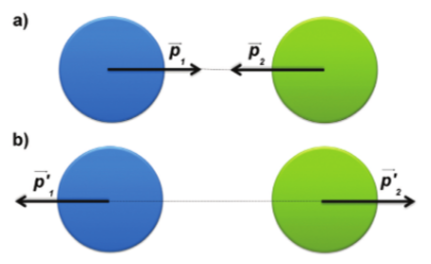
The kinetic energy of an object is the energy associated with the object which is under motion. It is defined as "the energy required by a body to accelerate from rest to stated velocity." It is a vector quantity and the momentum of an object is the virtue of its mass. It is defined as the product of mass and velocity. It is a vector quantity. The relation between them is given by $E =\frac{P^2}{2 m}$. In case of the elastic collision both of these quantities remain constant.
Image
1.Two masses of 1 gm and 4 gm are moving with equal linear momentum. The ratio of their kinetic energy is:
(a) $1: 2$ (b) $4: 1$ (c) $1: 1$ (d) $4: 2$
2. If the linear momentum is increased by $50 \%$, then K .E will be increased by:
(a) $50 \%$ (b) $200 \%$ (c) $125 \%$ (d) $100 \%$
3.A heavy object and a light object have the same momentum. Which has the greater speed?
(a) both heavy and light object
(b) heavy object
(c) Moderate object
(d) light object
OR
Kinetic energy with any reference must be $\qquad$
(a) Change (b) negative (c) zero (d) positive
4.When a body moves with a constant speed along a circle then
(a) no acceleration is produced
(b) no work is done on it
(c) no displacement on it
(d) no force acts on it
View full solution
Q 174 Marks Question4 Marks
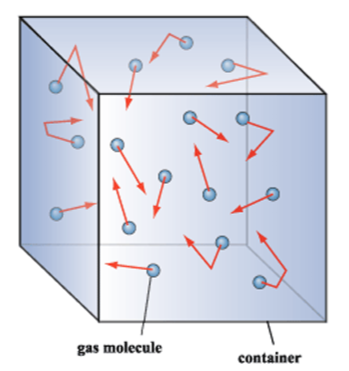
Gas molecules move in random motion inside the container. The pressure exerted by the gas is due to the continuous collision of the molecules against the walls of the container. Due to this continuous collision, the walls experience a continuous force which is equal to the total momentum imparted to the walls per second.
Image
1. If the mass of each molecule is halved and speed is doubled, find the ratio of initial and final pressure:
(a) $1: 16$ (b) $1: 4$ (c) $1: 8$ (d) $1: 2$
2. The pressure exerted by the gases is:
(a) inversely proportional to the density
(b) inversely proportional to the square of the density
(c) directly proportional to the density
(d) directly proportional to the square of the density
3. If the force of attraction between the molecules suddenly disappears, then what will be the change in pressure:
(a) pressure increase
(b) pressure decrease
(c) pressure remains constant
(d) pressure falls
4. If the pressure of a given gas is halved at a certain temperature. what will be its volume:
(a) becomes triple (b) becomes double (c) remains constant (d) becomes half
OR
Dimension formula for R ?
(a) $M ^1 L^2 T^2 K^{-1}$ (b) $M ^1 L^1 T^{-1}$
(c) $M ^{-1} L^0 T^1$ (d) $M ^1 L^2 T^{-2} K^{-1}$
View full solution
An air chamber of volume $V$ has a neck of the area of cross-section $A$ into which a ball of mass $m$ can move without friction. Show that when the ball is pressed down through some distance and released, the ball executes SHM. Obtain the formula for the time period of this SHM, assuming pressure-volume variations of the air to be
i. isothermal and
ii. adiabatic.
View full solution
A metre scale AB is held vertically with its one end A on the floor and is then allowed to fall. Find the speed of the other end B when it strikes the floor, assuming that the end on the floor does not slip.
View full solution
$\hat{i}$ and $\hat{j}$ are unit vectors along x and y -axes respectively. What is the magnitude and direction of vectors $\hat{i}+\hat{j}$ and $\hat{i}$ $\hat{j}$ ? What are the components of a vector $A =2 \hat{ i }+3 \hat{ j }$ along the direction $\hat{i}+\hat{j}$ and $\hat{i}-\hat{j}$ ?
View full solution
Two identical springs, each of spring factor k, may be connected in the following ways. Deduce the spring factor of the oscillation of the body in each case.
View full solution
Assertion: In an isochoric process, work done by the gas is zero.
Reason: In a process, if initial volume is equal to the final volume, work done by the gas is zero.
  • A
    Assertion and reason both are correct statements and reason is correct explanation for assertion.
  • B
    Assertion and reason both are correct statements but reason is not correct explanation for assertion.
  • C
    Assertion is correct statement but reason is wrong statement.
  • D
    Assertion is wrong statement but reason is correct statement.
View full solution
Assertion (A): The division of a vector by another vector is not defined.
Reason (R): The division of a vector by a direction is not possible.
  • A
    Both A and R are true and R is the correct explanation of A.
  • B
    Both A and R are true but R is not the correct explanation of A.
  • C
    A is true but R is false.
  • D
    A is false but R is true.
View full solution
Assertion (A): The Work-Energy theorem is applicable for non-inertial frames also.
Reason (R): The Work-Energy theorem is applicable to non-inertial frames provided we include the pseudo forces in the calculation of the net force acting on the body under consideration.
  • A
    Both A and R are true and R is the correct explanation of A.
  • B
    Both A and R are true but R is not the correct explanation of A.
  • C
    A is true but R is false.
  • D
    A is false but R is true.
View full solution
Assertion (A): Even when orbit of a satellite is elliptical, its plane of rotation passes through the centre of earth.
Reason (R): According to law of conservation of angular momentum plane of rotation of satellite always remain same.
  • A
    Both A and R are true and R is the correct explanation of A.
  • B
    Both A and R are true but R is not the correct explanation of A.
  • C
  • D
    A is false but R is true.
View full solution

Generate a Model Paper 3 paper free

Pick question groups from the list above, set marks and difficulty, and export a branded PDF with step-by-step answer keys. First 3 chapters free — no signup.

Download App