Question
Show that $\text{AB} + \overline{\text{AB}}$ is always 1.

Answer

Given,
$\text{X}=\text{AB} + \overline{\text{AB}}$
Let,
$\text{AB}=\text{y}$
$\therefore\text{X}=\text{y} + \overline{\text{y}}$
$\text{For y} = 0,$
$\text{X}=0+1$
$=1$
$\text{For y} = 1,$
$\text{X}=1+0$
$=1$
thus, X = 1 for all values of y = AB.

Need a full question paper?

Generate a complete, print-ready paper with questions like this in minutes — across 16+ boards, with answer keys.
Start Generating Free

Similar questions

A parallel-plate capacitor of plate-area A and plate separation d is joined to a battery of emf $\in$ and internal resistance R at t = 0. Consider a plane surface of area $\frac{\text{A}}{2}$ parallel to the plates and situated symmetrically between them. Find the displacement current through this surface as a function of time.
A long straight wire in the horizontal plane carries a current of 50 A in north to south direction. Give the magnitude and direction of B at a point 2.5 m east of the wire.
  1. A circular coil of 30 turns and radius 8.0 cm carrying a current of 6.0 A is suspended vertically in a uniform horizontal magnetic field of magnitude 1.0 T. The field lines make an angle of 60º with the normal of the coil. Calculate the magnitude of the counter torque that must be applied to prevent the coil from turning.
  2. Would your answer change, if the circular coil in (a) were replaced by a planar coil of some irregular shape that encloses the same area? (All other particulars are also unaltered.)
A charged particle having a charge of $-2.0 \times 10^{-6}C$ is placed close to a nonconducting plate having a surface charge density $4.0 \times 10^{-5}Cm^{-2}$. Find the force of attraction between the particle and the plate.
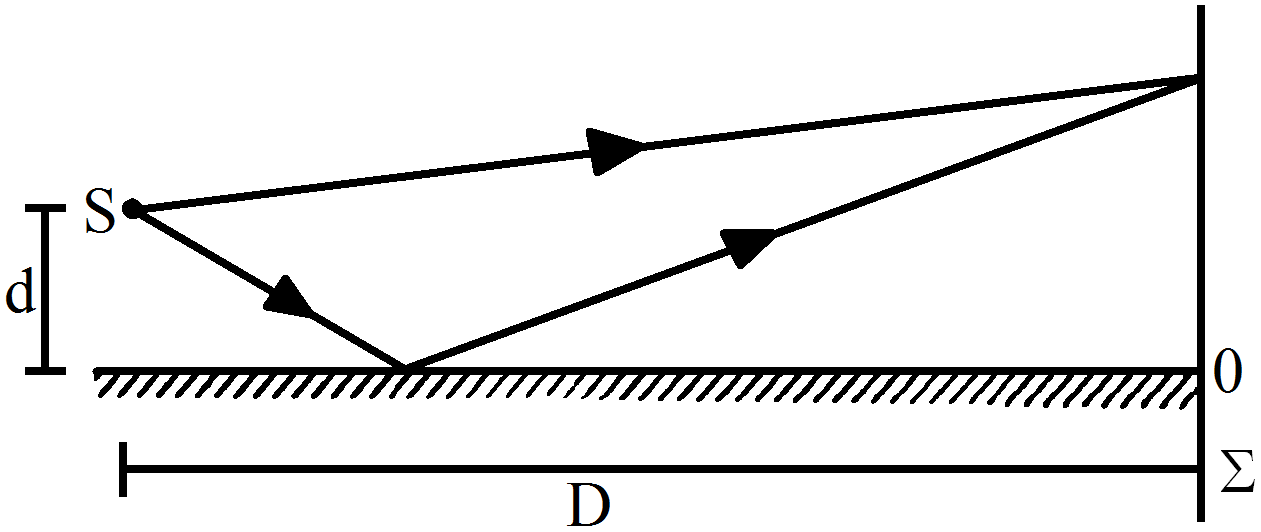
A narrow slit S transmitting light of wavelength $\lambda$ is placed a distance d above a large plane mirror as shown in figure (17-E1). The light coming directly from the slit and that coming after the reflection interfere at a screen $\sum$ placed at a distance D from the slit.
  1. What will be the intensity at a point just above the mirror, i.e., just above O?
  2. At what distance from 0 does the first maximum occur?
A circular coil of 20 turns and radius 10 cm is placed in a uniform magnetic field of 0.10 T normal to the plane of the coil. If the current in the coil is 5.0 A, what is the
  1. Total torque on the coil,
  2. Total force on the coil,
  3. Average force on each electron in the coil due to the magnetic field.
$($The coil is made of copper wire of cross-sectional area $10^{–5} m^{2}$ , and the free electron density in copper is given to be about $10^{29} m^{–3}).$
A uranium reactor develops thermal energy at a rate of 300MW. Calculate the amount of $^{235}U$ being consumed every second. Average released per fission is 200MeV.
Suppose white light falls on a double slit but one slit is covered by a violet filter (allowing $\lambda=400\text{nm}$). Describe the nature of the fringe pattern observed.
A 660Hz tuning fork sets up vibration in a string clamped at both ends. The wave speed for a transverse wave on this string is 220m/s and the string vibrates in three loops.
  1. Find the length of the string.
  2. If the maximum amplitude of a particle is 0.5cm, write a suitable equation describing the motion.
Sketch a graph showing the variation of fringe width versus the distance of the screen from the plane of the slits (keeping other parameters same) in Young’s double slit experiment. What information can one obtain from the slope of this graph?