Question
Show that the angular momentum about any point of a single particle moving with constant velocity remains constant throughout the motion.

Answer

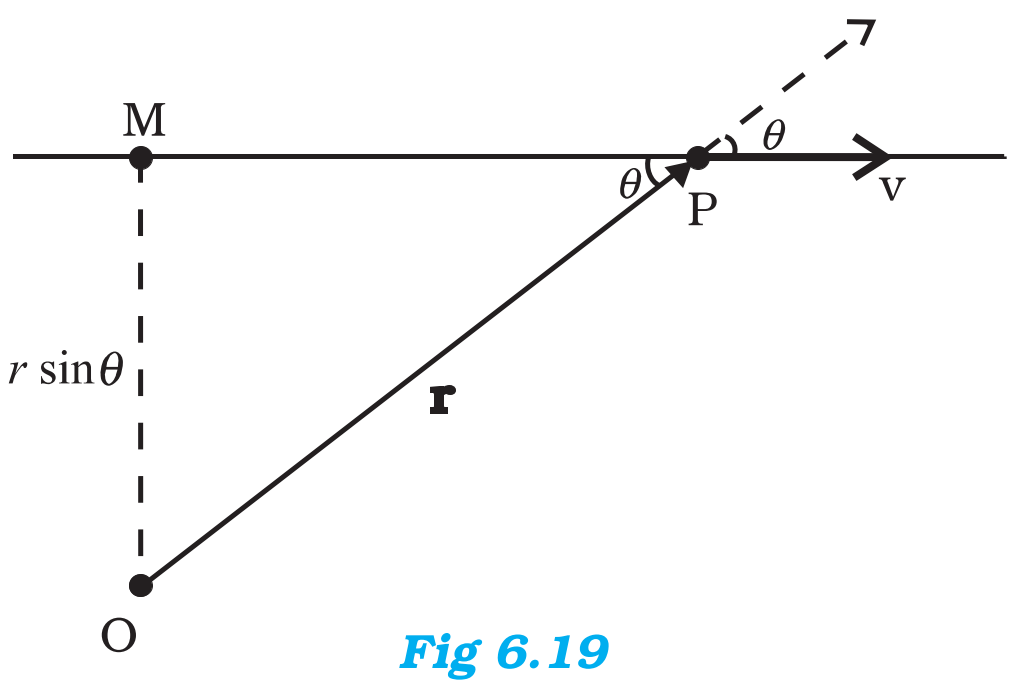
Let the particle with velocity v be at point P at some instant t. We want to calculate the angular momentum of the particle about an arbitrary point O.
Image
The angular momentum is l = r × mv. Its magnitude is mvr sinθ, where θ is the angle between r and v as shown in Fig. 6.19. Although the particle changes position with time, the line of direction of v remains the same and hence OM = r sin θ. is a constant.
Further, the direction of l is perpendicular to the plane of r and v. It is into the page of the figure.This direction does not change with time. Thus, l remains the same in magnitude and direction and is therefore conserved. Is there any external torque on the particle?
Need a full question paper?

Generate a complete, print-ready paper with questions like this in minutes — across 16+ boards, with answer keys.

Start Generating Free

Similar questions

The sunlight reaching Earth has maximum electric field of $810Vm^{-1}$. What is the maximum magnetic field in this light?
A cyclist moving with a velocity of $7.5m s^{-1}$ approaches a U-turn of radius $80m$. He applies brakes to slow down his speed at a rate of $0.5m s^{-2}$. Calculate the acceleration of the cyclist on the turn.
Find the energy, the frequency and the momentum of an $X-$ray photon of wavelength $0.10\ nm.$
A glass full of water has a bottom of area $20\ cm^2$, top of area $20\ cm^2$, height $20\ cm$ and volume half a litre.
  1. Find the force exerted by the water on the bottom.
  2. Considering the equilibrium of the water, find the.
Resultant force exerted by the sides of the glass on the water. Atmospheric pressure $= 1.0 \times 10^5N/m^2$. Density of water $= 1000\ kg/m^3$ and $g = 10m/s^2$. Take all numbers to be exact.​​​​​​​
Which is greater; the angular velocity of the hour hand of a watch or angular velocity of earth around its own axis?
Two particles of masses $m_1$ and $m_2$ are joined by a light rigid rod of length r. The system rotates at an angular speed co about an axis through the centre of mass of the system and perpendicular to the rod. Show that the angular momentum of the system is $\text{L}=\mu\text{r}^2\omega$ where $\mu$ is the reduced mass of the system defined as $\mu=\frac{\text{m}_1\text{m}_2}{\text{m}_1+\text{m}_2}.$
Define Coefficient of Thermal Conductivity and derive its SI unit. Calculate the rate of loss of heat through a glass window of area $1000 cm^2$ and thickness $0.4 cm$ when temperature inside is $37^\circ C$ and outside is $-5^\circ C$. Coefficient of thermal conductivity of glass is $2.2 \times 10^{-3}cal \  s^{-1}\ cm^{-1}\ K^{-1}$.
Define centripetal acceleration. Give two examples.
A vector $\overrightarrow{\text{A}}$ makes an angle of 20° and $\overrightarrow{\text{B}}$ makes an angle of 110° with the X-axis. The magnitudes of these vectors are 3 m and 4 m respectively. Find the resultant.
Show that the motion of a particle represented by $\text{y}=\sin\text{ax}-\cos\cot$ is simple harmonic with a period of $\frac{2\pi}{\omega}.$