Question
Show that the following system of linear equations is consistent and also find solution:
$2x + 3y = 5$
$6x + 9y = 15$

Answer

$2\text{x}+3\text{y}=5\dots(1)$
$6\text{x}+9\text{y}=15\dots(2)$
Or , $AX = B$
Where,
$\text{A}=\begin{bmatrix}2&3\\ 6&9\end{bmatrix},\text{x}=\begin{bmatrix}\text{x}\\ \text{y}\end{bmatrix}\text{and }\text{B}=\begin{bmatrix}5\\ 15\end{bmatrix}$
$\begin{bmatrix}2&3\\ 6&9\end{bmatrix}\begin{bmatrix}\text{x}\\ \text{y}\end{bmatrix}=\begin{bmatrix}5\\ 15\end{bmatrix}$
$\therefore\ |\text{A}|=\begin{vmatrix}2&3\\6&9\end{vmatrix}$
$=18-18$
$=0$
So, A is singular. Thus, the given system of equations is either inconsistent or it is consistent with infinitely many solutions because $(\text{adj A})\text{B}\neq0\text{ or }(\text{adj A})=0$.
$C_{11} = 9, C_{12} = -6, C_{21} = -3$ and $C_{22} = 2$
$\therefore\ \text{adj A}=\begin{bmatrix}9&-6\\-3&2\end{bmatrix}^\text{T}$
$=\begin{bmatrix}2&-3\\-6&9\end{bmatrix}$
$\Rightarrow(\text{adj A})\text{B}=\begin{bmatrix}9&-3\\-6&2\end{bmatrix}\begin{bmatrix}5\\15\end{bmatrix}$
$=\begin{bmatrix}45-45\\-30+30\end{bmatrix}$
$=\begin{bmatrix}0\\0\end{bmatrix}$
If |A| = 0 and (adj A) B = 0, then the system is consistent and has infinitely many solutions.
Thus, AX = B has infinitely many solutions.
Substituting y = k in eq. (1), we get
$2\text{x} + 3\text{k}=5$
$\Rightarrow2\text{x}=5-3\text{k}$
$\Rightarrow\text{x}=\frac{5-3\text{k}}{2}\text{ and }\text{y}=\text{k}$
These values of x and y satisfy the third equation.
Thus, $\Rightarrow\text{x}=\frac{5-3\text{k}}{2}\text{ and }\text{y}=\text{k}$ (where k is a real number) satisfy the given system of equations.

Need a full question paper?

Generate a complete, print-ready paper with questions like this in minutes — across 16+ boards, with answer keys.
Start Generating Free

Similar questions

If $\overrightarrow{\text{a}}\text{ and } \overrightarrow{\text{b}}$are two vectors such that $|\overrightarrow{\text{a}} + \overrightarrow{\text{b}}| = | \overrightarrow{\text{a}}|,$ then prove that vector 2 $\overrightarrow{\text{a}} + \overrightarrow{\text{b}}$is perpendicular to vector$\overrightarrow{\text{b}}.$
Evaluate the following integrals:
$\int\limits^{\pi}_0\text{x}\cos^2\text{x dx}$
Solve the following equation for x:
$\tan^{-1}\frac{\pi}{2}+\tan^{-1}\frac{\pi}{3}=\frac{\pi}{4},0<\text{x}<\sqrt6$
Evaluate the following integrals:
$\int\limits_{0}^{{2\pi}}\sqrt{1-\sin\frac{\text{x}}{2}}\text{ dx}$
Evaluate the following integrals:
$\int\frac{\text{x}^2+1}{\text{x}^4+\text{x}^2+1}\ \text{dx}$
A manufacturer makes two products A and B. Product A sells at Rs. 200 each and takes 1/2 hour to make. Product B sells at Rs. 300 each and takes 1 hour to make. There is a permanent order for 14 of product A and 16 of product B. A working week consists of 40 hours of production and weekly turnover must not be less than Rs 10000. If the profit on each of product A is Rs. 20 and on product B is Rs. 30, then how many of each should be produced so that the profit is maximum. Also, find the maximum profit.
Solve the following systems of homogeneous linear equations by matrix method:
$x + y - z = 0$
$x - 2y + z = 0$
$3x + 6y - 5z = 0$
Solve the following differential equation:$(\text{x}^{2} - 1 ) \frac{\text{dy}}{\text{dx}} + 2 \text{xy} = \frac{2}{\text{x}^{2} - 1 }.$
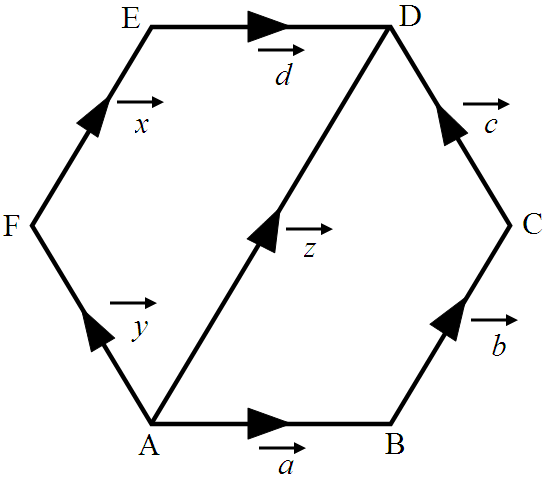
In Figure ABCD is a regular hexagon, which vectors are:
  1. Collinear.
  2. Equal.
  3. Co-initial.
  4. Collinear but not equal.
Solve the following system of equations by matrix method:
$5x + 7y + 2 = 0$
$4x + 6y + 3 = 0$