Question
  1. Show that the normal component of electrostatic field has a discontinuity from one side of a charged surface to another given by
$(\text{E}_2-\text{E}_1).\hat{\text{n}}=\frac{\sigma}{\in_0}$

where $\hat{\text{n}}$ is a unit vector normal to the surface at a point and σ is the surface charge density at that point. (The direction of $\hat{\text{n}}$ is from side 1 to side 2.) Hence show that just outside a conductor, the electric field is σ $\hat{\text{n}} /ε_0.$
  1. Show that the tangential component of electrostatic field is continuous from one side of a charged surface to another.
[Hint: For (a), use Gauss’s law. For, (b) use the fact that work done by electrostatic field on a closed loop is zero.]

Answer

  1. Electric fielcl on one side of a charged body is $E_1$ and electric field on the other side of the same body is $E_2.$ If infinite plane charged body has a uniform thickness, then electric field due to one surface of the charged body is given by,
$\vec{\text{E}}_1=-\frac{\sigma}{2\in_0}\hat{\text{n}} \dots\dots(1)$
Where,
$\hat{\text{n}}$ = Unit vector normal to the surface at a point
$\sigma$ = Surface charge density at that point
Electric field due to the other surface of the charged body,
$\vec{\text{E}}_2=-\frac{\sigma}{2\in_0}\hat{\text{n}} \dots\dots(2)$
Electric field at any point due to the two surfaces,
$\vec{\text{E}}_2-\vec{\text{E}}_1=\frac{\sigma}{2\in_0}\hat{\text{n}}+\frac{\sigma}{2\in_0}\hat{\text{n}}=\frac{\sigma}{\in_0}\hat{\text{n}}$
$(\vec{\text{E}}_2-\vec{\text{E}}_1).\hat{\text{n}}=\frac{\sigma}{\in_0} \dots\dots(3)$
Since inside a closed conductor, $\vec{\text{E}}_1=0,$
$\therefore\vec{\text{E}}=\vec{\text{E}}_2=-\frac{\sigma}{2\in_0}\hat{\text{n}}$
Therefore, the electric fielcl just outside the conductor is $\frac{\sigma}{\in_0}\hat{\text{n}}.$
  1. When a charged particle is moved from one point to the other on a closed loop, the work done by the electrostatic field is zero. Hence, the tangential component of electrostatic field Is continuous from one side of a charged surface to the other.

Need a full question paper?

Generate a complete, print-ready paper with questions like this in minutes — across 16+ boards, with answer keys.

Start Generating Free

Similar questions

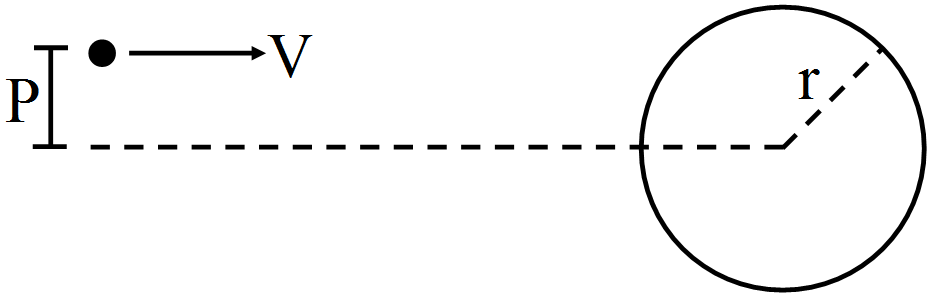
A small particle travelling with a velocity u collides elastically with a spherical body of equal mass and of radius r initially kept at rest. The centre of this spherical body is located a distance (p < r) away from the direction of motion of the particle. Find the final velocities of the two particles.

[Hint: The force acts along the normal to the sphere through the contact. Treat the collision as onedimensional for this direction. In the tangential direction no force acts and the velocities do not change].
  1. Explain, giving reasons, the basic difference in converting a galvanometer into (i) a voltmeter and (ii) an ammeter.
  2. Two long straight parallel conductors carrying steady currents $I_1$ and $I_2$ are separated by a distance 'd'. Explain briefly, with the help of a suitable diagram, how the magnetic field due to one conductor acts on the other. Hence deduce the expression for the force acting between the two conductors. Mention the nature of this force.
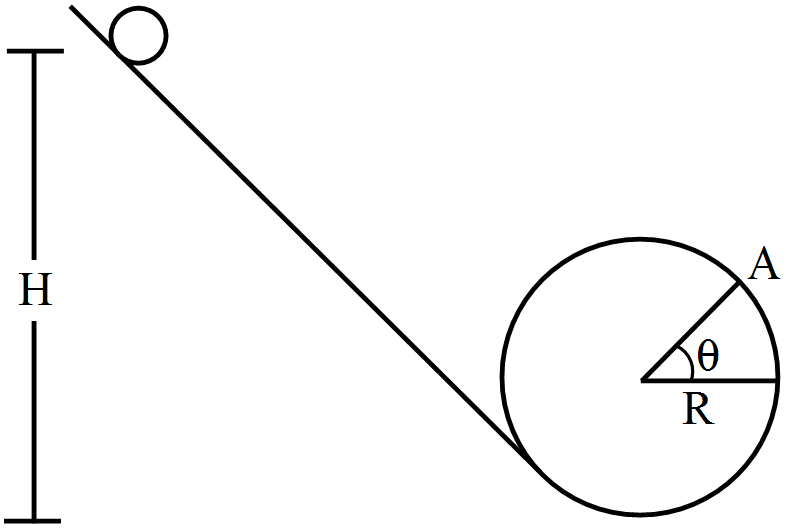
Figure shows a small spherical ball of mass m rolling down the loop track. The ball is released on the linear portion at a vertical height H from the lowest point. The circular part shown has a radius R.
  1. Find the kinetic energy of the ball when it is at a point A where the radius makes an angle $\theta$ with the horizontal.
  2. Find the radial and the tangential accelerations of the centre when the ball is at A.
  3. Find the normal force and the frictional force acting on the ball if H = 60cm, R = 10cm, $\theta=0 $ and m = 70g.
Establish the formula for the capacitance of a parallel plate capacitor in the presence of dielectric material completely and partially.
$i.$ Draw a ray diagram showing the image formation by a compound microscope. Hence obtain the expression for total magnification when the image is formed at least distance of distinct vision.
$iii.$ A compound microscope consists of an objective lens of focal length $2.0 \ cm$ and an eyepiece of focal length $6.0 \ cm$. If they are separated by a distance of $24 \ cm$, find the total magnification when the image is formed at infinity.
An X-ray tube operates at 40kV. Suppose the electron converts 70% of its energy into a photon at each collision. Find the lowest there wavelengths emitted from the tube. Neglect the energy imparted to the atom with which the electron collides.
One morning an old man walked bare-foot to replace the fuse wire in kit kat fitted with the power supply mains for his house. Suddenly he screamed and collapsed on the floor. His wife cried loudly for help. His neighbour’s son Anil heard the cries and rushed to the place with shoes on. He took a wooden baton and used it to switch off the main supply.
Answer the following questions:
  1. What is the voltage and frequency of mains supply in India?
  2. These days most of the electrical devices we use require a.c. voltage. Why?
  3. Can a transformer be used to step up d.c.voltage?
  4. Write two qualities displayed by Anil by his action.
Assume that a tunnel is dug along a chord of the earth, at a perpendicular distance $\frac{\text{R}}{2}$ from the earth's centre where R is the radius of the earth. The wall of the tunnel is frictionless.
  1. Find the gravitational force exerted by the earth on a particle of mass m placed in the tunnel at a distance x from the centre of the tunnel.
  2. Find the component of this force along the tunnel and perpendicular to the tunnel.
  3. Find the normal force exerted by the wall on the particle.
  4. Find the resultant force on the particle.
  5. Show that the motion of the particle in the tunnel is simple harmonic and find the time period.
A wire of length l is bent in the form of an equilateral triangle and carries an electric currrent i.
  1. Find the magnetic field B at the centre.
  2. If the wire is bent in the form of a square, what would be the value of B at the centre?
  1. Differentiate between three segments of a transistor on the basis of their size and level of doping.
  2. How is a transistor biased to be in active state?
  3. With the help of necessary circuit diagram, describe briefly how n-p-n transistor in CE configuration amplifies a small sinusoidal input voltage. Write the expression for the ac current gain.