Question
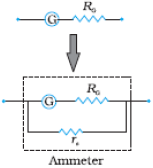
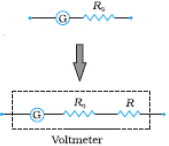
  1. Explain, giving reasons, the basic difference in converting a galvanometer into (i) a voltmeter and (ii) an ammeter.
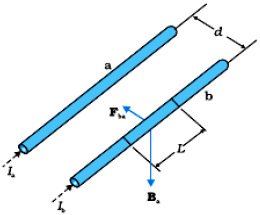
  2. Two long straight parallel conductors carrying steady currents $I_1$ and $I_2$ are separated by a distance 'd'. Explain briefly, with the help of a suitable diagram, how the magnetic field due to one conductor acts on the other. Hence deduce the expression for the force acting between the two conductors. Mention the nature of this force.
Answer

  1. A galvanometer can be converted into a voltmeter by connecting a high resistance in series with its coil.
  2. A galvanometer can be converted into an ammeter by connecting a low resistance in parallel to its coil.
Alternate Answer


The magnetic field, due to wire – 1, at any point on the wire – 2, is directed normal to the direction of current flowin wire – 2.
Expression for force
$B_{21} =$Magnetic field atwire – 2, due to a current $I_1$ in
wire $ - 1 = \frac{\mu_{o}\text{I}_{1}}{2\pi\text{r}}$
Force upon conductor carrying current due to magnetic field
$\overrightarrow{\text{F}} = \text{I}(\overrightarrow{\ell}\times\overrightarrow{\text{B}})$
$\therefore\text{ Force, F}_{21}\text{ on a length l of wire} – 2 = \text{I}_{2} . l.\frac{\mu_{o}\text{I}_{1}}{2\pi\text{r}}$
$ =\frac{\mu_{o}\text{I}_{1}\text{I}_{2}}{2\pi\text{r}}l$
$\text{Similarly,} = \text{F}_{12} = \frac{\mu_{0}\text{I}_{1}\text{I}_{2}}{2\pi\text{r}}l$
Nature
The force is repulsive for currents in opposite direction and attractive when currents flow in the same direction.

Need a full question paper?

Generate a complete, print-ready paper with questions like this in minutes — across 16+ boards, with answer keys.

Start Generating Free

Similar questions

Suppose that the radius of cross-section of the wire used in the previous problem is r. Find the increase in the radius of the loop if the magnetic field is switched off. Young's modulus of the material of the wire is Y.
Radiation coming from transition n = 2 to n = 1 of hydrogen atoms falls on helium ions in n = 1 and n = 2 states. What are the possible transitions of helium ions as they absorbs energy from the radiation?
A sound wave of frequency 100Hz is travelling in air. The speed of sound in air is 350m/s.
  1. By how much is the phase changed at a given point in 2.5ms?
  2. What is the phase difference at a given instant between two points separated by a distance of 10.0cm along the direction of propagation?
A 100kg block is started with a speed of $2.0ms^{-1}$ on a long, rough belt kept fixed in a horizontal position. The coefficient of kinetic friction between the block and the belt is $0.20$.
  1. Calculate the change in the internal energy of the block-belt system as the block comes to a stop on the belt.
  2. Consider the situation from a frame of reference moving at $2.0ms^{-1}$ along the initial velocity of the block. As seen from this frame, the block is gently put on a moving belt and in due time the block starts moving with the belt at $2.0ms^{-1}$ Calculate the increase in the kinetic energy of the block as it stops slipping past the belt.
  3. Find the work done in this frame by the external force holding the belt.
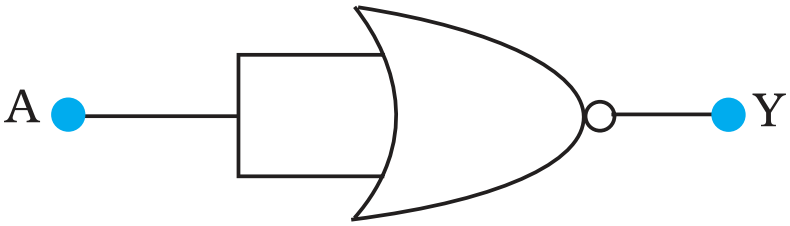
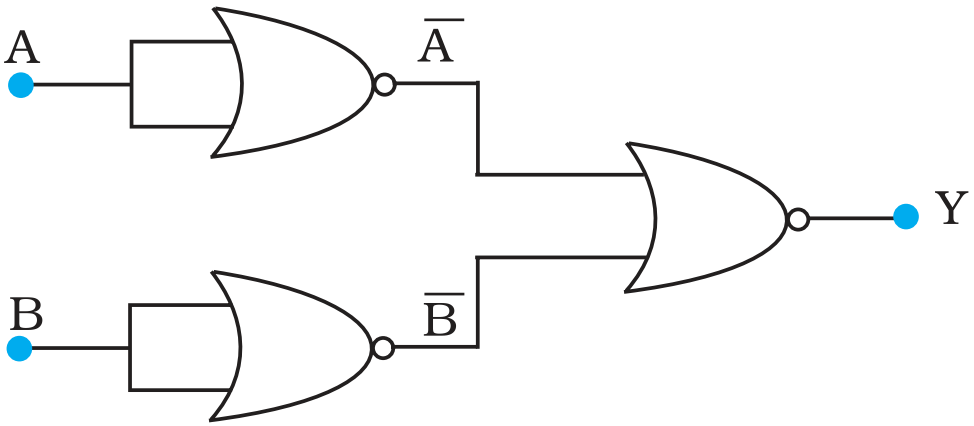
Write the truth table for the circuits given in Fig. 14.48 consisting of NOR gates only. Identify the logic operations (OR, AND, NOT) performed by the two circuits.
  1.  
  1.  
A long straight horizontal cable carries a current of 2.5 A in the direction 10° south of west to 10° north of east. The magnetic meridian of the place happens to be 10° west of the geographic meridian. The earth’s magnetic field at the location is 0.33 G, and the angle of dip is zero. Locate the line of neutral points (ignore the thickness of the cable). (At neutral points, magnetic field due to a current-carrying cable is equal and opposite to the horizontal component of earth’s magnetic field.)
In a Young's double slit interference experiment the fringe pattern is observed on a screen placed at a distance D from the slits. The slits are separated by a distance d and are illuminated by monochromatic light of wavelength $\lambda$. Find the distance from the central point where the intensity falls to,
  1. Half the maximum.
  2. One fourth of the maximum.
Consider a neutron and an electron bound to each other due to gravitational force. Assuming Bohr's quantization rule for angular momentum to be valid in this case, derive an expression for the energy of the neutron-electron system.
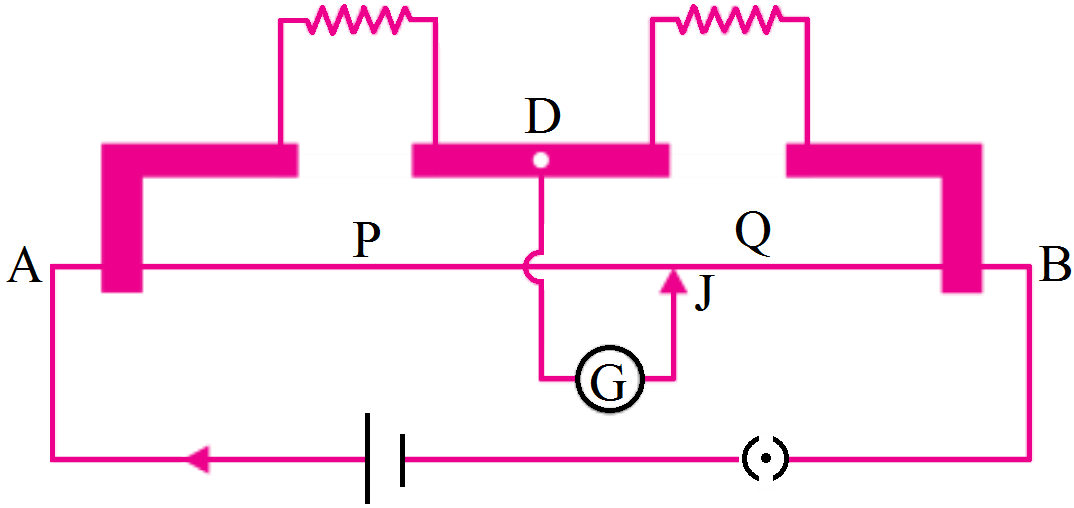
In a practical Wheatstone bridge circuit, wire AB is 2m long. When resistance Y = 2.0W and jockey is in position J such that AJ = 1.20m, there is no current in galvanometer, find the value of unknown resistance X. The resistance per unit length of wire AB = 0.01W/cm. Also calculate the current drawn by the cell of emf 4.0V and negligible internal resistance.
A solenoid is connected to a battery so that a steady current flows through it. If an iron core is inserted into the solenoid, will the current increase or decrease? Explain.