Question
Show that the polynomial $f(x)=x^4+4 x^2+6$ has no zeroes.

Answer

Let $t = x^2$​​​​​​​
So, $f(t) = t^4 + 4t^2 + 6$
Now, to find the zeros, we will equate f(t) = 0
$\Rightarrow t^4 + 4t^2 + 6 = 0$
Now, $\text{t}=\frac{-4\pm\sqrt{16-24}}{2}$
$=\frac{-4\pm\sqrt{-8}}{2}$
$=2\pm\sqrt{-2}$
i.e., $\text{x}^2=-2\pm\sqrt{-2}$
$\Rightarrow\text{x}=\sqrt{-2\pm\sqrt{-2}},$ which is not a real number.
The zeros of a polynomial should be real number s.
$\therefore$ The given f(x) has no zeros.

Need a full question paper?

Generate a complete, print-ready paper with questions like this in minutes — across 16+ boards, with answer keys.
Start Generating Free

Similar questions

The following table gives the number of boys of a particular age in a class of 40 students. Calculate the mean age of the students
Age (in yeare) 15 16 17 18 19 20
No. of students 3 8 10 10 5 4
Using the distance formula, show taht the given points are collinear:
(1, -1), (5, 2) and (9, 5)
Find the value of k for which the following equation have real root:
$kx(x - 2) + 6 = 0$
Four equal circles, each of radius a units, touch each other. show that area between them is $\Big(\frac{6}{7}\text{a}^2\Big)$ sq units. $\Big[\text{Use }\pi=\frac{22}{7}\Big]$
Find the area of the rhombus, the lengths of whose diagonals are 3cm and 16cm. Also find the perimeter of the rhombus.
Find the value of $m$ for which the quadratic equation $(m+1) y^2-6(m+1) y+3(m+9)=0, m \neq-1$ has equal roots. Hence find the roots of the equation.
Solve each of the following given systems of equations graphically and find the vertices and area of the triangle formed by these lines and the y-axis:
5x - y - 7 = 0, x - y + 1 = 0
Determine, by drawing graphs, whether the following system of linear equations has a unique solution or not:
2x - 3y = 6, x + y = 1.
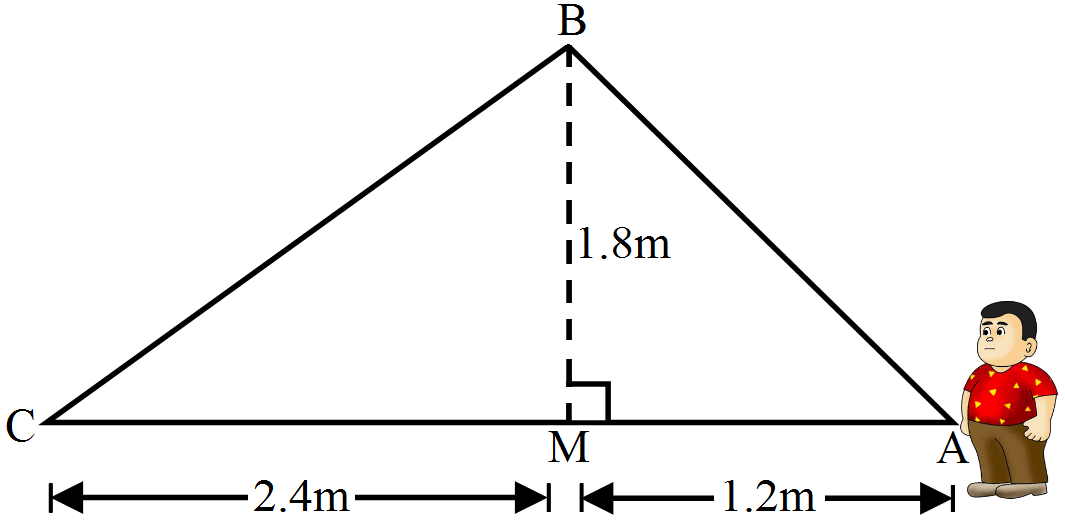
Naman is diing fly-fishing in a stream. The tip of his fishing rod is 1.8m above the surface of the water and the fly at the eand of the string rests on the water 3.6m away from him and 2.4m from the point directly under the tip of the rod Assuming that the string (from tip of his rod to the fly) is taut, how much string does he have out (see the adjoining figure)? If he pulls in the string at the rate of 5cm per second, what will be the horizontal distance of the fly from him after 12 seconds?
If $\text{cosec}\theta+\cot\theta=\text{p},$ then prove that $\cos\theta=\frac{\text{p}^2-1}{\text{p}^2+1}.$