Question
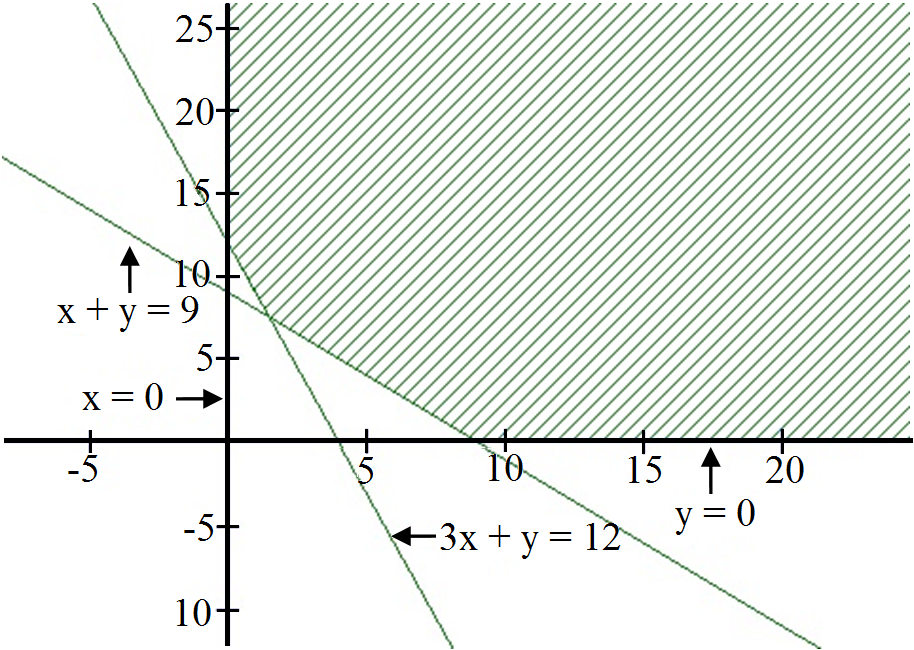
Show that the solution set of the following linear in equations is an unbounded set: $\text{x}+\text{y}\geq9,3\text{x}+\text{y}\geq12,\text{x}\geq0,\text{y}\geq0.$
Answer


We have,
$\text{x}+\text{y}\geq9,3\text{x}+\text{y}\geq12,\text{x}\geq0,\text{y}\geq0.$
Converting the inequations into equations, we get
x + y = 9, 3x + y = 12, x = 0 and y = 0.
Region represented by $\text{x}+\text{y}\geq9.$
Putting x = 0 in x + y = 9, we get y = 9.
Putting y = 0 in x + y = 9, we get x = 9.
$\therefore$ The line x + y = 9 meets the coordinat axes at (0, 9) and (9, 0). Join these points by a thick line.
Now, putting x = 0 and y = 0 in $\text{x}+\text{y}\geq9.$ we get 0 9 This is not possible.
$\therefore$ We find that (0, 0) is not satisfies the inequation $\text{x}+\text{y}\geq9.$
So, the portion not containing the origin is represented by the given inequation.
Region represented by 3x + y > 12:
Putting x = 0 in 3x + y = 12, we get y = 12
Putting y = 0 in 3x + y = 12, we get $\text{x}=\frac{12}{3}=4$
$\therefore$ The line 3x + y = 12 meets the coordinate axes at (0, 12) and (4, 0). Joining these points by a thick line.
Now, putting x = 0 and y = 0 in $3\text{x}+\text{y}\geq12$ we get, $0\geq12$
This is not possible.
$\therefore$ We find that (0, 0) is not satisfies the inequation $3\text{x}+\text{y}\geq12.$ so the portion not containing the origin is represented by the given inequation.
Region represented by $\text{x}\geq0$ and $\text{y}\geq0$: clearly, $\text{x}\geq0$ and $\text{y}\geq0$ represent the first quadrant.

Need a full question paper?

Generate a complete, print-ready paper with questions like this in minutes — across 16+ boards, with answer keys.

Start Generating Free

Similar questions

The ratio of the A.M. and G.M. of two positive numbers a and b is Show that $a : b = \left( \begin{array} { c } { m + \sqrt { m ^ { 2 } - n ^ { 2 } } } \end{array} \right) : \left( m - \sqrt { m ^ { 2 } - n ^ { 2 } } \right)$
Convert the complex numbers given in Exercises in the polar form: $\sqrt{3}+\text{i}.$
Find the values of the parameter a so that the point (a, 2) is an interior point of the triangle formed by the lines x + y - 4 = 0, 3x - 7y - 8 = 0 and 4x - y - 31 = 0.
Find the centre, the lengths of the axes, eccentricity, foci of the following ellipse:$\text{x}^2+4\text{y}^2-2\text{x}=0$
If θ is the angle which the straight line joining the points ($x_1, y_1$) and ($x_2, y_2$) subtends at the origin, prove that $\tan\theta=\frac{\text{x}_2\text{y}_1-\text{x}_1\text{y}_2}{\text{x}_1\text{x}_2+\text{y}_1\text{y}_2}$ and $\cos\theta=\frac{\text{x}_1\text{x}_2+\text{y}_1\text{y}_2}{\sqrt{\text{x}_1^2+\text{y}_1^2}\sqrt{\text{x}_2^2+\text{y}_2^2}}$
Show that $\lim\limits_{\text{x}\rightarrow0}\ \sin\frac{1}{\text{x}}$ does not exist.
Find the conditions that the straight lines $y = m_1x + c_1, y = m_2x + c_2$ and $y = m_3x + c_3$ may meet in a point.
Find the conjugates of the following complex numbers: $\frac{(3-\text{i})^2}{2+\text{i}}$
Evaluate the following limit: $\lim\limits_{\text{n}\rightarrow\infty}\frac{\sin\big(\frac{\text{a}}{2^{\text{n}}}\big)}{\sin\big(\frac{\text{b}}{2^{\text{n}}}\big)}$
Find the coordinates of the point of intersection of the axis and the directrix of the parabola whose focus is (3, 3) and directrix is 3x - 4y = 2. Find also the length of the latus-rectum.