Question 14 Marks
Solve the following systems of linear inequations graphically: $\text{x}-\text{y}\leq1,\text{x}+2\text{y}\leq8,2\text{x}+\text{y}\geq2,\text{x}\geq0$ and $\text{y}\geq0$
Answer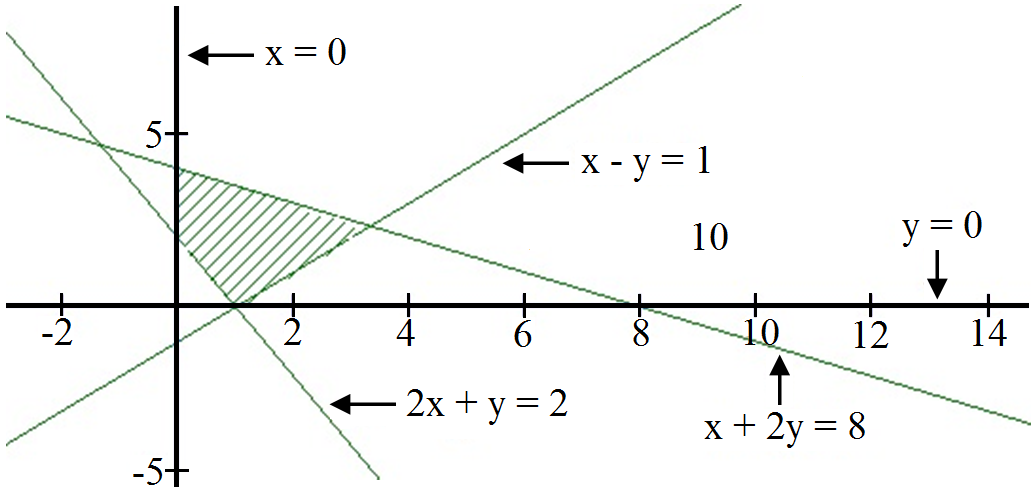
We have,
$\text{x}-\text{y}\leq1,\text{x}+2\text{y}\leq8,2\text{x}+\text{y}\geq2,\text{x}\geq0$ and $\text{y}\geq0$
Converting the inequations into equations, we obtain
x - y = 1, x + 2y = 8, 2x + y > 2,
x = 0 and y = 0.
Region represented by x - y = 1:
Putting x = 0 in x - y = 1,
we get y = -1
Putting y = 0 in X - Y = 1,
we get x = 1
$\therefore$ The line x - y = 1 meets the coordinate axes at (0, -1) and (1, 0). Draw a thick line joining these points.
Now, putting x = 0 and y = 0 in $\text{x}-\text{y}\leq1$
In $\text{x}-\text{y}\leq1$ we get $0\leq1$
Clearly, we find that (0, 0) satisfies inequation $\text{x}-\text{y}\leq1$
Region represented by $\text{x}+2\text{y}\leq8$
Putting x = 0 in x + 2y = 8,
we get, $\text{y}=\frac{8}{2}=4$
Putting y = 0 in x + 2y = 8,
we get x = 8,
$\therefore$ The line x + 2y = 8 meets the coordinate axes at (8, 0) and (0, 4). Draw a thick line joining these points.
Now, putting x = 0, y = 0 in x +2y < 8, we get 0 < 8
Clearly, we find that (0, 0) satisfies inequation $\text{x}+2\text{y}\leq8$
Region represented by 2x + y > 2
Putting x = 0 in 2x + y = 2, we get y = 2
Putting y = 0 in 2x + y = 2, we get $\text{x}=\frac{2}{2}=1$
The line 2x + y = 2 meets the coordinate axes at (0, 2) and (1, 0). Draw a thick line joining these points. View full question & answer→Question 24 Marks
Represent to solution set of each of the following inequations graphically in two dimensional plane: $\text{x}+2\text{y}-4\leq0$
AnswerWe have,
$\text{x}+2\text{y}-\text{y}\leq0$
$\Rightarrow\text{x}+\text{y}\leq0$
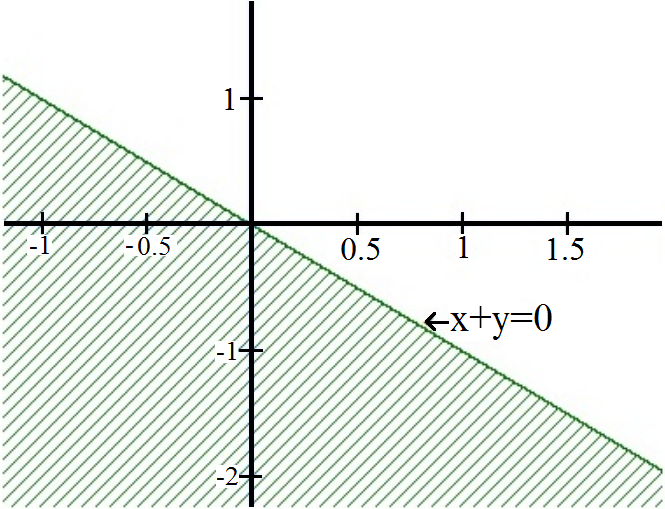
Converting the given inequation into equation we obtain, x + y = 0.
Putting y = 0, we get x = 0
Putting x = 0, we get y = 0
Putting x = 3, we get y = -3.
We plot these points and join them by a thick line. This lines divider the xy - plane in two parts. To determine the region represented by the given inequality consider the inequality.
So, the region containing the origin is represented by the given ineqation as show below:
View full question & answer→Question 34 Marks
Represent to solution set of each of the following inequations graphically in two dimensional plane: $\text{x}\leq8-4\text{y}$
AnswerWe have,
$\text{x}\leq8-4\text{y}\ ...(\text{i})$
Converting the given inequation into equation, we obtain, x - 8 - 4y.
Putting y = 0, we get x = 8
Putting x = 0, we get $\text{y}=\frac{8}{4}=2$
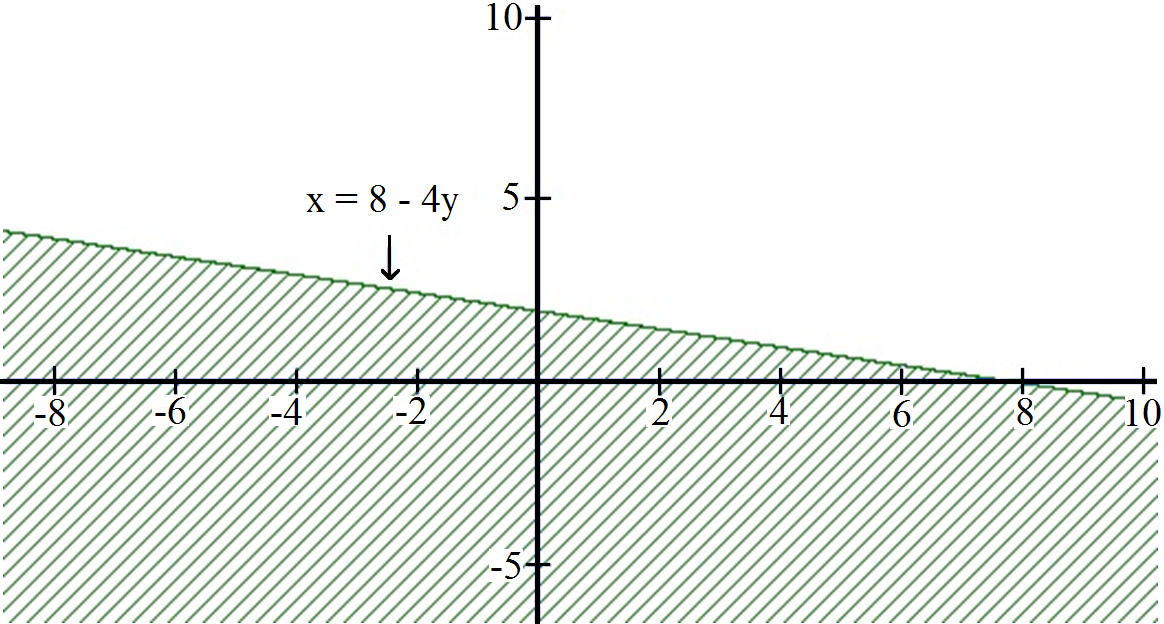
So, this line meets x-axis at (8, 0) and y-axis at (0, 2).
We plot these points and join them by a thick line. This line divides the xy-plane in two parts. To determine the region represented the given inequality consider the point 0 (0, 0)
Putting x = 0 and y = 0 in the inequation (i), we get $0\leq8$
Clearly, (0, 0) satisfies the inequality. so, the region containing the origin is represented by the given inequation as shown below:
View full question & answer→Question 44 Marks
Represent to solution set of each of the following inequations graphically in two dimensional plane: $\text{y}>2\text{x}-8$
AnswerWe have,
$\text{y}\geq2\text{x}-8\ ...(\text{i})$
Converting the given inequation into equation, we obtain, y = 2x - 8.
Putting x = 0, we get y = -8
Putting y = 0, we get $\text{x}=\frac{8}{2}=4$
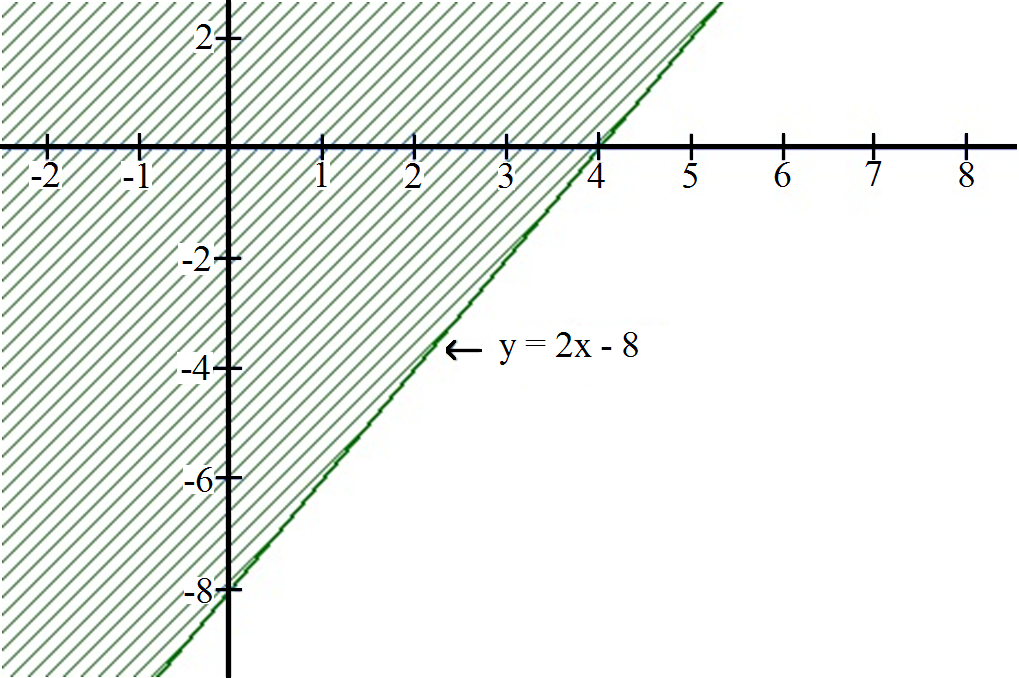
So, this line meets x-axis at (4, 0) and y-axis at (0, -8).
We plot these points and join them by a line. This line divides the xy-plane in two parts. To determine the region represented by the given inequality consider the point 0 (0, 0)
Putting x = 0 and y = 0 in the inequation (i), we get $0\geq-8$
Clearly, (0, 0) satisfies the inequality the region containing the origin is represented by the given inequation as show below:
View full question & answer→Question 54 Marks
Solve the following systems of inequations graphically: $5\text{x}+\text{y}\leq10,2\text{x}+2\text{y}\geq12,\text{x}+4\text{y}\geq12,\text{x}\geq0,\text{y}\geq0$
Answer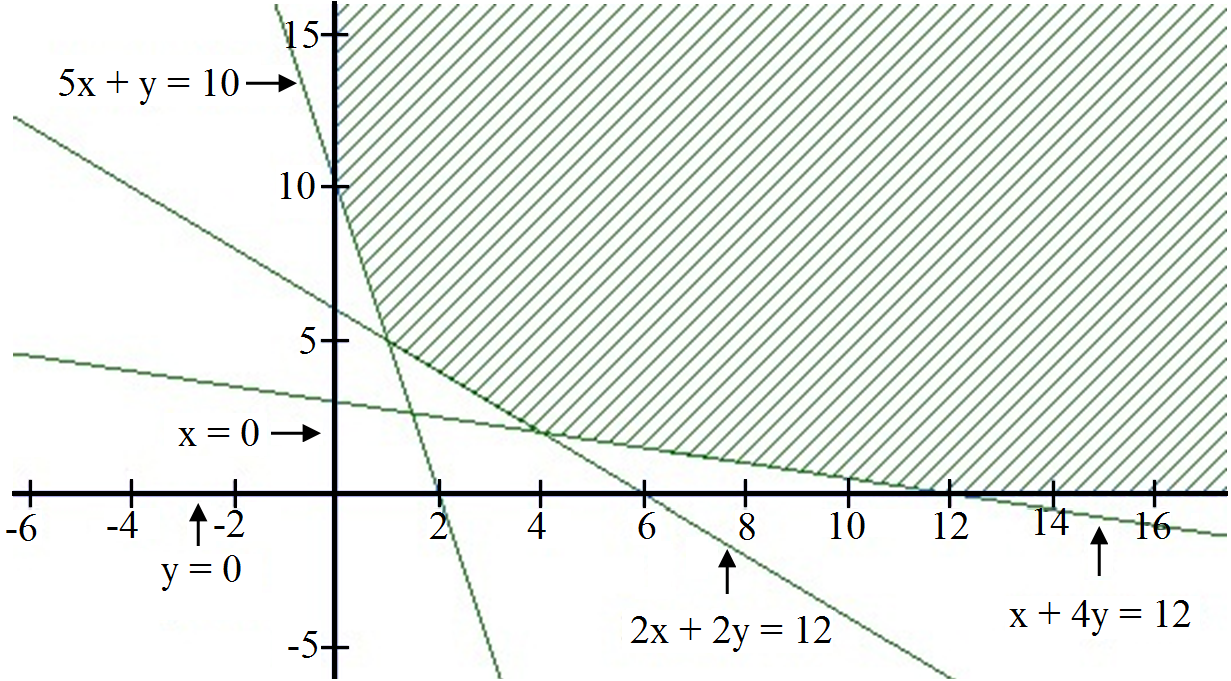
We have,
$5\text{x}+\text{y}\leq10,2\text{x}+2\text{y}\geq12,\text{x}+4\text{y}\geq12,\text{x}\geq0,\text{y}\geq0$
Converting the inequations into equations, we obtain,
5x + y = 10, 2x + 2y = 1, x + 4y = 12, x = 0 and y = 0
Region represented by $5\text{x}+\text{y}\geq1$
Putting x = 0 in 5x + y = 10, we get y = 10
Putting y = 0 in 5x + y = 10, we get $\text{x}=\frac{10}{5}=2$
$\therefore$ The line 5x + y = 10, meets the coordinate axes at (0, 10) and (2, 0). Join these points by a thick line.
Now, putting x = 0 and y = 0 in $5\text{x} + \text{y} \geq 10,$ we get $0\geq10,$ This is not possible.
$\therefore$ (0, 0) does not satisfies the inequality $5\text{x} + \text{y} \geq 10,$. so, the portion not containing the origin is represented by the inequation $5\text{x} + \text{y} \geq 10,$
Region represented by 2x + 2y > 12:
Putting x = 0 in 2x +2y = 12, we get $\text{y}=\frac{12}{2}=6$
Putting y = 0 in 2x + 2y = 12, we get $\text{x}=\frac{12}{2}=6$
The line 2x + 2y = 12 meets the coordinate axes at (0, 6) and (6, 0). Join these point by a thick line.
Now, putting x = 0 and y = 0 in 2x + 2y = 12, we get $0\geq12,$ which is not possible. Therefore, (0, 0) does not satisfies the inequality 2x + 2y = 12. so, the portion not containing the origin is represented by the inequation 2x + 2y = 12.
Region represented by $\text{x}+4\text{y}\geq12$
Putting x = 0 in x + 4y = 12, we get $\text{y}=\frac{12}{4}=3$
Putting y = 0 in x + 4y = 12, we get x = 12.
$\therefore$ The line x + 4y = 12 meets the coordinate axes at (0, 3) and (12, 0). Join these points by a thick line.
Now, putting x = 0 and y = 0 in x + 4y = 12, we get $0\geq12,$ which is not possible.
Therefore, (0, 0) does not satisfies the inequality $\text{x}+4\text{y}\geq12$ so, the portion not containing the origion is represented by the inequation $\text{x}+4\text{y}\geq12$ View full question & answer→Question 64 Marks
Represent to solution set of each of the following inequations graphically in two dimensional plane: $3\text{x}-2\text{y}\leq\text{x}+\text{y}-8$
Answer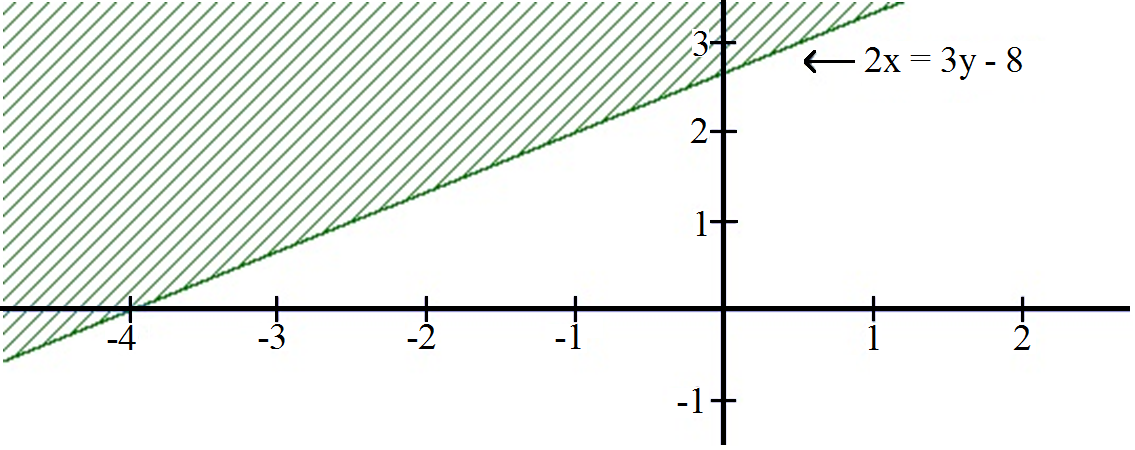 We have,
$3\text{x}-2\text{y}\leq\text{x}+\text{y}-8$
$\Rightarrow3\text{x}-\text{x}\leq\text{y}+2\text{y}-8$
$\Rightarrow2\text{x}\leq3\text{y}-8\ ...(\text{i})$
Converting the given inequation into equation, we obtain, 2x + 3y - 8.
Putting y = 0, we get $\text{x}=\frac{-8}{2}=-4$
Putting x = 0, we get $\text{y}=\frac{8}{3}$
So, this line meets x-axis at (-4, 0) and y-axis at $\Big(0,\frac{8}{3}\Big).$
we plot these points and join them by a line. This line divides the xy-plane in two parts. To determine the region represented by the given inequality consider the point 0 (0, 0).
Putting x = 0 and y = 0 in the inequation (i), we get $0\leq-8$ It is not possible.
we find that the point (0, 0) does not satisfy the inequation 2x < 3y - 8. so, the region represented by the given equation is the shaded region. View full question & answer→Question 74 Marks
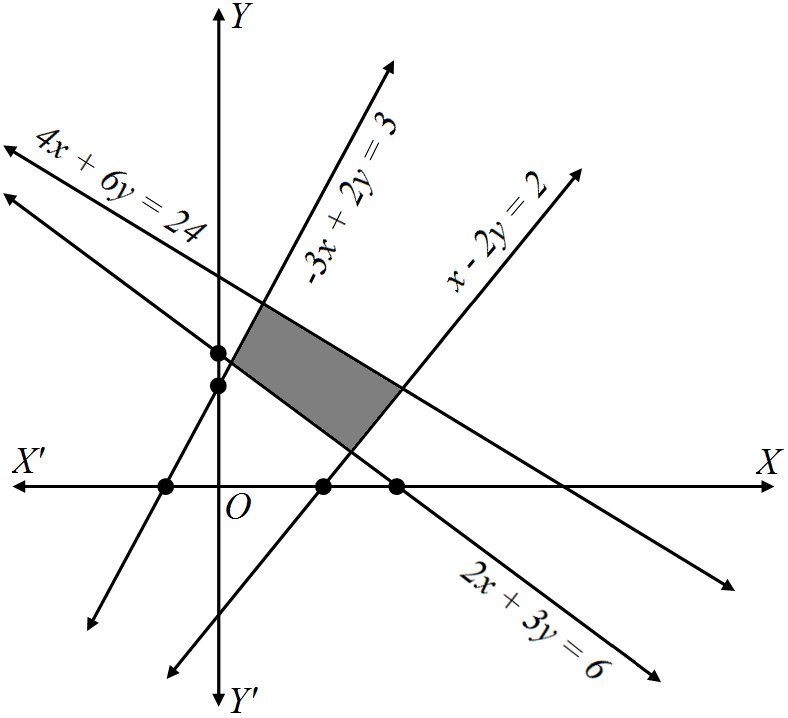
Find the linear inequations for which the shaded area in Fig. is the solution set. Draw the diagram of the solution set of the linear inequations:
Answer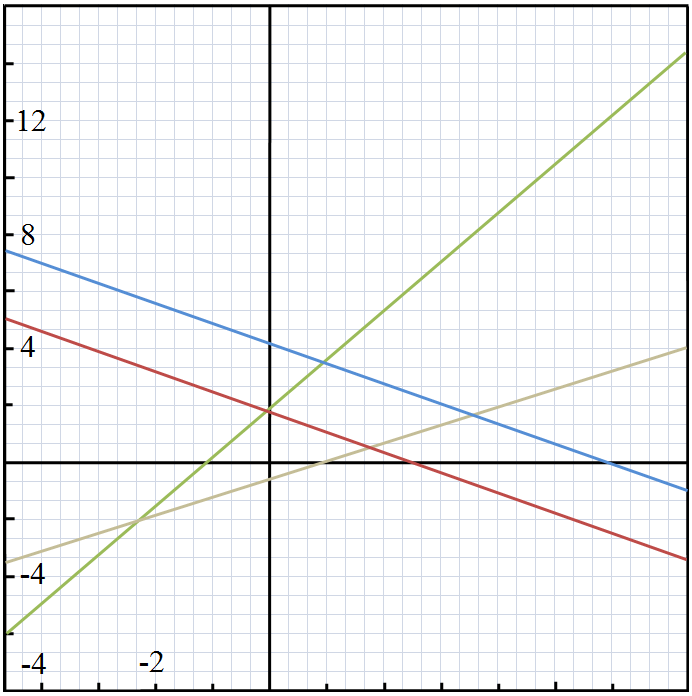
Consider the line 2x + 3y = 6. we observe that the shaded region and the origin are on the opposite sides of the line 2x + 3y = 6 and (0, 0) does not satisfy the inequation 2x + 3y 2 6. So, we must have one inequations as $2\text{x} + 3\text{y}\geq 26$
Consider the line 4x + 6y = 24. we observe that the shaded region and the origin are on the same side of the line 4x + 6y = 24 and (0, 0) satisfies the linear inequation $4\text{x} + 6\text{y}\leq 24.$
So, the second inequations is $4\text{x} + 6\text{y}\leq 24.$
Consider the line - 3x + 2y = 3. We observe that the shaded region and the origin are on the same side of the line - 3x + 2y = 3 and (0, 0) satisfies the linear inequation $-3\text{x}+2\text{y}\leq3.$ so, the third inequations is $-3\text{x}+2\text{y}\leq3.$
Finaly,consider the line x - 2y = 2. We observe that the shaded region and the origin are on the same side of the line x - 2y = 2 and (0, 0) satisfies the linear inequation $\text{x} - 2\text{y}\leq2.$ so, the forth inequations is $\text{x} - 2\text{y}\leq2.$
We also notice that the shaded region is above x-axis and is on the right side of y-axis. so, we must have $\text{x}\geq0$ and $\text{y}\geq0$
Thus, the linear inequations corresponding to the given solution set are
$2\text{x}+3\text{y}\geq6,4\text{x}+6\text{y}\leq24,-3\text{x}+2\text{y}\leq3,\text{x}-2\text{y}\leq2,\text{x}\geq0,\text{y}\geq0.$ View full question & answer→Question 84 Marks
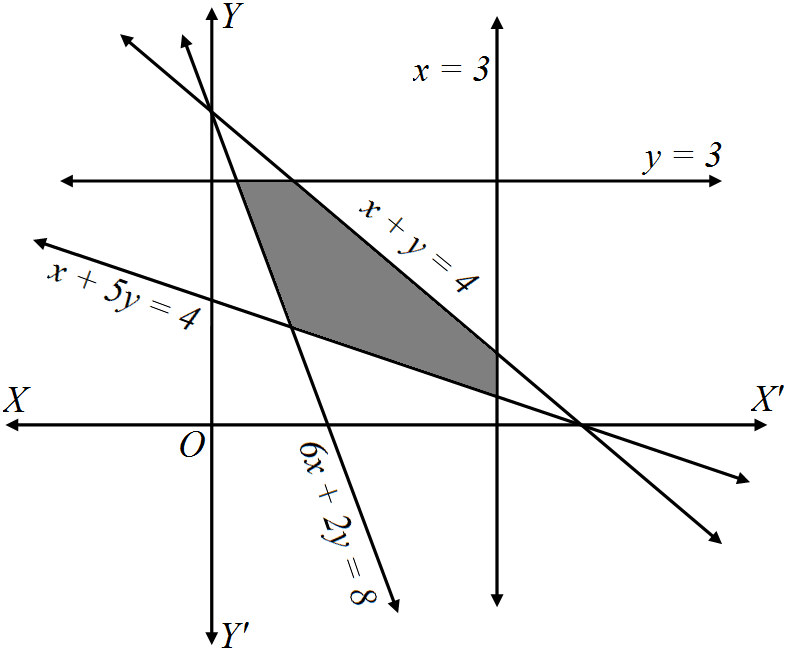
Find the linear inequations for which the solution set is the shaded region given in Fig.
Answer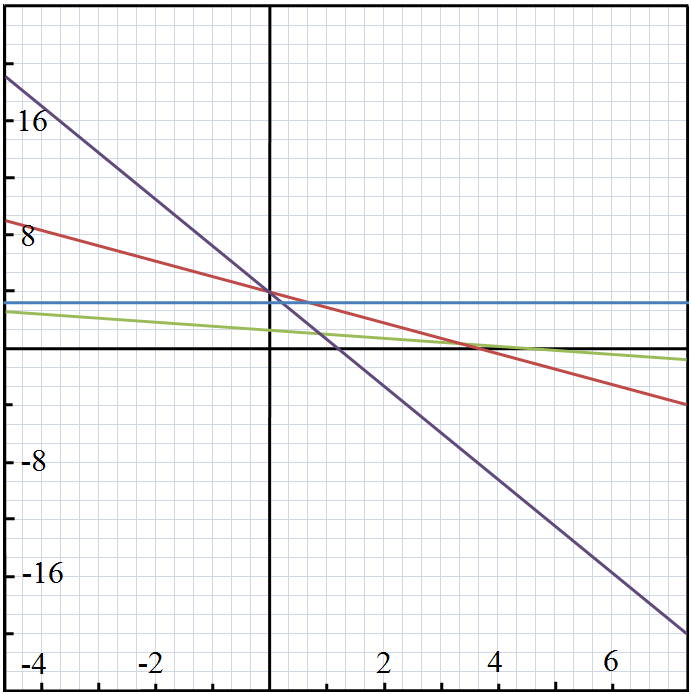
Consider the line x + y = 4. We observe that the shaded region and the origin are on the same side of the line x + y = 4 and (0, 0) satisfies the linear inequation $\text{x}+\text{y}\leq4.$ So, we must have one inequations as $\text{x}+\text{y}\leq4.$
Consider the line y = 3. We observe that the shaded region and the origin are on the same side of the line y = 3 and (0, 0) satisfies the linear inequation $\text{y}\leq3$ so, the second inequations is $\text{y}\leq3.$
Consider the line x = 3.
We observe that the shaded region and the origin are on the same side of the line x = 3 and (0, 0) satisfies the linear inequation $\text{x}\leq3$ so, the third inequations is $\text{x}\leq3$
Consider the line x + 5y = 4. We observe that the shaded region and the origin are on the opposite sides of the line x + 5y = 4 and (0, 0) does not satisfy the inequation $\text{x} + 5\text{y} \geq 4.$ so, the fourth inequations is $\text{x} + 5\text{y} \geq 4.$
Finaly, consider the line 6x + 2y = 8. We observe that the shaded region and the origin are on the opposite sides of the 6x + 2y = 8 and(0, 0) does not satisfy the inequation 6x + 2y = 8.
so the fifth inequations is 6x + 2y = 8,
we also, notice that the shaded region is above x-axis and is on the right side of y-axis. So, we must have $\text{x}\geq0$ and $\text{y}\geq0$
Thus, the linear inequations corresponding to the given solution set are
$\text{x}+\text{y}\leq4,\text{y}\leq3,\text{x}\,\leq3\text{x}+5\text{y}\geq4,,6\text{x}+2\text{y}\geq8,\text{x}\geq0,\text{y}\leq0$ View full question & answer→Question 94 Marks
Solve the following systems of linear inequations graphically: $\text{x}+\text{y}\geq1,7\text{x}+9\text{y}\leq63,\text{x}\leq6,\text{y}\leq5,\text{x}\geq0,\text{y}\geq0$
Answer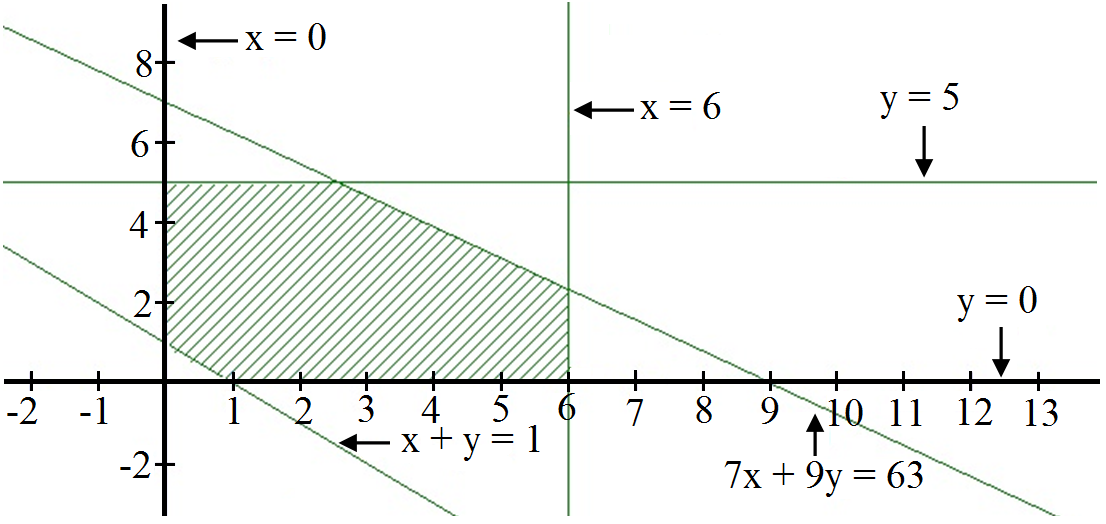
We have,
$\text{x}+\text{y}\geq1,7\text{x}+9\text{y}\leq63,\text{x}\leq6,\\\text{y}\leq5\text{x}\geq0\ \text{and }\text{y}\geq0$
Converting the inequations into equations, we obtain
x + y = 1, 7x + 9y = 63, x = 6, y = 5, x = 0 and y = 0.
Region represented by x + y > 1:
Putting x = 0 in x + y = 1, we get y = 1
Putting y = 0 in x + y = 1, we get x = 1
$\therefore$ The line x + y = 1 meets the coordinate axes at (0, 1) and (1, 0) join these point by a thick line.
Now, putting X = 0 and y = 0 in x + y > 1, we get $0\geq1$
This is not possible
$\therefore$ (0, 0) is not satisfies the inequality x + y > 1. So, the portion not containing the origin is represented by the inequation $\text{x}+\text{y}\geq1.$
Region represented by 7x + 9y = 63
Putting x = 0 in 7x +9y = 63, we get, $\text{y}=\frac{63}{9}=7.$
Putting y = 0 in 7x + 9y = 63 we get, $\text{y}=\frac{63}{7}=9.$
$\therefore$ The line 7x + 9y = 63 meets the coordinete axes of (0, 7) and (9, 0). Join these points by a thick line.
Now, putting x = 0 and y = 0 in $7\text{x}+9\text{y}\leq63,$ we get, $0\leq63$
$\therefore$ we find (0, 0) satisfies the inequality $7\text{x}+9\text{y}\leq63,$ So, the portion containing the origin represents the solution set of the inequation $7\text{x}+9\text{y}\leq63,$
Region represented by $\text{x}\leq6$: Clearly, x = 6 is a line parallel to y-axis at a distance of 6 units from the origin. Since (0, 0) satisfies the inequation X $ 6. so, the portion lying on the left side of x = 6 is the region represented by $\text{x}\leq6$
Region represented by $\text{y}\leq5$ Clearly, y = 5 is a line parallel to x-axis at a distance 5 from it. since (0, 0) satisfies by the given inequation.
Region represented by $\text{x}\geq0$ and $\text{y}\geq0$: cearly, $\text{x}\geq0$ and $\text{x}\geq0$ represent the first quadrant.
The common region of the above six regions represents the solution set of the given inequation as shown below. View full question & answer→Question 104 Marks
Represent to solution set of each of the following inequations graphically in two dimensional plane: $0\leq2\text{x}-5\text{y}+10$
AnswerWe have,
$0\leq2\text{x}-5\text{y}+10\ ...(\text{i})$
Converting the given inequation into equation, we obtain, 2x - 5y + 10 = 0.
Putting x = 0, we get $\text{y}=\frac{-10}{-5}=2$
Putting y = 0, we get $\text{x}=\frac{-10}{2}=-5$
So, this line meets x-axis at (-5, 0) and y-axis at (0, 2).
we plot these points and join them by a thick line. This line divides the xy-plane in two parts. To determine the region represented by the given inequality consider the point 0 (0, 0)
Putting x = 0 and y = 0 in the inequation (),we get 0 < 10
Clearly, (0, 0) satisfies the inequality. so, the region containing the origin is represented by the given inequation as shown below:
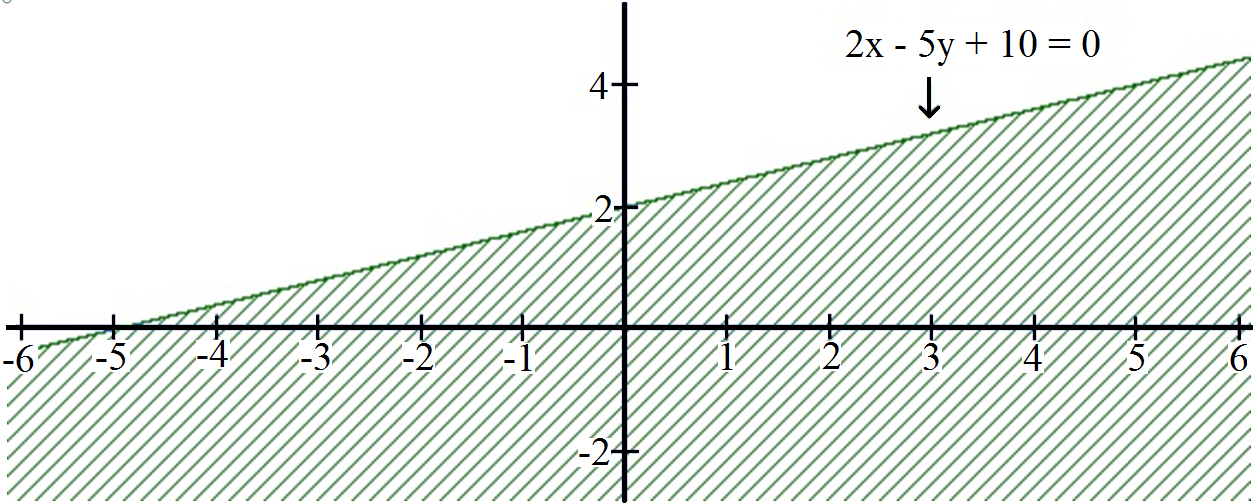
View full question & answer→Question 114 Marks
Solve the following systems of linear equations has no solution: $\text{x}+2\text{y}\leq3,3\text{x}+4\text{y}\geq12,\text{x}\geq0,\text{y}\geq1.$
Answer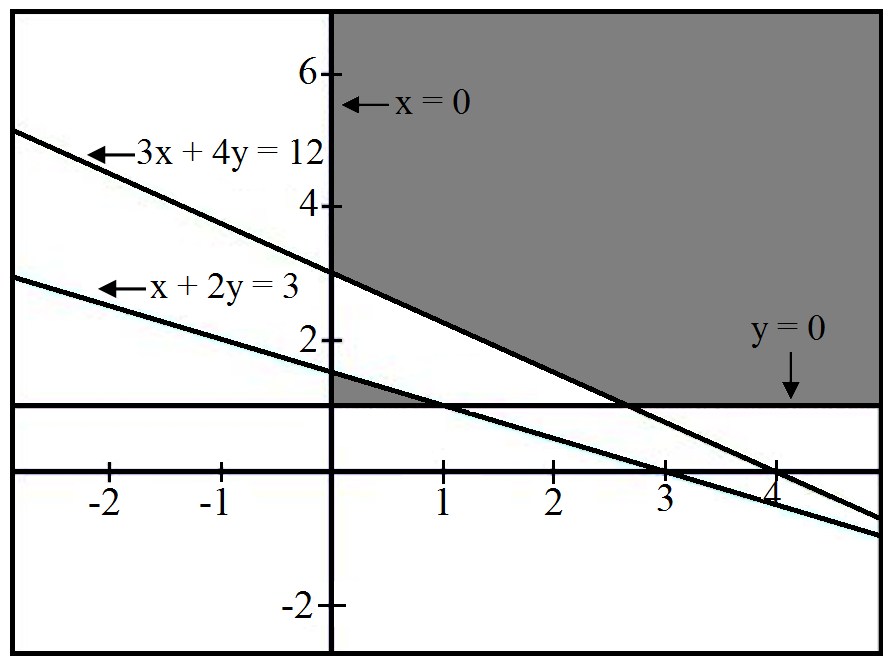
Converting theinequations into equations, we get
$\text{x}+2\text{y}\leq3,3\text{x}+4\text{y}\geq12,\text{x}\geq0,\text{y}\geq1.$
Region represented by $\text{x}+2\text{y}\leq3:$
The line x + 2y = 3 meets the coordinate axes at $\Big(0,\frac{3}{2}\Big)$ and (3,0). We find that (0, 0) satisfies inequation $\text{x}+2\text{y}\leq3.$ So the portion containing origin represents the solution set of the inequation $\text{x}+2\text{y}\leq3.$
Region represented by $3\text{x}+4\text{y}\geq12:$
The line 3x + 4y = 12 meets the coordinate axes at (0, 3) and (4, 0). We find that (0, 0) does not satisfy inequation $3\text{x}+4\text{y}\geq12.$So the portion not containing the origin is represented by the inequation $3\text{x}+4\text{y}\geq12.$
Region represented by $\text{x}\geq0:$
Clearly, $\text{x}\geq0$ represents the region lying on the right side of y-axis.
Region represented by $\text{y}\geq1: $
The line y = 1 is parallel to x-axis. (0, 0) does not satisfy inequation $\text{y}\geq1.$ So the region lying above the line y = 1 is represented by $\text{y}\geq1.$ View full question & answer→Question 124 Marks
Solve the following systems of inequations graphically: $2\text{x} + \text{y} \geq 8, \text{x} + 2\text{y} \geq 8,\text{ x} +\text{ y}\leq 6$
Answer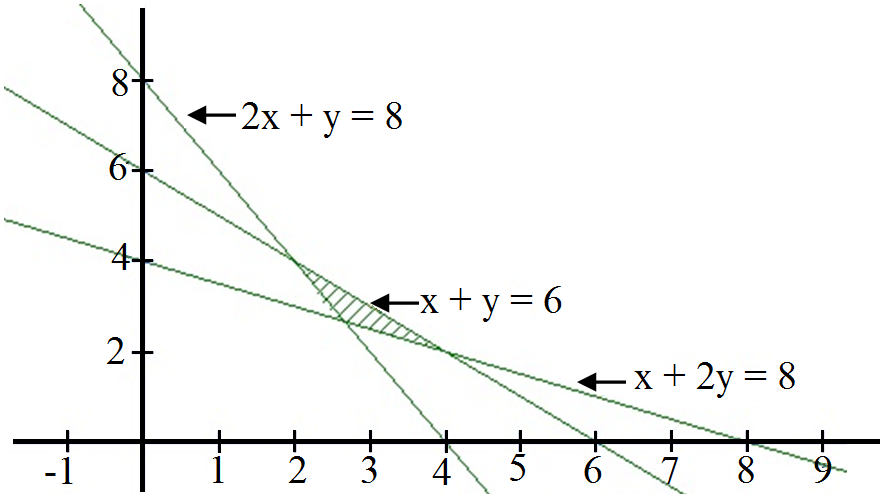
We have,
$2\text{x} + \text{y} \geq 8, \text{x} + 2\text{y} \geq 8,\text{ x} +\text{ y}\leq 6$
Converting the inequations into equations, we obtain,
2x + y = 8, x + 2y = 8, and x + y = 6
Region represented by $2\text{x}+\text{y}\geq8$
Putting x = 0 in 2x + y = 8, we get y = 8.
Putting y = 0 in 2x + y = 8, we get $\text{x}=\frac{8}{2}=4$
$\therefore$ The line 2x + y - 8 meets the coordinate axes at (0, 8) and (4, 0). Join these points by a thick line.
Now, putting x = 0 and y = 0 in $2\text{x}+\text{y}\geq8,$ we get $0\geq8$ This is not possible.
We find that (0, 0) is not satisfies the inequation $2\text{x}+\text{y}\geq8$ So, the portion not containing the origin is represented by the given inequation.
Region represented by $\text{x}+\text{y}\leq6$
Putting x = 0 in x + 2y = 8, we get y = 4
Putting y = 0 in x + 2y = 8, we get x = 8.
$\therefore$ The line x + y = 6 meets the coordinate axes at (0, 6) and (6, 0). Joining these points by a thick line. Now, putting x = 0 and y = 0 in $\text{x}+\text{y}\leq6$ we get, $0\leq6$ This is not possible.
$\therefore$ we find that (0, 0) is not satisfies the inequation $\text{x} + 2\text{y} \geq8.$ so the portion not containing the origin is represented by the given inequation.
Region represented by x + y = 6:
Putting x = 0 in x + y = 6, we get, y = 6.
Putting y = 0 in x + y = 6, we get, x = 6.
$\therefore$ The line x + y = 6 meets the coordinate axes at (0, 6) and (6, 0). Joining these points by a thick line. Now, putting X = 0 and y = 0 in $\text{x}+\text{y}\leq6$ we get $0\leq6$
Therefore, (0, 0) satisfies $\text{x}+\text{y}\leq6$ so the portion containing the origin is represented by the given inequation. The common region of the above three regions represents the solution set of the given inequations as shown below: View full question & answer→Question 134 Marks
show that the solution set of the following system of linear inequalities is an unbounded region $2\text{x}+\text{y}\geq8,\text{x}+2\text{y}\geq10,\text{x}\geq0,\text{y}\geq0.$
AnswerConverting the inequations into equations, we get
2x + y = 8,x + 2 y = 10,x = 0, y = 0.
Region represented by $2\text{x}+\text{y}\geq8$
The line 2x + y = 8 meets the coordinate axes at (0, 8) and (4, 0). We find that (0, 0) does not satisfy inequation $2\text{x}+\text{y}\geq8$ So the portion not containing the
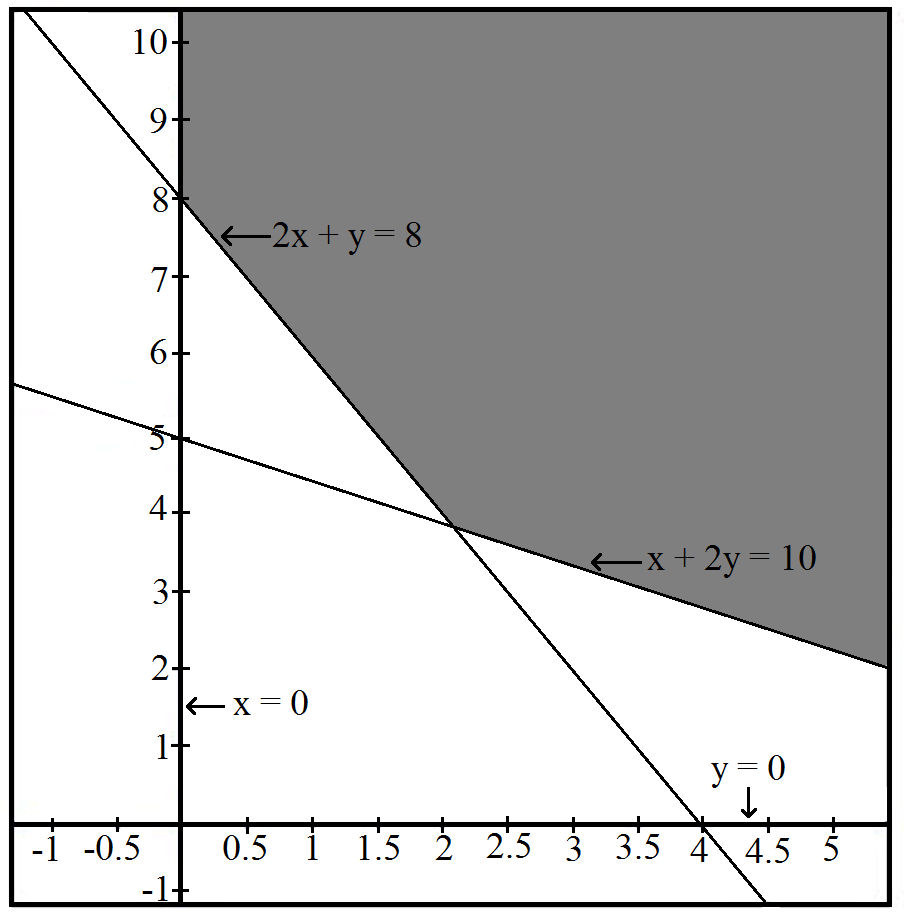
From graph we can see that the solution set satisfying the given inequalities is an unbounded region. View full question & answer→Question 144 Marks
Represent to solution set of each of the following inequations graphically in two dimensional plane: $-3\text{x}+2\text{y}\leq6$
AnswerWe have,
$-3\text{x}+2\text{y}\leq6\ ...(\text{i})$
Converting the given inequation into equation, we obtain, -3x + 2y = 6.
Putting x = 0, we get $\text{y}=\frac{6}{2}=3$
Putting y = 0, we get $\text{x}=\frac{-6}{3}=-2$
we plot these points and join them by a thick line. This line meets x - axis at (-2, 0) and y - axis at (0, 3). This line divides the xy - plan into two parts. To determine the region represented by the given inequality, consider the point 0 (0, 0). Putting X = 0 and y = 0 in the inequation (i), we get, $0\leq6$
Clearly, (0, 0) satisfies the inequality. So the region containing the origin is represented by the given inequation as shown below.
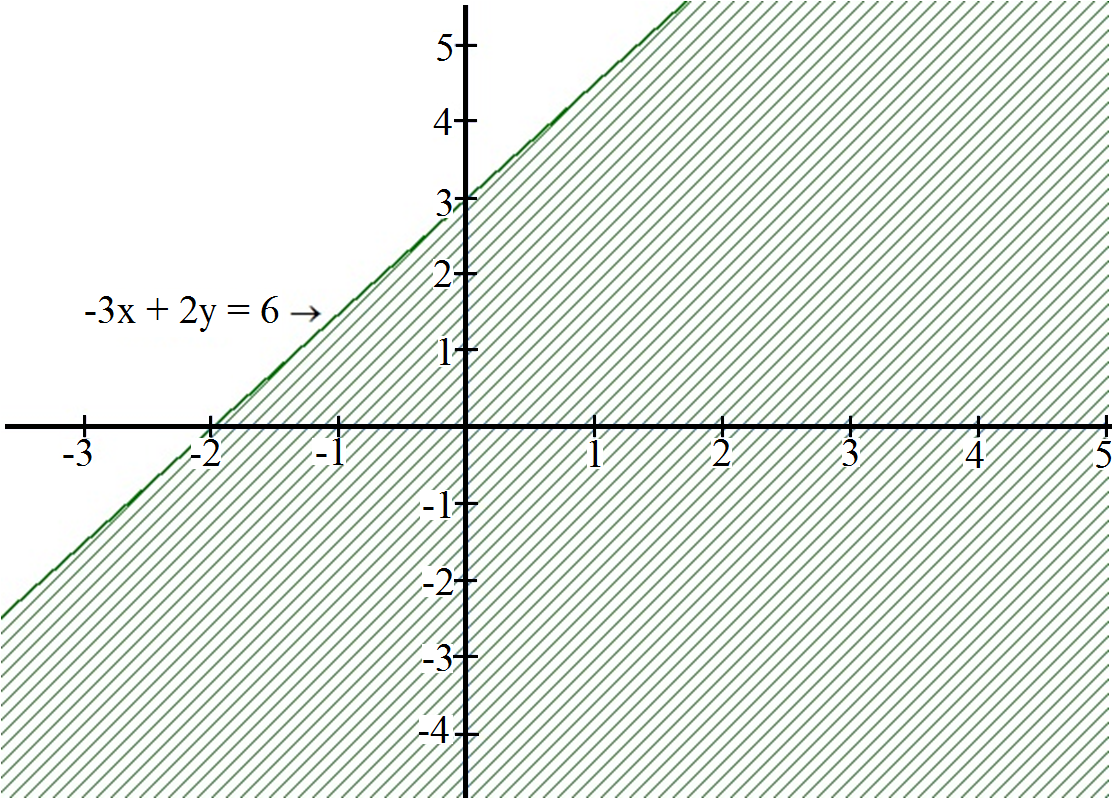
View full question & answer→Question 154 Marks
Solve the following systems of linear inequations graphically: $2\text{x}+3\text{y}\leq6,3\text{x}+2\text{y}\leq6,\text{x}\geq0,\text{y}\geq0$
Answer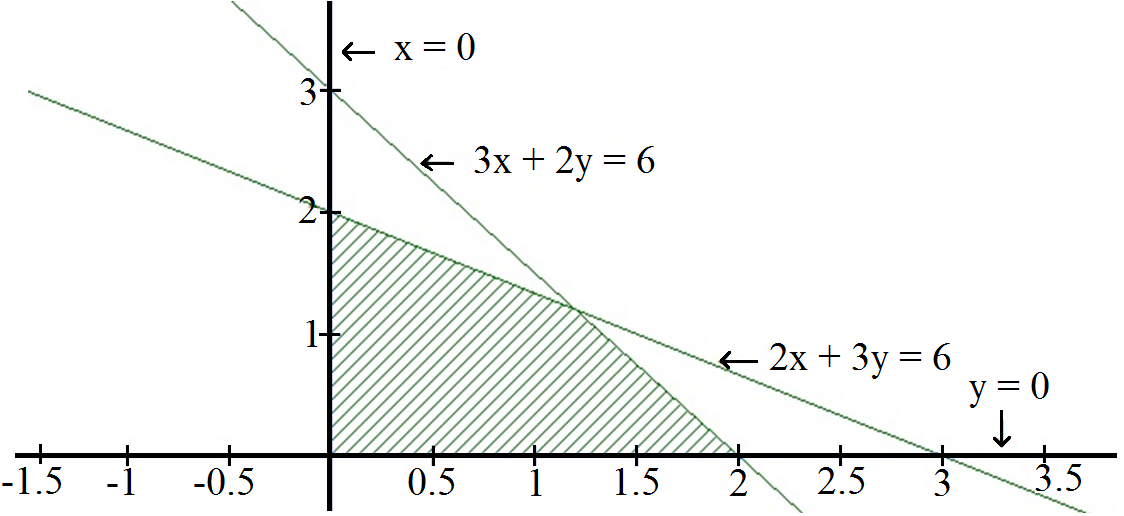
We have,
$2\text{x}+3\text{y}\leq6,3\text{x}+2\text{y}\leq6,\text{x}\geq0,\text{y}\geq0$
Converting the given inequation into equations, the inequations reduce to 2x + 3y = 6,
3x + 2y = 6, X = 0 and y = 0.
Region represented by $2\text{x}+3\text{y}\leq6$
Putting x = 0 inequation 2x + 3y = 6
we get $\text{y}=\frac{6}{3}=2$
Putting y = 0 in the equation 2x + 3y = 6,
we get $\text{x}=\frac{6}{3}=3.$
$\therefore$ This line 2x + 3y = 6 meets the coordinate axes at (0, 2) and (3, 0). Draw a thick line joining these points. We find that (0, 0) satisfies inequation 2x + 3y 36.
Region represented by 3x + 2y 56:
Putting x = 0 in the equation
3x + 2y = 6, we get $\text{y}=\frac{6}{2}=3$
Putting y = 0 in the equation
3x +2y = 6, we get $\text{x}=\frac{6}{2}=2$
$\therefore$ This line 3x + 2y = 6 meets the coordinate axes at (0, 3) and (2, 0). Draw a thick line joining these points. we find that (0, 0) satisfies inequation $2\text{x}+3\text{y}\leq6.$
Region represented by $\text{x}>0$ and $\text{y}\geq0$
Clearly $\text{x}>0$ and $\text{y}\geq0$ represent the first quadrant. View full question & answer→Question 164 Marks
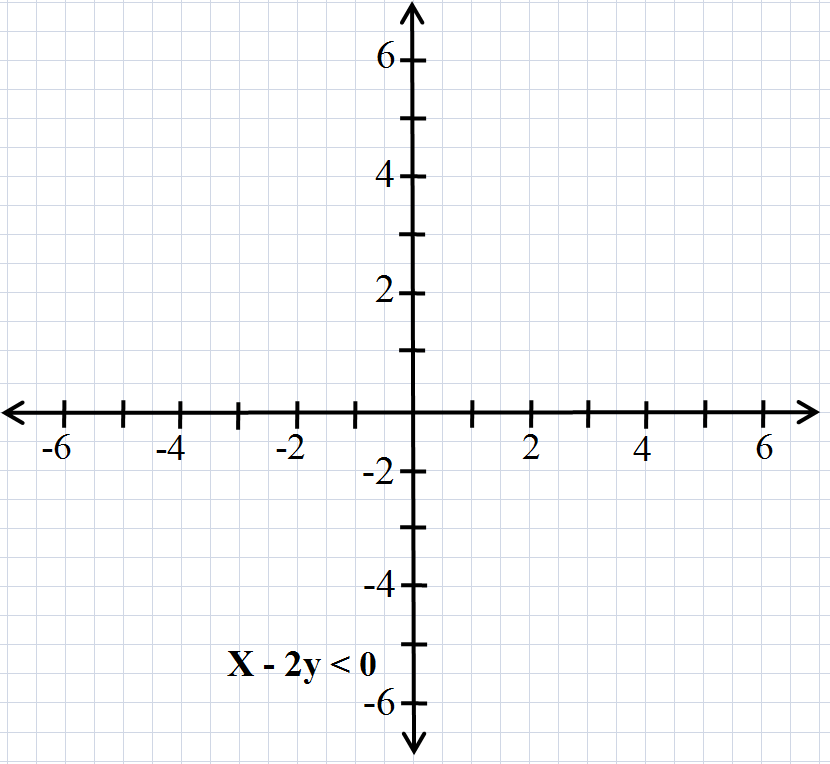
Represent to solution set of each of the following inequations graphically in two dimensional plane: $\text{x}-2\text{y}<0$
AnswerWe have
x - 2y < 0
Converting the inequation into e qaution, we obtain,
X < 2y
To determine the region represented by the given inequality consider the point (0, 0)
Putting x = 0 and y = 0 in equation we have
0 < 0
It is not possibvle. Clearly o (0, 0) does not satisfy the inequality
So, the region represented by the given inequation is the shadd region shown below:
View full question & answer→Question 174 Marks
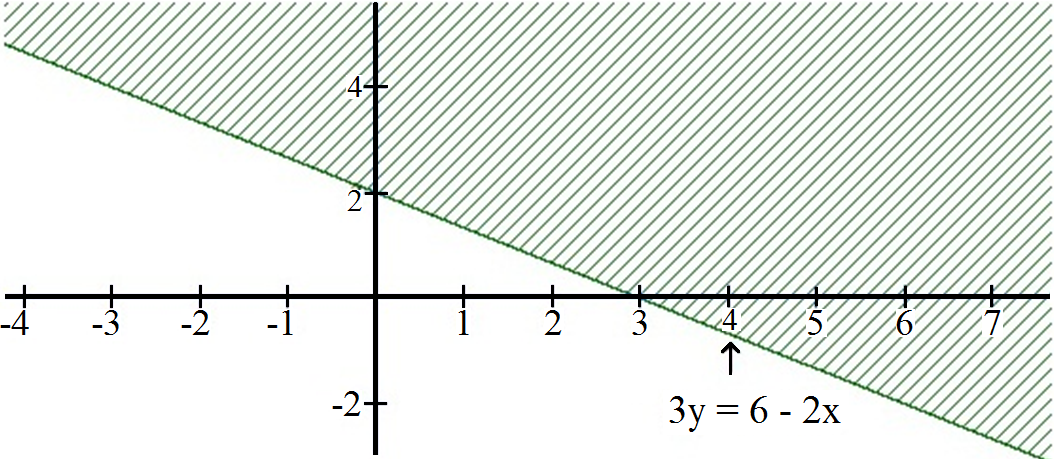
Represent to solution set of each of the following inequations graphically in two dimensional plane: $3\text{y}>6-2\text{x}$
AnswerWe have,
$3\text{y}\geq6-2\text{x}\ ...(\text{i})$
Converting the given inequation into equation, we obtain, 3y = 6 - 2x.
Putting x = 0, we get $\text{y}=\frac{6}{3}=2$
Putting y = 0, we get $\text{x}=\frac{6}{2}=3$
So, this line meets x-axis at (3, 0) and y-axis at (0, 2).
we plot these points and join them by a thick line. This line divides the xy-plane in two parts. To determine the region represented by the given inequality consider the point 0(0, 0)
Putting x = 0 and y = 0 in the inequation (i), we get $0\geq6$ it is not possible.
$\therefore$ we find that the point (0, 0) does not satisfy the equation $3\text{y}\geq6-2\text{x}.$
So, the region represented by the given equation is shaded region shown below:
View full question & answer→Question 184 Marks
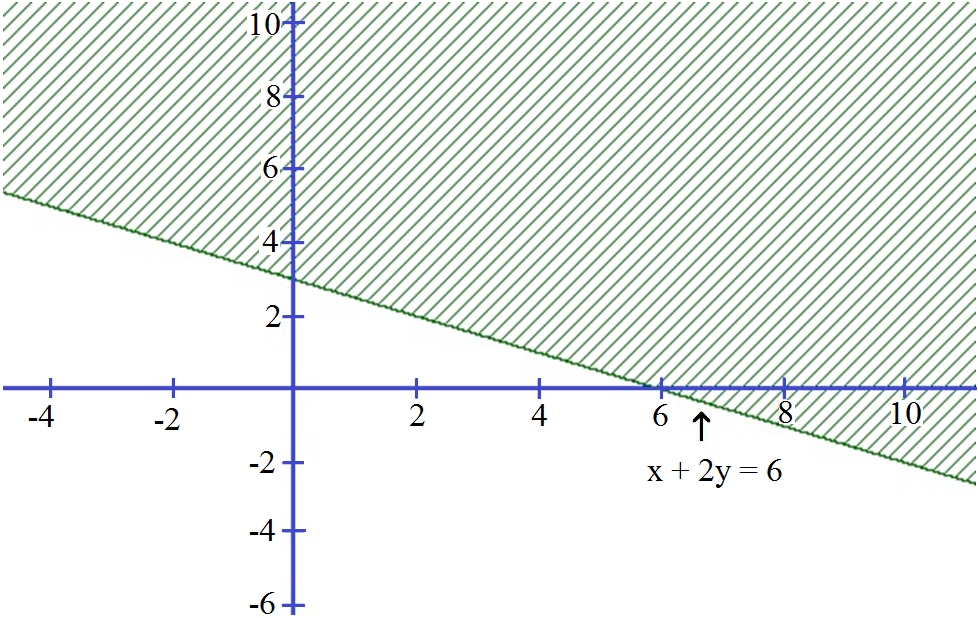
Represent to solution set of each of the following inequations graphically in two dimensional plane: $\text{x}+2\text{y}\geq6$
AnswerWe have,
$\text{x}+2\text{y}\geq6$
Converting the inequation into equation, we obtain, x + 2y = 6.
Putting y = 0, we get x = 6
Putting x = 0, we get 2y = 6 ⇒ y = 3
We plot these points and join them by a thick line. This lines divider the xy -plane in two parts. To determine the region represented by the given inequality consider the point (0, 0).
Putting x = 0 and y = 0 in (i) we get, $0\geq6$
It is not possible.
Clearly, 0(0, 0) does not satisfies the inequality.
So, the region represented by the given inequation is the shaded region shown below:
View full question & answer→Question 194 Marks
Solve the following systems of inequations graphically: $\text{x}+2\text{y}\leq40,3\text{x}+\text{y}\geq30,4\text{x}+3\text{y}\geq60,\text{x}\geq0,\text{y}\geq0$
Answer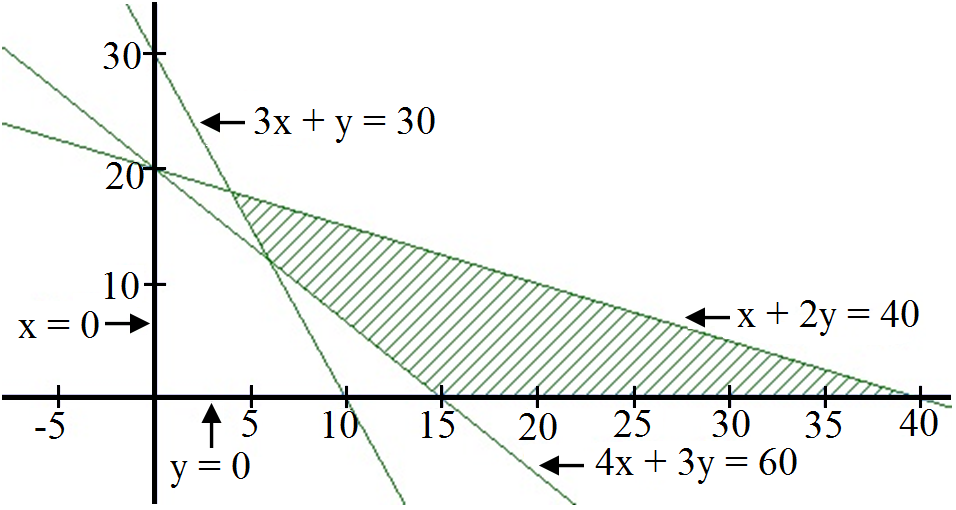
We have,
$\text{x}+2\text{y}\leq40,3\text{x}+\text{y}\geq30,4\text{x}+3\text{y}\geq60,\text{x}\geq0,\text{y}\geq0$
Converting the inequations into equations, we obtain,
x + 2y = 40, 3x + y = 30, 4x + 3y = 60, x = 0 and y = 0
Region represented by $\text{x} + 2\text{y} \leq 40:$
Putting x = 0 in x +2y = 40, we get $\text{y}=\frac{40}{2}=20$
Putting y - 0 in x + 2y = 40, we get x = 40
$\therefore$ The line x + 2y = 40, meets the coordinate axes at (0, 20) and (40, 0). Join these points by a thick line.
Now, putting x = 0 and y = 0 in $\text{x} + 2\text{y} \leq 40$ we get $0\leq40$
Therefore, (0, 0) satisfies the inequality $\text{x} + 2\text{y} \leq 40$ so, the portion containing the origin represents the solution set of the inequation $\text{x} + 2\text{y} \leq 40$
Region represented by $3\text{x} + \text{y} \geq 30$
Putting x = 0 in $3\text{x} + \text{y} \leq 30$ we get y = 30
Putting y = 0 in 3x + y = 30, we get, $\text{x}=\frac{30}{3}=10$
$\therefore$ The line 3x + y = 30 meets the coordinate axes at (0, 30) and (10, 0). Joining these points by a thick line.
Now, putting x = 0 and y = 0 in $3\text{x}+\text{y}\geq30$ we get, $0\geq30$ This is not possible.
Therefore (0, 0) does not satisfies the inequality $3\text{x} +\text {y} \geq 30.$ so, the portion not containing the origin is represented by the inequation $3\text{x} +\text {y} \geq 30.$
Region represented by 4x + 3y > 60:
Putting x = 0 in 4x + 3y = 60, we get, $\text{y}=\frac{60}{3}=20$
Putting y = 0 in 4x + 3y = 60, we get, $\text{x}=\frac{60}{4}=15.$
$\therefore$ The line 4x + 3y = 60 meets the coordinate axes at (0, 20) and (15, 0). Join these points by a thick line.
Now, putting x = 0, y = 0 in $4\text{x} + 3\text{y} \geq260,$ we get $0\geq60.$
This is not possible. Therefore, (0, 0) does not satisfies the inequality $4\text{x}+3\text{y}\geq60$ so, the portion not containing the origin is represented by the inequation $4\text{x}+3\text{y}\geq60$ View full question & answer→Question 204 Marks
Solve the following systems of linear inequations graphically: $2\text{x}+3\text{y}\leq35,\text{y}\geq3,\text{x}\geq2,\text{x}\geq0,\text{y}\geq0$
Answer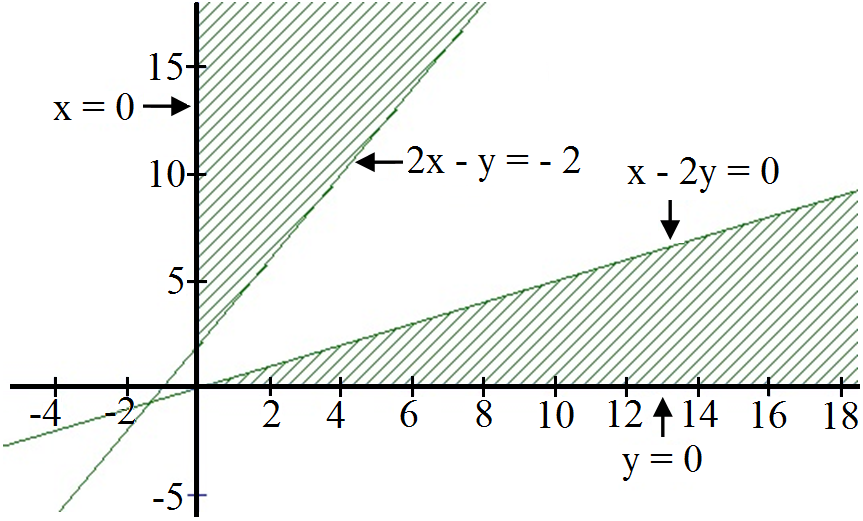
We have,
$2\text{x}+3\text{y}\geq35,\text{y}\geq3,\text{x}\geq2,\text{x}\geq0\text{ and }\text{y}\geq0$
Converting the inequations into equations, we get
2x + 3y = 35, y = 3, X = 2, x = 0 and y = 0.
Region represented by $2\text{x}+3\text{y}\geq35$
Putting x = 0 in 2x + 3y = 35, we get $\text{y}=\frac{35}{3}$
Putting y = 0 in 2x + 3y = 35, we get $\text{x}=\frac{35}{2}$
$\therefore$ The line 2x + 3y = 35 meets the coordinate axes at $\Big(0,\frac{35}{3}\Big)$ and $\Big(\frac{35}{2},0\Big)$ joining these point by a thick line.
Now, putting x = 0 and y = 0 in $2\text{x}+3\text{y}\leq35$ we get $0\leq35.$
Clearly, (0, 0) satisfies the inequality $2\text{x}+3\text{y}\leq35$ So, the portion containing the origin represents the solution $2\text{x}+3\text{y}\leq35$
Region represented by $\text{y}\geq3$
Clearly, y = 3 is a line parallel to x-axis at a distance 3 units from the origin. Since (0, 0) does not satisfies the inequation $\text{y}\geq 3.$
So, the portion not containing the origin is represented by the $\text{y}\geq 3.$
Region represented by $\text{x}\geq2$ Clearly, x = 2 is a line parallel to y-axis at a distance of 2 units from the origin. Since (0, 0) does not satisfies the inequation $\text{x}\geq2$ so, the portion not containing the origin is represented by the given inequation.
Region represented by $\text{x}\geq0$ and $\text{y}\geq0$ dearly, $\text{x}\geq0$ and $\text{y}\geq0$ represent the first quadrant.
The common region of the above five regions represents the solution set of the given inequations as shown below. View full question & answer→Question 214 Marks
Solve the following systems of linear inequations graphically: $\text{x}+2\text{y}\leq3,3\text{x}+4\text{y}\geq12,\text{y}\geq1,\text{x}\geq0,\text{y}\geq0$
Answer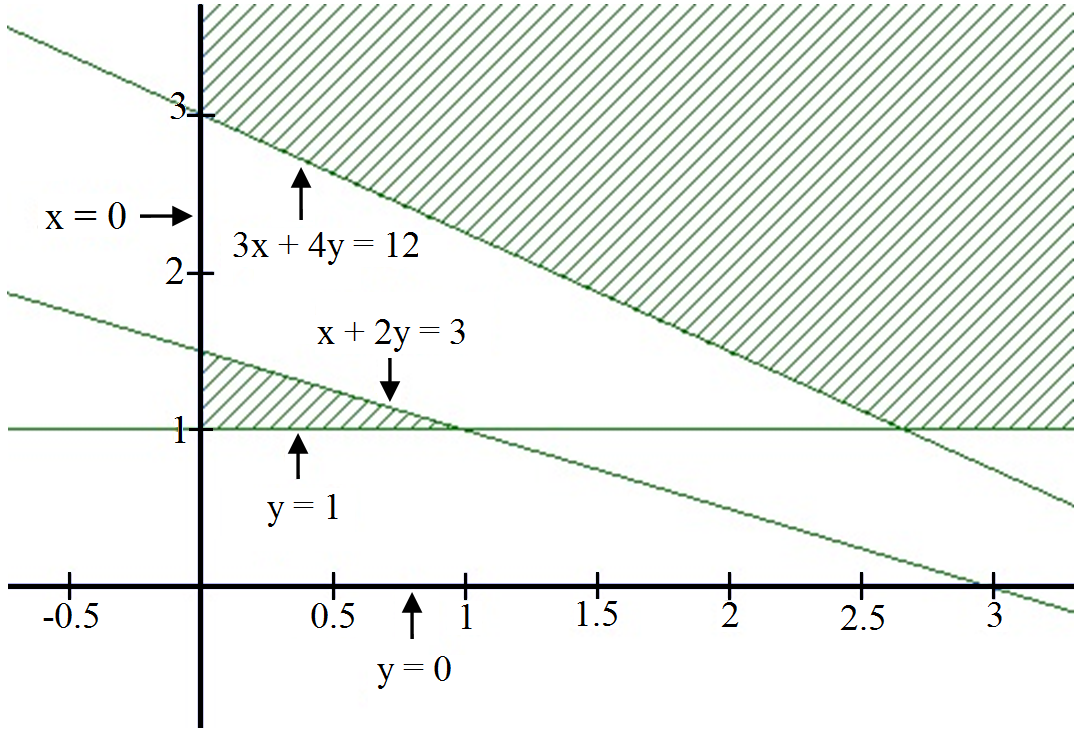
We have,
$\text{x}+2\text{y}\leq3,3\text{x}+4\text{y}\geq12,\text{y}\geq1,\text{x}\geq0,\text{y}\geq0$
Converting the inequations into equations, we get
x + 2y = 3, 3x + 4y = 12
y = 1, x = 0 and y = 0
Region represented by $\text{x}+2\text{y}\leq3$
Putting x = 0 in x + 2y = 3, we get $\text{y}=\frac{3}{2}$
Putting y = 0 in x + 2y = 3, we get $\text{x}=3$
$\therefore$ The line x + 2y = 3 meets the coordinate axes at $\Big(0,\frac{3}{2}\Big)$ and (4, 0) joining these point by a thick line.
Now, putting x = 0 and y = 0 in $3\text{x}+4\text{y}\leq3$ we get $0\leq12$
since, (0, 0) does not satisfies the inequality $3\text{x}+4\text{y}\leq3$ So, the portion containing the origin represents the solution $3\text{x}+4\text{y}\leq3$
Region represented by $\text{y}\geq1$ Clearly, y = 1 is a line parallel to x-axis at a distance 3 units from the origin. Since (0, 0) does not satisfies the inequation $\text{y}\geq1$
So, the portion not containing the origin is represented by the inequation
Region represented by $\text{x}\geq0$ and $\text{y}\geq\alpha$
Clearly, $\text{x}\geq0$ and $\text{y}\geq0$ represent the first quadrant. View full question & answer→Question 224 Marks
Solve the following systems of linear inequations graphically: $2\text{x}+3\text{y}\leq6,\text{x}+4\text{y}\leq4,\text{x}\geq0,\text{y}\geq0$
Answer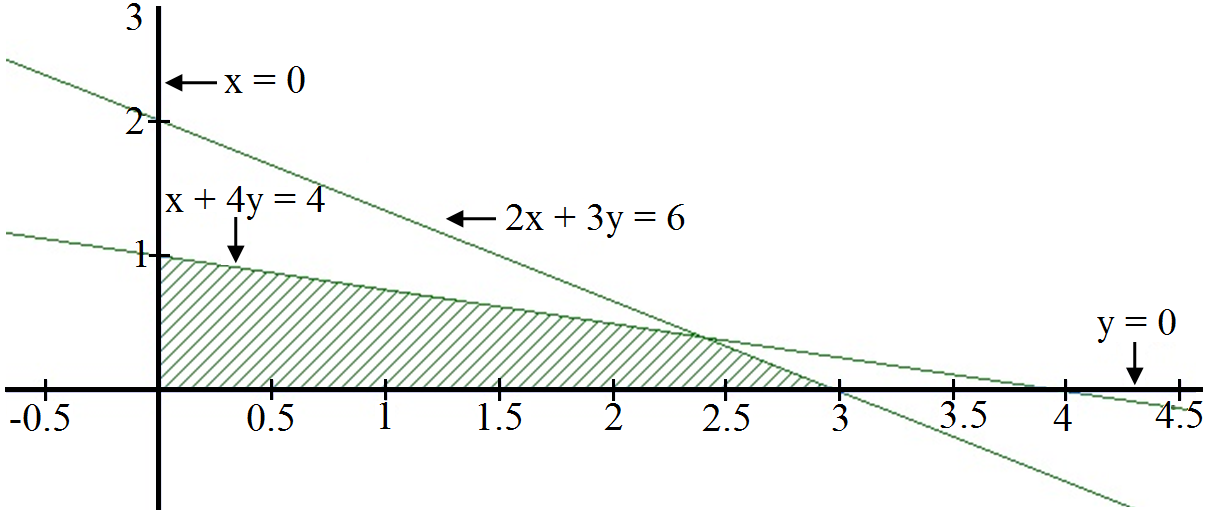
We have,
$2\text{x}+3\text{y}\leq6,\text{x}+4\text{y}\leq4,\text{x}\geq0,\text{y}\geq0$
Converting the given inequation into equations, the inequations reduce to 2x + 3y = 6,
x + 4y = 4, x = 0 and y = 0.
Region represented by $2\text{x}+3\text{y}\leq6$
Putting x = 0 inequation 2x + 3y = 6
we get $\text{y}=\frac{6}{3}=2$
Putting y = 0 in the equation 2x + 3y = 6,
we get $\text{x}=\frac{6}{2}=3.$
$\therefore$ This line 2x + 3y = 6 meets the coordinate axes at (0, 2) and (3, 0). Draw a thick line joining these points. We find that (0, 0) satisfies inequation 2x + 3y 36.
Region represented by $\text{x}+4\text{y}\leq4$
Putting x = 0 in x + 4y = 4
we get $\text{y}=\frac{4}{4}=1$
Putting y = 0 in x + 4y = 4
we get x = 4
$\therefore$ This line x + 4y = 4 meets the coordinate axes at (0, 1) and (4, 0). Draw a thick line joining these points.
Now putting x = 0, y = 0 in $\text{x}+4\text{y}\leq4$ we get $0\leq4$
Clearly, we find that (0, 0) satisfying in equation $\text{x}+4\text{y}\leq4$
Region represent by $\text{x}\geq0$ and $\text{y}\geq0$
Clearly $\text{x}\geq0$ and $\text{y}\geq0$ represent in first quadrant. View full question & answer→Question 234 Marks
Solve the following systems of inequations graphically: $12\text{x} + 12\text{y} \geq 840, 3\text{x} + 6\text{y} \leq 300,8\text{x} +4\text{y}\leq 480\text{x}\geq0,\text{y}\geq0$
Answer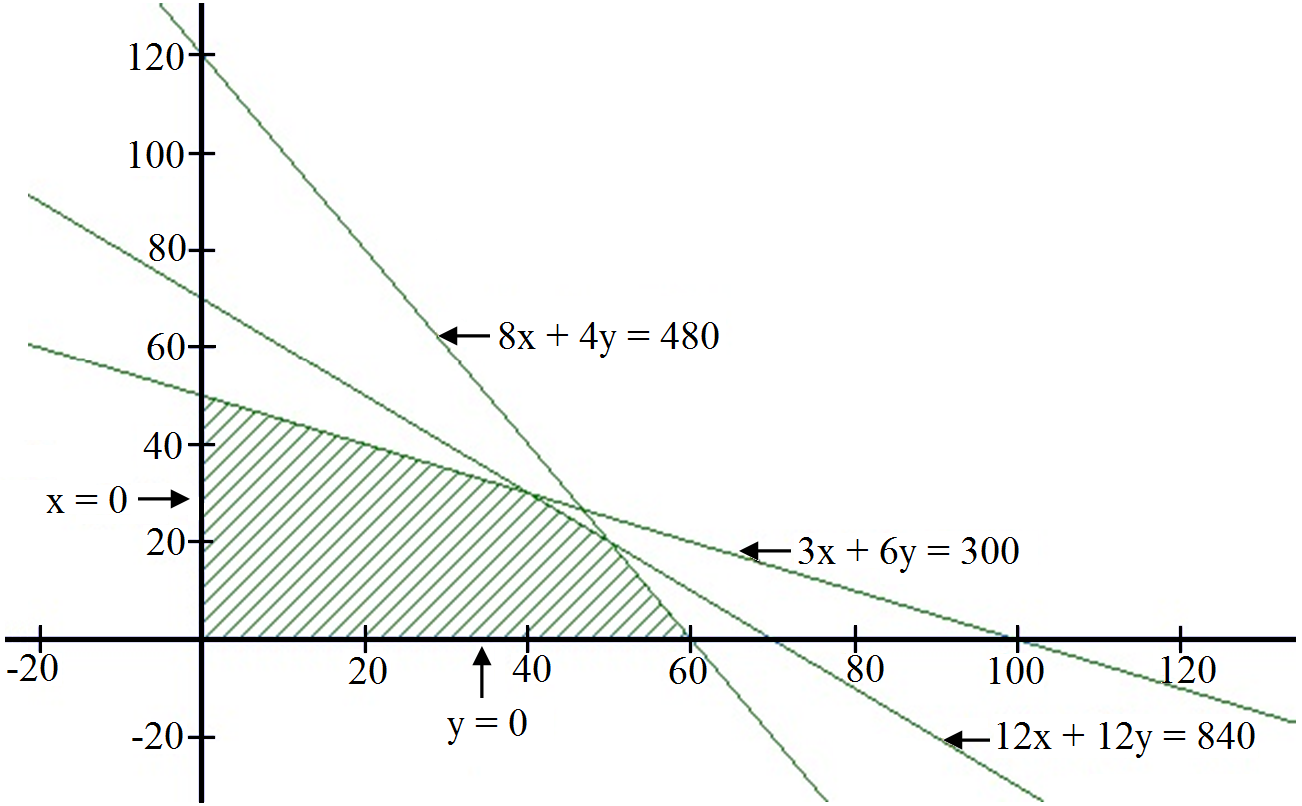
We have,
$12\text{x} + 12\text{y} \geq 840, 3\text{x} + 6\text{y} \leq 300,8\text{x} +4\text{y}\leq 480\text{x}\geq0,\text{y}\geq0$
Converting the inequations into equations, we obtain,
12x + 12y = 840, 3x + 6y = 300, 8x + 4y = 480, x = 0 and y = 0
Region represented by x + 2y < 40:
Putting x = 0 in 12x + 12y = 840, we get $\text{y}=\frac{840}{12}=70$
Putting y = 0 in 12x + 12y < 840, we get $\text{x}=\frac{840}{12}=70$
$\therefore$ The line 12x + 12y = 840, meets the coordinate axes at (0, 70) and (70, 0). Join these points by a thick line.
Now, putting x = 0 and y = 0 in $12\text{x} +2\text{y} \leq 40,$ we get $0\leq840$
Therefore, (0, 0) satisfies the inequality $12\text{x}+12\text{y}\leq840$ so, the portion containing the origin represents the solution set of the inequation $12\text{x}+12\text{y}\leq840$
Region represented by $3\text{x}+6\text{y}\leq300$
Putting x = 0 in $3\text{x}+6\text{y}\leq300$ we get $\text{y}=\frac{300}{6}=50$
Putting y = 0 in $\text{x}=\frac{300}{3}=100$
$\therefore$ The line 3x + y = 300 meets the coordinate axes at (0, 50) and (100, 0). Joining these points by a thick line.
Now, putting x = 0 and y = 0 in $3\text{x}+6\text{y}\leq300$ we get $0\leq300$ This is not possible.
Therefore (0, 0) does not satisfies the inequality $3\text{x}+6\text{y}\leq300$. so, the portion not containing the origin is represented by the inequation $3\text{x}+6\text{y}\leq300$
Region represented by $8\text{x}+4\text{y}\leq48$
Putting x = 0 in 8x + 4y = 480, we get, $\text{y}=\frac{480}{4}=120$
Putting y = 0 in 8x + 4y = 480, we get, $\text{y}=\frac{480}{8}=60$
$\therefore$ The line 8x + 4y = 480 meets the coordinate axes at (0, 120) and (60, 0). Join these points by a thick line.
Now, putting x = 0, y = 0 in 8x + 4y = 480, we get $0\leq480$
Therefore, (0, 0) does not satisfies the inequality $8\text{x}+4\text{y}\leq480$ View full question & answer→Question 244 Marks
Show that the solution set of the following linear in equations is an unbounded set: $\text{x}+\text{y}\geq9,3\text{x}+\text{y}\geq12,\text{x}\geq0,\text{y}\geq0.$
Answer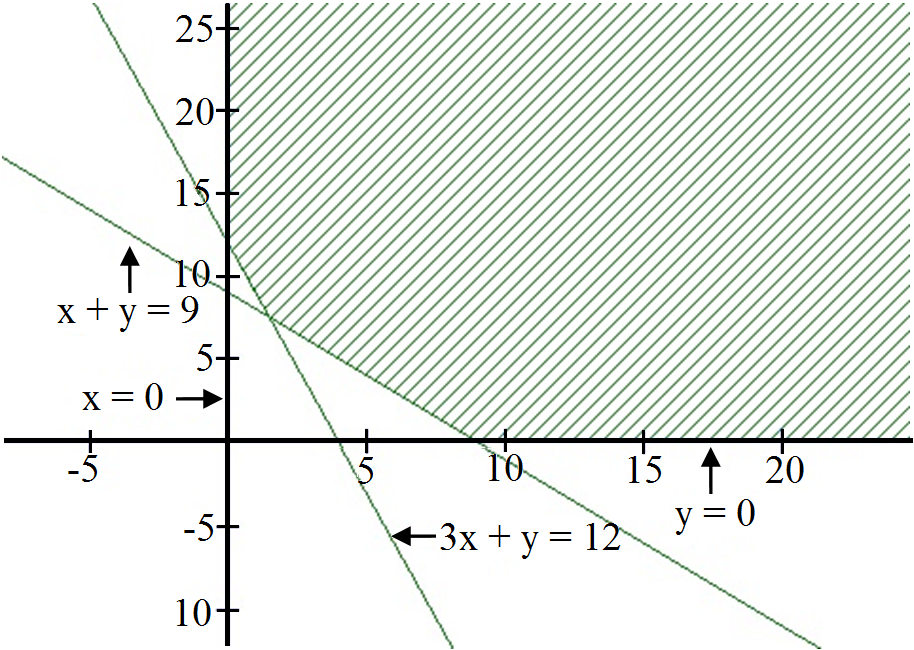
We have,
$\text{x}+\text{y}\geq9,3\text{x}+\text{y}\geq12,\text{x}\geq0,\text{y}\geq0.$
Converting the inequations into equations, we get
x + y = 9, 3x + y = 12, x = 0 and y = 0.
Region represented by $\text{x}+\text{y}\geq9.$
Putting x = 0 in x + y = 9, we get y = 9.
Putting y = 0 in x + y = 9, we get x = 9.
$\therefore$ The line x + y = 9 meets the coordinat axes at (0, 9) and (9, 0). Join these points by a thick line.
Now, putting x = 0 and y = 0 in $\text{x}+\text{y}\geq9.$ we get 0 9 This is not possible.
$\therefore$ We find that (0, 0) is not satisfies the inequation $\text{x}+\text{y}\geq9.$
So, the portion not containing the origin is represented by the given inequation.
Region represented by 3x + y > 12:
Putting x = 0 in 3x + y = 12, we get y = 12
Putting y = 0 in 3x + y = 12, we get $\text{x}=\frac{12}{3}=4$
$\therefore$ The line 3x + y = 12 meets the coordinate axes at (0, 12) and (4, 0). Joining these points by a thick line.
Now, putting x = 0 and y = 0 in $3\text{x}+\text{y}\geq12$ we get, $0\geq12$
This is not possible.
$\therefore$ We find that (0, 0) is not satisfies the inequation $3\text{x}+\text{y}\geq12.$ so the portion not containing the origin is represented by the given inequation.
Region represented by $\text{x}\geq0$ and $\text{y}\geq0$: clearly, $\text{x}\geq0$ and $\text{y}\geq0$ represent the first quadrant. View full question & answer→Question 254 Marks
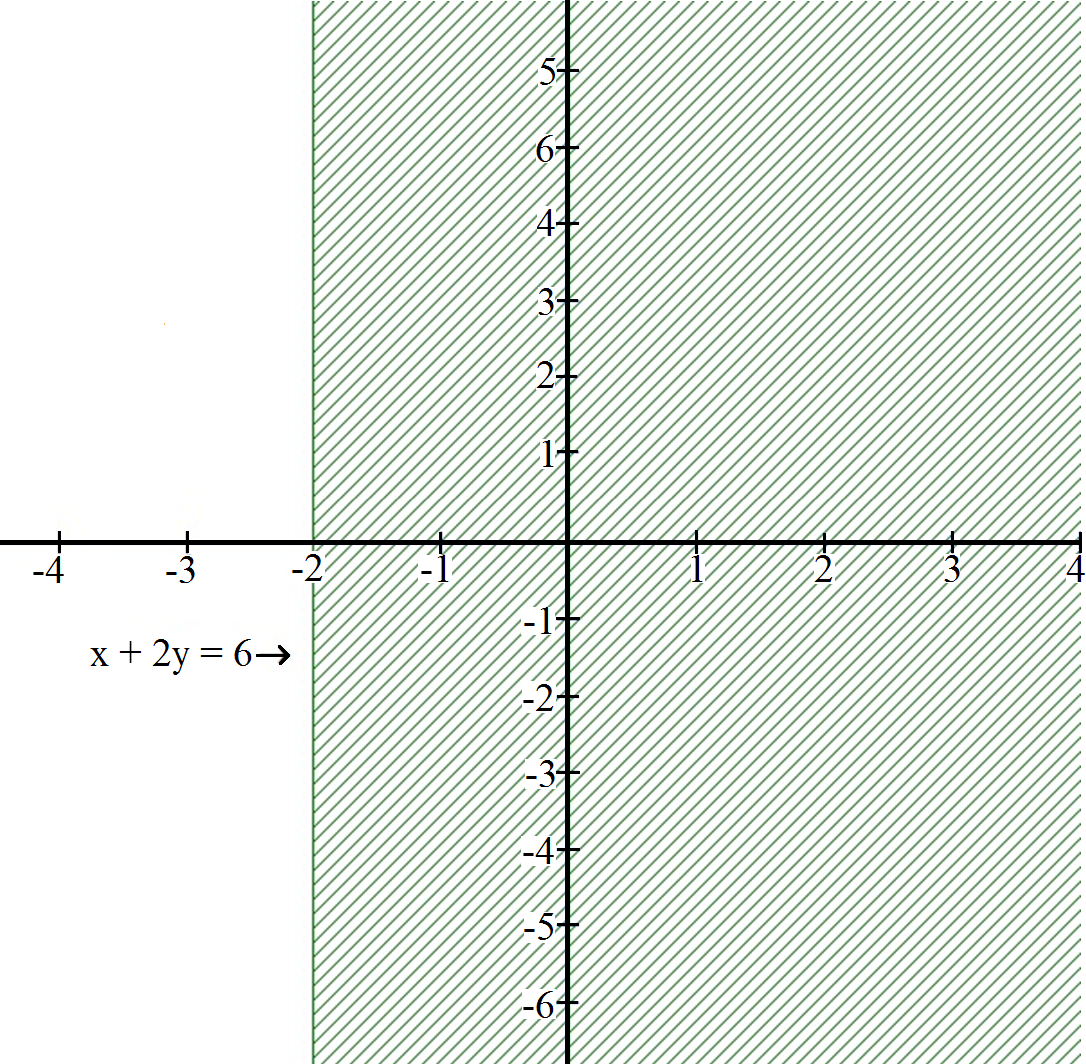
Represent to solution set of each of the following inequations graphically in two dimensional plane: $\text{x}+2\geq0$
AnswerWe have,
$\text{x}+2\geq0\ ...(\text{i})$
Converting the inequation into equation, we obtain, x = -2. Clearly, it is a line parallel to y-axis. This line divides the xy - plane in two parts. One part on the LHS of x = -2 and the other on its RHS.
Putting x = 0 in the inequation (i), we get $2\geq0$
we find that the point(0, 0) satisfies the inequality. So, the region represented by the given inequation is the shaded region shown below:
View full question & answer→Question 264 Marks
Solve the following system of equations in R. $2\text{x}+5\leq0,\text{x}-3\leq0$
AnswerConsider the first inequation, $2\text{x}+5\leq0$ $2\text{x}\leq-5$ $\text{x}\leq\frac{-5}{2}\ ...(\text{ii})$ Consider the secound inequation, $\text{x}-3\leq0$ $\text{x}\leq3\ ..(\text{ii})$ From (i) and (ii), $\Big(-\infty,\frac{-5}{2}\Big]$ is the solution of the simultaneous equations.
View full question & answer→Question 274 Marks
How many litres of water will have to be added to 1125 litres of the 45% solution of acid so that the resulting mixture will contain more than 25% but less than 30% acid content?
AnswerLet the quantity of water to be added to solution = x liters.
$\therefore$ 25% (1125 + x) < 45% of 1125
$\Rightarrow\frac{25}{100}(1125+\text{x})<\frac{45}{100}\times1125$
$\Rightarrow1125+\text{x}<\frac{45}{25}\times1125$
⇒ 1125 + x < 25 × 45
⇒ 1125 + x < 2025
⇒ x < 2025 - 1125
⇒ x < 900 ...(i)
and 45% of 1125 < 30% (1125 + x)
$\Rightarrow\frac{45}{100}\times1125<\frac{30}{100}(1125)+\text{x}$
$\Rightarrow\frac{45}{30}\times1125<1125+\text{x}$
$\Rightarrow\frac{3}{2}\times1125<1125+\text{x}$
⇒ 1.5 × 1125 < 1125 + x
⇒ 1687.5 < 1125 + x
⇒ 1687.5 - 1125 < x
⇒ 562.5 < x ...(ii)
using (i) and (ii), we get 562.5 < x < 900
hence, quantity of water lies between 562.5 liters and 900 Liters.
View full question & answer→Question 284 Marks
Solve the following system of equations in R. $\frac{|\text{x}-2|-1}{|\text{x}-2|-2}\leq0$
Answer$\frac{|\text{x}-2|-1}{|\text{x}-2|-2}\leq0$ Let $\text{y}=|\text{x}-2|$ $\Rightarrow\frac{\text{y}-1}{\text{y}-2}\leq0$ $\Rightarrow1\leq\text{y}<2 $ $\Rightarrow1\leq|\text{x}-2|<2$ $\Rightarrow\text{x}\in[-2+2,-1+2]\cup[1+2,2+2]$ $\Rightarrow\text{x}\in[0,1]\cup[3,4]$ The solution set is $[0,1]\cup[3,4].$
View full question & answer→Question 294 Marks
To receive grade 'A' in a course, one must obtain an average of 90 marks or more in five papers each of 100 marks. If Shikha scored 87, 95, 92 and 94 marks in first four paper, find the minimum marks that she must score in the last paper to get grade 'A' in the course.
AnswerSuppose shikha scores x marks in the fifth paper. Then,
$90\leq\frac{87+95+92+94+\text{x}}{5}$
$\Rightarrow90\times5\leq182+186+\text{x}$
$\Rightarrow450\leq368+\text{x}$
$\Rightarrow450-368\leq\text{x}$
$\Rightarrow82\leq\text{x}$
Hence, the maximum marks is required in the last paper is 82.
View full question & answer→Question 304 Marks
Solve the following system of equations in R. $|\text{x}-1|+|\text{x}-2|+|\text{x}-3|\geq6$
AnswerWe have, $|\text{x}-1|+|\text{x}-2|+|\text{x}-3|\geq6$ Case 1: $|\text{x}-1|\geq0$ $\text{x}\geq1$ $\Rightarrow\text{x}-1-(\text{x}-2)-(\text{x}-3)-6\geq0$ $\Rightarrow-\text{x}+4-6\geq0$ $\Rightarrow-\text{x}\geq2$ $\Rightarrow\text{x}\leq-2$ $\Rightarrow(-\infty,-2]\ ...(\text{ii})$ Case 2: $|\text{x}-2|\geq0$ $\Rightarrow\text{x}-1+\text{x}-2-(\text{x}-3)-6\geq0$ $\text{x}\geq6$ $\Rightarrow[6,\infty)\ ...(\text{ii})$ Case 3: When $|\text{x}-3|\geq0$ $\text{x}\geq3$ $\Rightarrow\text{x}-1+\text{x}-2+\text{x}-3-6\geq0$ $\Rightarrow3\text{x}-12\geq0$ $\Rightarrow3\text{x}\geq12$ $\Rightarrow\text{x}\geq4$ $\therefore\text{x}\in[4,\infty)$ Also $\Rightarrow|\text{x}-1|<0$ $\Rightarrow\text{x}<1$ $\Rightarrow-(\text{x}-1)-(\text{x}-2)-(\text{x}-3)-6\geq0$ $\Rightarrow-3\text{x}\geq0$ $\Rightarrow\text{x}\leq0$ $\Rightarrow|\text{x}-2|<0$ $\text{x}<2$ $\Rightarrow(\text{x}-1)-(\text{x}-2)-(\text{x}-3)-6\geq0$ $\Rightarrow\text{x}-1-\text{x}+2-\text{x}+3-6\geq0$ $\Rightarrow-\text{x}-2\geq0$ $\Rightarrow-\text{x}\geq2$ $\Rightarrow\text{x}\leq-2$ $\Rightarrow|\text{x}-3|<0$ $\Rightarrow\text{x}<3$ $\Rightarrow(\text{x}-1)+(\text{x}-2)-(\text{x}-3)-6\geq0$ $\Rightarrow\text{x}-6\geq0$ $\Rightarrow\text{x}\geq6 $ Combining all cases we get $(-\infty,0]\cup,[4,\infty)$ as the solution set.
View full question & answer→Question 314 Marks
Solve the following system of equations in R. $2\text{x}+6\geq0,4\text{x}-7<0$
AnswerConsider the first inequation, $2\text{x}+6\geq0$ $2\text{x}\geq-6$ $\text{x}\geq\frac{-6}{2}$ $\text{x}\geq-3\ ...(\text{i})$ Consider the secound inequation, 4x - 7 < 0 4x < 7 $\text{x}<\frac{7}{4}\ ...(\text{ii})$ From (i) and (ii), $\Big[-3,\frac{7}{4}\Big]$ is the solution of the simultaneous equations.
View full question & answer→Question 324 Marks
Solve the following system of equations in R. $|\text{x}+1|+|\text{x}|>3$
Answer$|\text{x}+1|+|\text{x}|>3$ Case 1: when $-\infty<\text{x}<-1$ |x + 1| = -(x + 1) and |x| = -x $\therefore$ |x + 1| + |x| > 3 ⇒ -(x + 1) - x > 3 ⇒ -2x > 4 ⇒ x < -2 But, $-\infty<\text{x}<-1$ $\therefore$ The solution set of the given inequation is $(-\infty,-2)$ Case 2: When $-1\leq\text{x}<0$ |x + 1| = (x + 1) and |x| = -x $\therefore$ |x +1| + |x| > 3 ⇒ (x + 1) - x > 3 ⇒ 1 > 3 Which is not true Case 3: when $0<\text{x}<\infty$ |x + 1| = (x + 1) and |x| = x $\therefore$ |x + 1| + |x| > 3 ⇒ (x + 1) + x > 3 ⇒ 2x > 2 ⇒ x > 1 But, $0<\text{x}<\infty$ $\therefore$ The solution set of the given inequation is $(1, \infty)$ Combining case 1, case 2 and case , we obtain that the solution set of given in equality is $(-\infty,-2)\cup(1,\infty)$
View full question & answer→Question 334 Marks
Solve the following system of equations in R. $\Big|\frac{3\text{x}-4}{2}\Big|\leq\frac{5}{12}$
AnswerWe have, $\Big|\frac{3\text{x}-4}{2}\Big|\leq\frac{5}{12}\leq0$ Case 1: when $|3\text{x}-4|\geq0$ $\frac{|3\text{x}-4|}{}-\frac{5}{12}\leq0$ $\Rightarrow\frac{|3\text{x}-4|}{2}-\frac{5}{12}\leq0$ $\Rightarrow\frac{6(3\text{x}-4)-5}{12}\leq0$ $\Rightarrow18\text{x}-24-5\leq0$ $\Rightarrow18\text{x}-29\leq0$ $\Rightarrow\text{x}\leq\frac{29}{18}\ ...(\text{ii})$ Case 2: when |3x - 4| < 0 $\frac{|3\text{x}-4|}{2}-\frac{5}{12}\leq0$ $\Rightarrow-6(3\text{x}-4)-5\leq0$ $\Rightarrow-18\text{x}+24-5\leq0$ $\Rightarrow-18\text{x}+19\leq0$ $\Rightarrow-18\text{x}\geq19 $ $\Rightarrow\text{x}\geq\frac{19}{18}\ ...(\text{iii})$ Combining (ii) and (iii) to get solution set as $\Big(\frac{19}{18},\frac{29}{18}\Big)$
View full question & answer→Question 344 Marks
Solve the following system of equations in R. $\frac{1}{|\text{x}|-3}<\frac{1}{2}$
AnswerWe have, $\frac{1}{|\text{x}|-3}-\frac{1}{2}<0\ ...(\text{i})$ Case 1: when $|\text{x}|\geq0\Rightarrow\text{x}\geq0$ $\Rightarrow\frac{1}{\text{x}-3}-\frac{1}{2}<0$ $\Rightarrow\frac{2-(\text{x}-3)}{2(\text{x}-3)}<0$ $\Rightarrow\frac{2-\text{x}+3}{2\text{x}-6}<0$ $\Rightarrow\frac{-\text{x}+5}{2\text{x}-6}<0$ $\Rightarrow\text{x}+5<0$ $\Rightarrow-\text{x}<-5$ $\Rightarrow\text{x}>5\ ...(\text{ii})$ Case2: when |x| < 0, x < 0 $\Rightarrow\frac{1}{-\text{x}-3}-\frac{1}{2}<0$ $\Rightarrow\frac{2-(-\text{x}-3)}{2(-\text{x}-3)}<0$ $\Rightarrow2+\text{x}+3<0$ $\Rightarrow\text{x}+5<0$ $\Rightarrow\text{x}<-5\ ...(\text{iii})$ Combining (ii) and (iii) we get $(-\infty,-5)\cup(-3,3)\cup(5,\infty)$ as the solution set.
View full question & answer→