Question
Show that the vector addition is associative.
OR
Show that $(\vec{\text{A}}+\vec{\text{B}})+\vec{\text{C}}=\vec{\text{A}}+(\vec{\text{B}}+\vec{\text{C}}).$OR
Show that $(\vec{\text{A}}+\vec{\text{B}})+\vec{\text{C}}=\vec{\text{A}}+(\vec{\text{B}}+\vec{\text{C}}).$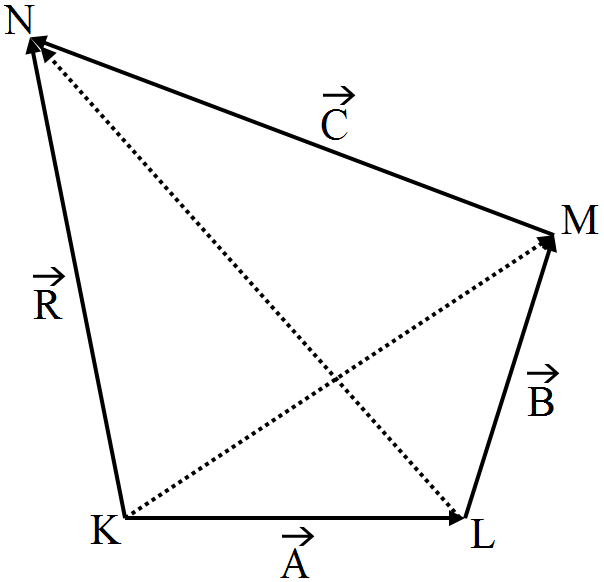
To show that vector addition is associative, we consider addition of three vectors $\vec{\text{A}},\vec{\text{B}}$ and $\vec{\text{C}}$ in two different manners. Let us first add $\vec{\text{A}}$ and $\vec{\text{B}}$ to obtain a vector
$\overrightarrow{\text{KM}}$ and then add $\vec{\text{C}}$ to it so as to get the resultant vector $\overrightarrow{\text{KN}}.$ It means that$(\vec{\text{A}}+\vec{\text{B}})+\vec{\text{C}}=\overrightarrow{\text{KN}}=\vec{\text{R}}\dots(\text{i})$
Again we add $\vec{\text{B}}$ and $\vec{\text{C}}$ to obtain a vector $\overrightarrow{\text{LN}}.$ Now to vector $\vec{\text{A}}$ add $\overrightarrow{\text{LN}}$ so as to get a resultant $\overrightarrow{\text{KN}}=\vec{\text{R}}$ as shown in Fig. It means that,
$(\vec{\text{A}})+(\vec{\text{B}}+\vec{\text{C}})=\overrightarrow{\text{KL}}+\overrightarrow{\text{LN}}=\overrightarrow{\text{KN}}=\vec{\text{R}}\dots(\text{ii})$
From (i) and (ii), it is clear that,
$(\vec{\text{A}}+\vec{\text{B}})+\vec{\text{C}}=\vec{\text{A}}+(\vec{\text{B}}+\vec{\text{C}})$
That is the vector addition is associative.
Generate a complete, print-ready paper with questions like this in minutes — across 16+ boards, with answer keys.