Question
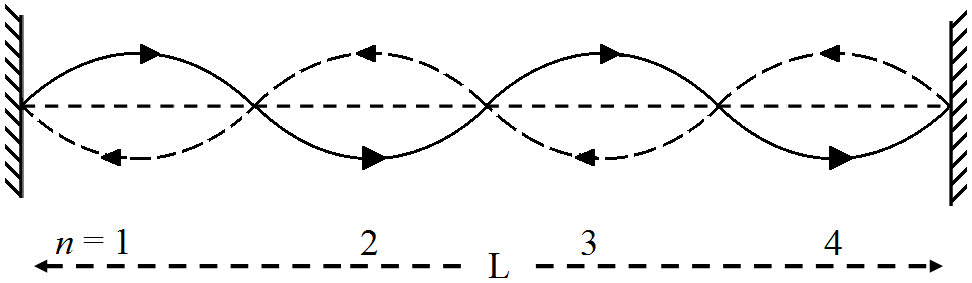
Show that when a string fixed at its two ends vibrates in 1 loop, 2 loops, 3 loops and 4 loops, the frequencies are in the ratio 1 : 2 : 3 : 4.

Answer

​​​​Let n be the number of loop in the string.

The length of each loop is $\frac{\lambda}{2}$

$\therefore\text{L}=\frac{\text{n}\lambda}{2}$ or $\lambda=\frac{2\text{L}}{\text{n}}$
$\text{v}=\text{v}\lambda$ and $\lambda=\frac{\upsilon}{\text{v}}.$

so $\frac{\upsilon}{\text{v}}=\frac{2\text{L}}{\text{n}}$

$\text{v}=\frac{\text{n}}{2\text{L}}.\text{v}$ v is stretch string $=\sqrt{\frac{\text{T}}{\text{m}}}$

$\therefore\text{v}=\frac{\text{n}}{2\text{L}}\sqrt{\frac{\text{T}}{\text{m}}}$

For n =1, $\text{v}_1=\frac{1}{2\text{L}}\sqrt{\frac{\text{T}}{\text{m}}}=\text{v}_0$

If n = 2 then $\text{v}_2=\frac{2}{2\text{L}}\sqrt{\frac{\text{T}}{\text{m}}}=2\text{v}_0$

n = 3 then $\text{v}_3=\frac{3}{2\text{L}}\sqrt{\frac{\text{T}}{\text{m}}}=3\text{v}_0$

$\therefore\text{v}_1:\text{v}_2:\text{v}_3:\text{v}_4:=\text{n}_1:\text{n}_2:\text{n}_3:\text{n}_4:=1:2:3:4$

Need a full question paper?

Generate a complete, print-ready paper with questions like this in minutes — across 16+ boards, with answer keys.
Start Generating Free

Similar questions

An ideal gas is kept in a long cylindrical vessel fitted with a frictionless piston of cross-sectional area 10cmand weight 1kg. The length of the gas column in the vessel is 20cm. The atmospheric pressure is 100kPa. The vessel is now taken into a spaceship revolving round the earth as a satellite. The air pressure in the spaceship is maintained at 100kPa. Find the length of the gas column in the cylinder.
A boy's catapult is made of a rubber cord 42cm long and 6mm in diameter. The boy stretches the cord by 20cm. Find the Young's modulus of the rubber if a stone weighing 0.02kg when catapulted flies with a velocity of 20ms-1. Disregard the change in the cross-section of the cord in stretching.
A cylindrical log of wood of height $h$ and area of cross-section A floats in a liquid. It is pressed and then released. Show that the log would execute S.H.M. with a time period.
$
T=2 \pi \sqrt{\frac{m}{A \rho g}}
$
Where $m$ is mass of the body and $\rho$ is the density of the liquid.
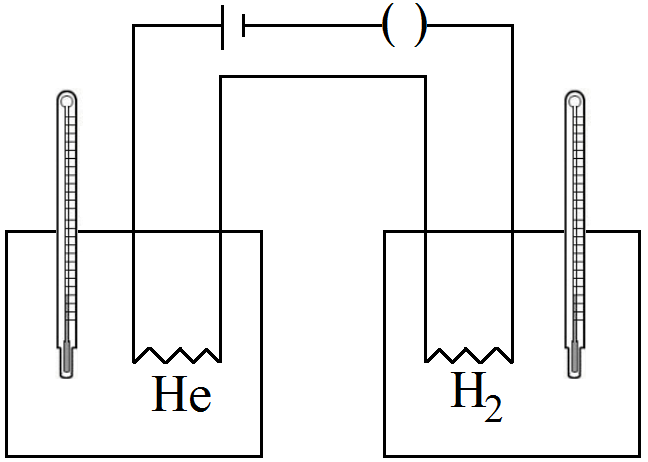
The figure shows two vessels with adiabatic walls, one containing 0.1g of helium $\big(\gamma=1.67,\text{M}=4\text{g-mol}^{-1}\big)$ and the other containing some amount of hydrogen $\big(\gamma=1.4,\text{M}=2\text{g-mol}^{-1}\big).$ Initially, the temperatures of the two gases are equal. The gases are electrically heated for some time during which equal amounts of heat are given to the two gases. It is found that the temperatures rise through the same amount in the two vessels. Calculate the mass of hydrogen.

Earth’s orbit is an ellipse with eccentricity 0.0167. Thus, earth’s distance from the sun and speed as it moves around the sun varies from day to day. This means that the length of the solar day is not constant through the year. Assume that earth’s spin axis is normal to its orbital plane and find out the length of the shortest and the longest day. A day should be taken from noon to noon. Does this explain variation of length of the day during the year?
Calculate the number of degrees of freedom of molecules of hydrogen in 1cc of hydrogen gas at NTP.
Write the three laws of thermodynamics (i.e. zeroth law, first law and second law) then explain their importance.
Consider a mass 'm' attached to a string of length 'l' performing vertical circle. Find an expression for the,
  1. Velocity at any point.
  2. Tension at any point.
  3. Velocity minimum at the lower-most point for a vertical circle.
Find the time period of mass M when displaced from its equilibrium positon and then released for the system shown in figure.
Consider that an ideal gas (n moles) is expanding in a process given by P = f( V ), which passes through a point (V0, P0 ). Show that the gas is absorbing heat at (P0, V0 ) if the slope of the curve P = f(V ) is larger than the slope of the adiabat passing through (P0, V0 ).