Question

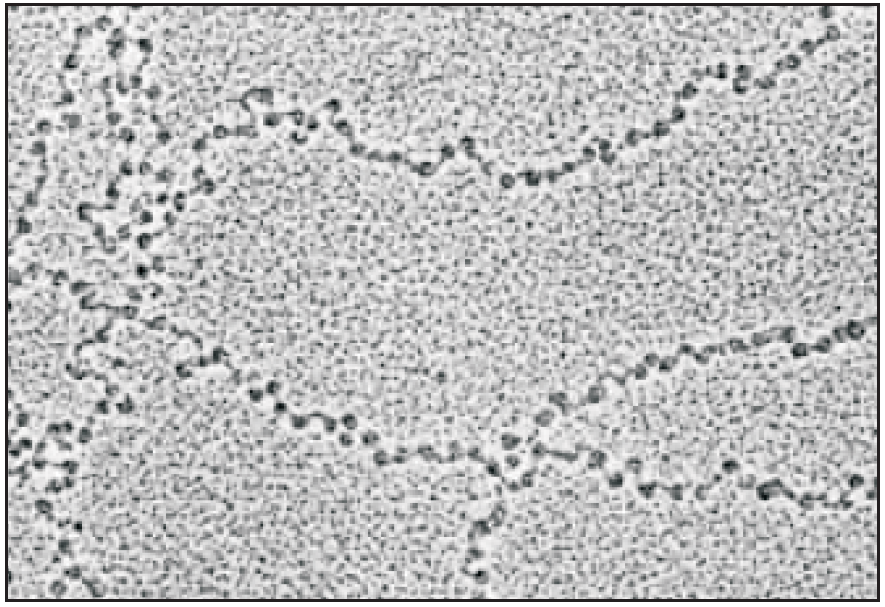
Shown above is the electron micrograph (EM) picture of 'beads-on-string'.
  1. Identify and explain the detailed structure of a bead with the help of a labelled diagram.
  2. Describe the packaging of 'beads-on-string'in a eukaryotic cell.

Answer

  1. The bead-like structures are the nucleosomes:
  1. There is a set of positively charged proteins, called histones, rich in basic amino acid residues, lysine and arginine.
  2. Histones are organised to form a unit of eight molecules, called histone octamer.
  3. The negatively charged DNA is wrapped around the positively charged histone octamer, to form a nucleosome; a nucleosome contains 200 bp of DNA helix.
  1.  
  1. The nucleosomes form the repeating units of the chromatin fibre in the nucleus; these nucleosomes of a chromatin are seen as the beads-on-string structure under electron microscope.
  2. The chromatin fibres are further coiled and condensed at metaphase stage to form the chromosomes.
  3. The packaging of chromatin at higher levels requires another set of proteins, called non histone chromosomal (NHC) proteins.

Need a full question paper?

Generate a complete, print-ready paper with questions like this in minutes — across 16+ boards, with answer keys.
Start Generating Free

Similar questions

What is tissue culture? What are the different types of tissue culture? Describe briefly.###Write an essay on tissue culture.
One of the main objectives of biotechnology is to minimise the use of insecticides on cultivated crops. Explain with the help of a suitable example how insect resistant crops have been developed using techniques of biotechnology.
Write the blood group of people with genotype IAIB. Give reasons in support of your answer.
State the laws of inheritance that can be derived from such a cross.
For selection of recombinants, insertional inactivation of antibiotic marker has been superceded by insertional inactivation of a marker gene coding for a chromogenic substrate. Give reasons.
a. Where is microsporangium located in an angiosperm? State the functions of tapetum and the other three layers of microsporangium.
b. Describe the structure of the male gametophyte produced as a result of microsporogenesis.
c. State the functions of each part of the male gametophyte.
Read the following and answer any four questions from (i) to (v) given below:
Apomixis is a mode of reproduction which does not involve formation of zygote through gametic fusion. In plants, apomixis commonly mimics sexual reproduction but produces seeds without fertilization. There are several methods of atomistic development in seeds. Thee two common ones are recurrent agamospermy and advective embryony.
  1. Apomixis is a type of reproduction in plants, in which?
  1. Fertilization does not take place.
  2. Male nucleus takes part in fertilization.
  3. Pollen fusion takes place.
  4. Generative nucleus takes part in fertilization.
  1. Which of the following statements is incorrect regarding recurrent agamospermy?
  1. It is the formation of seed that has an embryo formed without meiosis and syngamy.
  2. All the cells of embryo sac are diploid.
  3. An embryo develops directly from a diploid cell other than egg like that of nucleus and integument.
  4. None of these.
  1. Adventive embryony is found in:
  1. Citrus.
  2. Opuntia.
  3. Apple.
  4. Both (a) and (b).
  1. Formation of embryo directly from diploid egg without fertilization is called:
  1. Apospory.
  2. Diplospory.
  3. Polyembryony.
  4. Diploid parthenogenesis.
  1. If any somatic cell of sporophyte produces gametophyte without reduction division, it is called:
  1. Parthenogenesis.
  2. Apogamy.
  3. Apospory.
  4. Amphimixis.
Explain the causes, inheritance pattern, symptoms of two Mendelian genetic disorders.
Study the illustration given and answer the questions that follow:

Explain the role of hormones in the formation and release of ‘a’.

i. Describe the arrangement of nuclei and cells in a mature embryo sac of a typical angiosperm.
ii. Explain the devices the flowering plants have developed to prevent the following types of pollination:
1. Prevents both autogamy and geitonogamy
2. Prevents autogamy, but not geitonogamy