MCQ
Shown here are the velocities and acceleration vectors for a man in several different types of motion. In which case is the man slowing down and turning to the right
  • A


  • C

  • D

Answer

Correct option: B.

b
As the man is slowing down therefore, the acceleration component should be opposite to the velocity. so, the angle between velocity vector and acceleration vector should be obtuse.

As the man is turning to the right therefore, the acceleration vector component should be towards the left side.

 Thus, the correct option is $B.$

Need a full question paper?

Generate a complete, print-ready paper with questions like this in minutes — across 16+ boards, with answer keys.
Start Generating Free

Similar questions

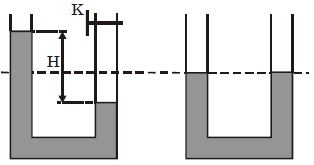
A $U$ -tube of small and uniform cross section contains water of total length $4H$. The height difference between the water columns on the left and on the right is $H$ when the valve $K$ is closed. The valve is suddenly open, and water is flowing from left to right. Ignore friction. The speed of water when the heights of the left and the right water columns are the same, is :-
When stopping potential is applied in an experiment on photoelectric effect, no photocurrent is observed. This means that:
  1. The emission of photoelectrons is stopped.
  2. The photoelectrons are emitted but are reabsorbed by the emitter metal.
  3. The photoelectrons are accumulated near the collector plate.
  4. The photoelectrons are dispersed from the sides of the apparatus.
A man of mass $m$ starts falling towards a planet of mass $M$ and radius $R$. As he reaches near to the surface, he realizes that he will pass through a small hole in the planet. As he enters the hole, he sees that the planet is really made of two pieces a spherical shell of negligible thickness of mass $2 M / 3$ and a point mass $M / 3$ at the centre. Change in the force of gravity experienced by the man is
Maximum value of static friction is called
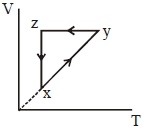
A thermodynamic cycle $xyzx$ is shown on a $V-T$ diagram.

The $P-V$ diagram that best describes this cycle is

(Diagrams are schematic and not to scale)
If $\vec{A}$ and $\vec{B}$ are two vectors satisfying the relation $\vec{A} . \vec{B}=[\vec{A} \times \vec{B}]$. Then the value of $[\vec{A}-\vec{B}]$. will be :
A piece of marble is projected from earth's surface with velocity of $19.6 \sqrt{2}\,m / s$ at $45^{\circ}.$ $2\,s$ later its velocity makes an angle $\alpha$ with horizontal, where $\alpha$ is $..........$
A body of mass $5\,kg$ strikes another body of mass $2.5\,kg$ initially at rest. The bodies after collision coalesce and begin to move as a whole with a kinetic energy of $5\,J$. The kinetic energy of the first body before collision is ............... $\mathrm{J}$
A body starts from rest on a long inclined plane of slope $45^o$ . The coefficient of friction between the body and the plane varies as $\mu = 0.3\,x$ . where $x$ is distance travelled down the plane. The body will have maximum speed ( for $g = 10\,m/s^2$ ) when $x=$  ........ $m$
Which of the following quantities is zero, when a uniform object is being supported at its centre of gravity?