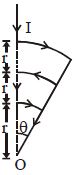
Shown in the figure is a conductor carrying a current $I$. The magnetic field intensity at the point $O$ (common centre of all the three arcs) is
Medium


Download our appand get started for free
Experience the future of education. Simply download our apps or reach out to us for more information. Let's shape the future of learning together!No signup needed.*
Similar Questions
- 1View SolutionA coil of one turn is made of a wire of certain length and then from the same length a coil of two turns is made. If the same current is passed in both the cases, then the ratio of the magnetic inductions at their centres will be
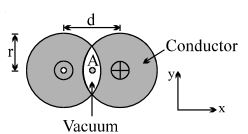
- 2Two long conductors are arranged as shown above to form overlapping cylinders, each of raidus $r$, whose centers are separated by a distance $d$. Current of density $J$ flows into the plane of the page along the shaded part of one conductor and an equal current flows out of the plane of the page along the shaded portion of the other, as shown. What are the magnitude and direction of the magnetic field at point $A?$View Solution
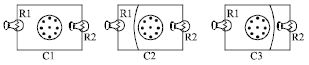
- 3A solenoid is oriented end-on so that its opening is perpendicular to the circuit containing the two light bulbs as drawn in figure $C_1.$ For figure $C_2$ and $C_3,$ a shorting wire of negligible resistance is added as shown. Assume that the magnetic field from the solenoid, shown coming out of the plane of the page, decreases uniformly with time at the same rate for each circuit. Rank the circuits for the brightness of the bulb labeled $R_1$ from brightest to dimmest.View Solution
- 4View SolutionA current carrying rectangular coil is placed in a uniform magnetic field. In which orientation, the coil will not tend to rotate
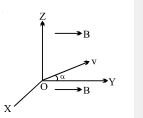
- 5In a region of space, a uniform magnetic field $B$ exists in the $y-$direction.Aproton is fired from the origin, with its initial velocity $v$ making a small angle $\alpha$ with the $y-$ direction in the $yz$ plane. In the subsequent motion of the proton,View Solution
- 6Two moving coil meters $M_1$ and $M_2$ having the following particulars :-View Solution
$R_1 = 10\,\Omega , N_1 = 30, A_1 = 3.6\times10^{-3}\, m^2, B_1 = 0.25\, T$
$R_2 = 14\,\Omega , N_2 = 42, A_2 = 1.8\times10^{-3}\, m^2, B_2 = 0.50\, T$
(The spring constants are identical for the two meters). Determine the ratio of voltage sensitivity of $M_2$ and $M_1$ - 7A circular coil of radius $4\, cm$ has $50$ $turns$. In this coil a current of $2\, A$ is flowing. It is placed in a magnetic field of $0.1$ $weber/{m^2}$. The amount of work done in rotating it through $180^\circ $ from its equilibrium position will be........$J$View Solution
- 8A coil in the shape of an equilateral triangle of side $10\, {cm}$ lies in a vertical plane between the pole pieces of permanent magnet producing a horizontal magnetic field $20\, {mT}$. The torque acting on the coil when a current of $0.2\, {A}$ is passed through it and its plane becomes parallel to the magnetic field will be $\sqrt{{x}} \times 10^{-5} \,{Nm}$. The value of ${x}$ is ..... .View Solution
- 9A particle moving with velocity v having specific charge $(q/m)$ enters a region of magnetic field $B$ having width $d=\frac{{3mv}}{{5qB}}$ at angle $53^o$ to the boundary of magnetic field. Find the angle $\theta$ in the diagram......$^o$View Solution

- 10Two circular coils $1$ and $2$ are made from the same wire but the radius of the $1^{st}$ coil is twice that of the $2^{nd}$ coil. What is the ratio of potential difference in volts should be applied across them so that the magnetic field at their centres is the same?View Solution