Two moving coil meters $M_1$ and $M_2$ having the following particulars :-
$R_1 = 10\,\Omega , N_1 = 30, A_1 = 3.6\times10^{-3}\, m^2, B_1 = 0.25\, T$
$R_2 = 14\,\Omega , N_2 = 42, A_2 = 1.8\times10^{-3}\, m^2, B_2 = 0.50\, T$
(The spring constants are identical for the two meters). Determine the ratio of voltage sensitivity of $M_2$ and $M_1$
$R_1 = 10\,\Omega , N_1 = 30, A_1 = 3.6\times10^{-3}\, m^2, B_1 = 0.25\, T$
$R_2 = 14\,\Omega , N_2 = 42, A_2 = 1.8\times10^{-3}\, m^2, B_2 = 0.50\, T$
(The spring constants are identical for the two meters). Determine the ratio of voltage sensitivity of $M_2$ and $M_1$
Medium


Download our appand get started for free
Experience the future of education. Simply download our apps or reach out to us for more information. Let's shape the future of learning together!No signup needed.*
Similar Questions
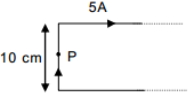
- 1Find force per unit length at $P$.View Solution
- 2View SolutionA current loop in a magnetic field
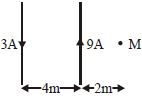
- 3Magnetic field at point $'M'$ of given current distributionView Solution
- 4The coil in a moving coil Galvanometer experiences torque proportional to current passed through it. If a steady current $i$ is passed through it the deflection of the coil is found to be $90^o$ . Now the steady current is switched off and a charge $Q$ is suddenly passed through the coil. If the coil has $N$ turns of area $A$ each and its moment of inertia is $I$ about the axis it is going to rotate then the maximum angle through which it deflects upon passing $Q$ isView Solution
- 5An ion beam of specific charge $5 \times 10^7$ $coulomb/kg$ enter a uniform magnetic field of $4 \times 10^{-2}\, tesla$ with a velocity $2 \times 10^5\, m/s$ perpendicularly. The radius of the circular path of ions in meter will beView Solution
- 6In toroid magnetic field on axis will be the radius $=0.5\, cm ,$ current $=1.5\, A ,$ turns $=250,$ permeability $=700$ (in Tesla)View Solution
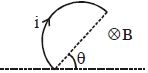
- 7A semicircular ring of radius $R$ carrying current $i$ is placed in a magnetic field of intensity $B$ so that plane of wire is perpendicular to magnetic field as shown. Net force acting on the ring isView Solution
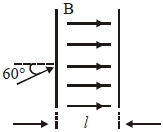
- 8The figure shows a region of length $'l'$ with a uniform magnetic field of $0.3\, T$ in it and a proton entering the region with velocity $4 \times 10^{5}\, ms ^{-1}$ making an angle $60^{\circ}$ with the field. If the proton completes $10$ revolution by the time it cross the region shown, $l$ is close to....... $m$View Solution
(mass of proton $=1.67 \times 10^{-27} \,kg ,$ charge of the proton $\left.=1.6 \times 10^{-19}\, C \right)$
- 9View SolutionThe phosphor bronze strip is used in a moving coil galvanometer because
- 10Two very long, straight and parallel wires carry steady currents $I$ and $I$ respectively. The distance between the wires is $d$. At a certain instant of time, a point charge $q$ is at a point equidistant from the two wires in the plane of the wires. Its instantaneous velocity $v$ is perpendicular to this plane. The magnitude of the force due to the magnetic field acting on the charge at this instant isView Solution