Shown in the figure is a semicircular metallic strip that has thickness $t$ and resistivity $\rho$. Its inner radius is $R_1$ and outer radius is $R_2$. If a voltage $V_0$ is applied between its two ends, a current $I$ flows in it. In addition, it is observed that a transverse voltage $\Delta V$ develops between its inner and outer surfaces due to purely kinetic effects of moving electrons (ignore any role of the magnetic field due to the current). Then (figure is schematic and not drawn to scale)-
$(A)$ $I =\frac{V_0 t}{\pi \rho} \ln \left(\frac{R_2}{R_1}\right)$
$(B)$ the outer surface is at a higher voltage than the inner surface
$(C)$ the outer surface is at a lower voltage than the inner surface
$(D)$ $\Delta V \propto I ^2$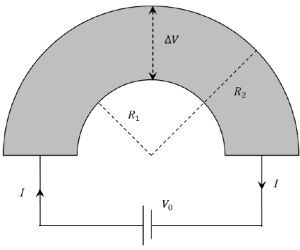
IIT 2020, Advanced
Download our app for free and get started
All the elements are in parallel
$\therefore \int \frac{1}{ dr }=\int_{ R _1}^{ R _2} \frac{ tdx }{\rho \pi x }$
$\frac{1}{ r }=\frac{ t }{\pi \rho} \ln \left(\frac{ R _2}{ R _1}\right)$
$\text { Resistance }=\frac{\pi \rho}{ t \ln \left(\frac{ R _2}{ R _1}\right)}$
$i=\frac{ V _0 t \ln \left(\frac{ R _2}{ R _1}\right)}{\pi \rho}$
$(-e $$\overrightarrow{ E }$ ) will be inward direction in order to provide centripetal acceleration. Therefore electric field will be radially outward
$V_{\text {outer }} < V_{\text {inmer }}$ ($C$)
$E =\frac{ m V_d^2}{ qr } \quad\left( I = meAV _{ d } \Rightarrow V _{ d } \propto i \right)$
$\Delta V =\int \overrightarrow{ E } \cdot \overrightarrow{ dr }$
$\Delta V \propto V _{ d }^2$
$\Delta V \propto I ^2$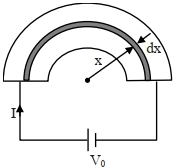

Download our appand get started for free
Experience the future of education. Simply download our apps or reach out to us for more information. Let's shape the future of learning together!No signup needed.*
Similar Questions
- 1When a positive $q$ charge is taken from lower potential to a higher potential point, then its potential energy willView Solution
- 2View SolutionIn a charged capacitor, the energy resides
- 3View SolutionAssertion : The electrostatic force between the plates of a charged isolated capacitor decreases when dielectric fills whole space between plates.
Reason : The electric field between the plates of a charged isolated capacitance increases when dielectric fills whole space between plates.
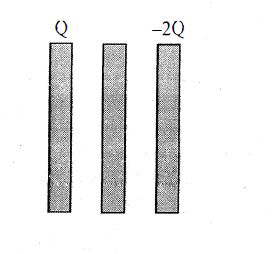
- 4The identical metal plates with large surface areas are kept parallel to each other as shown in figure. The left most plate is given a charge $Q$ , the rightmost a charge $-2Q$ and the middle one remains neutral. Find the charge appearing on the outer surface of the rightmost plateView Solution
- 5A parallel plate capacitor with a dielectric slab completely occupying the space between the plates is charged by a battery and then disconnected. The slab is pulled out with a constant speed. Which of the following curves represent qualitatively the variation of the capacitance $C$ of the system with time?View Solution
- 6Charge of $2Q$ and $-Q$ are placed on two plates of a parallel plate capacitor. If capacitance of capacitor is $C$, potential difference between the plates isView Solution
- 7A $16\ \Omega$ wire is bend to form a square loop. A $9 \mathrm{~V}$ battery with internal resistance $1\ \Omega$ is connected across one of its sides. If a $4\ \mu \mathrm{F}$ capacitor is connected across one of its diagonals, the energy stored by the capacitor will be $\frac{x}{2} \ \mu \mathrm{J}$. where $x=$________.View Solution
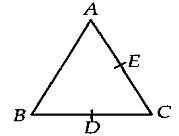
- 8Three charges, each $+q,$ are placed at the comers of an isosceles triangle $ABC$ of sides $BC$ and $AC, 2a.$ $D$ and $E$ are the mid-points of $BC$ and $CA.$ The work done in taking a charge $Q$ from $D$ to $E$ isView Solution
- 9The capacity and the energy stored in a parallel plate condenser with air between its plates are respectively ${C_o}$ and ${W_o}$. If the air is replaced by glass (dielectric constant $= 5$ ) between the plates, the capacity of the plates and the energy stored in it will respectively beView Solution
- 10A capacitor of $4\, \mu F$ is connected to a $15\, V$ supply through $1$ mega ohm resistance. The time taken by the capacitor to charge upto $63.2\%$ of its final charge will be......$s$View Solution