Question
Let x = f(t) and y = g(t) be parametric forms with t as a parameter, then
$\frac{\text{dy}}{\text{dx}}=\frac{\text{dy}}{\text{dt}}\times\frac{\text{dt}}{\text{dx}}=\frac{\text{g}'(\text{t})}{\text{f}'(\text{t})},$ where $\text{f}'(\text{t})\neq0.$
On the basis of above information, answer the following questions.
  1. The derivative of $\text{f}(\tan\text{x})\text{w.r.t.}\text{ g}(\sec\text{x})\text{ at}\text{ x}=\frac{\pi}{4},$ where f'(1) = 2 and $\text{g}'(\sqrt{2})=4,$ is:
  1. $\frac{1}{\sqrt{2}}$
  2. ${\sqrt{2}}$
  3. 1
  4. 0
  1. The derivative of $\sin^{-1}\Big(\frac{2\text{x}}{1+\text{x}^2}\Big)$ with respect to $\cos^{-1}\Big(\frac{1-\text{x}^2}{1+\text{x}^2}\Big)$ is:
  1. -1
  2. 1
  3. 2
  4. 4
  1. The derivative of $\text{e}^{\text{x}^3}$ with respect to log x is:
  1. $\text{e}^{\text{x}^3}$
  2. $3\text{x}^22\text{e}^{\text{x}^3}$
  3. $3\text{x}^3\text{e}^{\text{x}^3}$
  4. $3\text{x}^2\text{e}^{\text{x}^3}+3\text{x}$
  1. The derivative of $\cos^{-1}(2\text{x}^2-1)\text{w.r.t.}\cos^{-1}\text{x}$ is:
  1. $2$
  2. $\frac{-1}{2\sqrt{1-\text{x}^2}}$
  3. $\frac{2}{\text{x}}$
  4. $1-\text{x}^2$
  1. If $\text{y}=\frac{1}{4}\mu^4$ and $\mu=\frac{2}{3}\text{x}^3+5,$ then $\frac{\text{dy}}{\text{dx}}=$
  1. $\frac{2}{27}\text{x}^2(2\text{x}^3+15)^3$
  2. $\frac{2}{7}\text{x}^2(2\text{x}^3+15)^3$
  3. $\frac{2}{27}\text{x}(2\text{x}^3+5)^3$
  4. $\frac{2}{7}(2\text{x}^3+15)^3$

Answer

  1. (a) $\frac{1}{\sqrt{2}}$
Solution:
Now, $\frac{\text{df}(\tan\text{x})}{\text{dg}(\sec\text{x})}=\frac{\text{f}'(\tan \text{x})\sec^2\text{x}}{\text{g}'(\sec\text{x})\sec\text{x}\tan \text{x}}$
$=\frac{\text{f}'(\tan \text{x})\sec\text{x}}{\text{g}'(\sec\text{x})\tan \text{x}}$
$\therefore\Big[\frac{\text{df}(\tan\text{x})}{\text{dg}(\sec\text{x})}\Big]_{\text{x}=\frac{\pi}{4}}=\frac{\text{f}'(1)\sqrt{2}}{\text{g}'(\sqrt{2})\cdot1}=\frac{2\sqrt{2}}{4\cdot1}=\frac{1}{\sqrt{2}}$
  1. (b) 1
  1. (c) $3\text{x}^3\text{e}^{\text{x}^3}$
Solution:
Let $\text{y}=\text{e}^{\text{x}^3},\text{z}=\log\text{x}$
Differentiating w.r.t. x, we get
$\frac{\text{dy}}{\text{dx}}=\text{e}^{\text{x}^3}(3\text{x}^2)=3\text{x}^2\text{e}^{\text{x}^3}$ and $\therefore\frac{\text{dy}}{\text{dz}}=\frac{\frac{\text{dy}}{\text{dx}}}{\frac{\text{dz}}{\text{dx}}}=\frac{3\text{x}^2\text{e}^{\text{x}^3}}{\Big(\frac{1}{\text{x}}\Big)}=3\text{x}^3\text{e}^{\text{x}^3}$
  1. (a) $2$
Solution:
Let $\text{y}=\cos^{-1}(2\text{x}^2-1)=2\cos^{-1}\text{x}$
Differentiating w.r.t. $\cos^{-1}\text{x},$ we get
$\frac{\text{dy}}{\text{d}(\cos^{-1}\text{x})}=\frac{2\text{d}(\cos^{-1}\text{x})}{\text{d}(\cos^{-1}\text{x})}=2$
  1. (a) $\frac{2}{27}\text{x}^2(2\text{x}^3+15)^3$
Solution:
We have, $\text{y}=\frac{1}{4}\text{u}^4\Rightarrow\frac{\text{dy}}{\text{du}}=\frac{1}{4}\cdot4\text{u}^3=\text{u}^3$
and $\text{u}=\frac{2}{3}\text{x}^3+5\Rightarrow\frac{\text{du}}{\text{dx}}=\frac{2}{3}\cdot3\text{x}^2=2\text{x}^2$
$\therefore\frac{\text{dy}}{\text{dx}}=\frac{\text{dy}}{\text{du}}\cdot\frac{\text{du}}{\text{dx}}=\text{u}^3\cdot2\text{x}^2=\Big(\frac{2}{3}\text{x}^3+5\Big)^3(2\text{x})^2$
$=\frac{2}{27}\text{x}^2(2\text{x}^3+15)^3$

Need a full question paper?

Generate a complete, print-ready paper with questions like this in minutes — across 16+ boards, with answer keys.

Start Generating Free

Similar questions

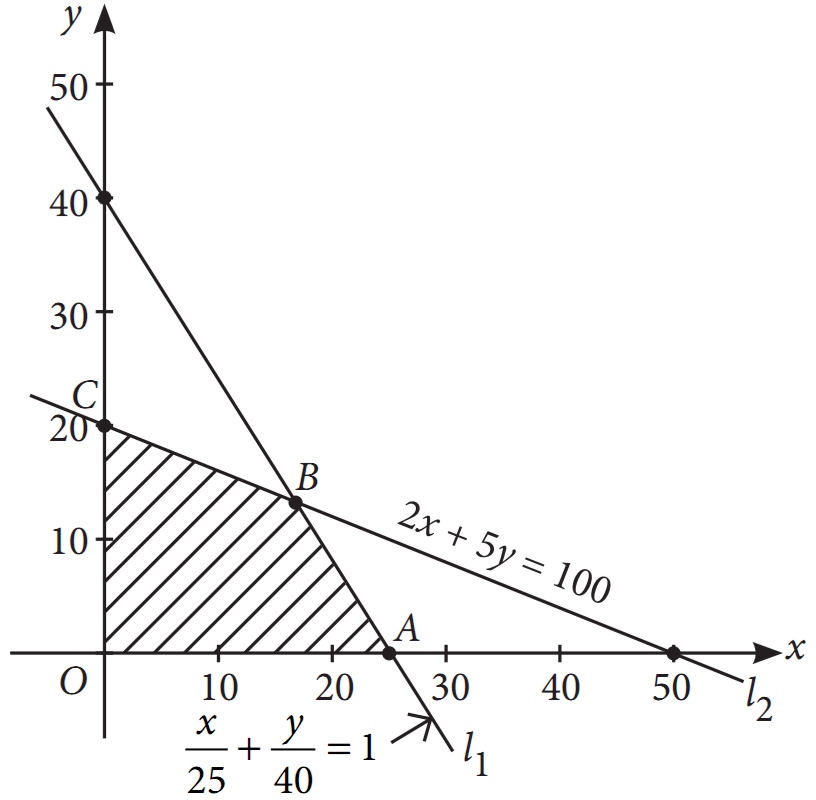
Deepa rides her car at $25 \mathrm{~km} / \mathrm{hr}$. She has to spend ₹ $2$ per km on diesel and if she rides it at a faster speed of $40 \mathrm{~km} /$ hr, the diesel cost increases to ₹ $5$ per km. She has ₹ $100$ to spend on diesel. Let she travels $x$ kms with speed $25 \mathrm{~km} /$ hr and y kms with speed $40 \mathrm{~km} / \mathrm{hr}$. The feasible region for the LPP is shown below:

Based on the above information, answer the following questions.
  1. What is the point of intersection of line $l_1$ and $l_2​​​​​​​$?
  1. $\Big(\frac{40}{3},\frac{50}{3}\Big)$
  2. $\Big(\frac{50}{3},\frac{40}{3}\Big)$
  3. $\Big(\frac{-50}{3},\frac{40}{3}\Big)$
  4. $\Big(\frac{-50}{3},\frac{-40}{3}\Big)$
  1. The comer points of the feasible region shown in above graph are:
  1. $(0,25),(20,0),\Big(\frac{40}{3},\frac{50}{3}\Big)$
  2. $(0, 0), (25, 0), (0, 20) $
  3. $(0,0),\Big(\frac{40}{3},\frac{50}{3}\Big),(0,20)$
  4. $(0,0),(25,0),\Big(\frac{50}{3},\frac{40}{3}\Big),(0,20)$
  1. If Z = x + y be the objective function and max Z = 30. The maximum value occurs at point:
  1. $\Big(\frac{50}{3},\frac{40}{3}\Big)$
  2. (0, 0)
  3. (25, 0)
  4. (0, 20)
  1. If Z = 6x - 9y be the objective function, then maximum value of Z is:
  1. -20
  2. 150
  3. 180
  4. 20
  1. If Z = 6x + 3y be the objective function, then what is the minimum value of Z?
  1. 120
  2. 130
  3. 0
  4. 150
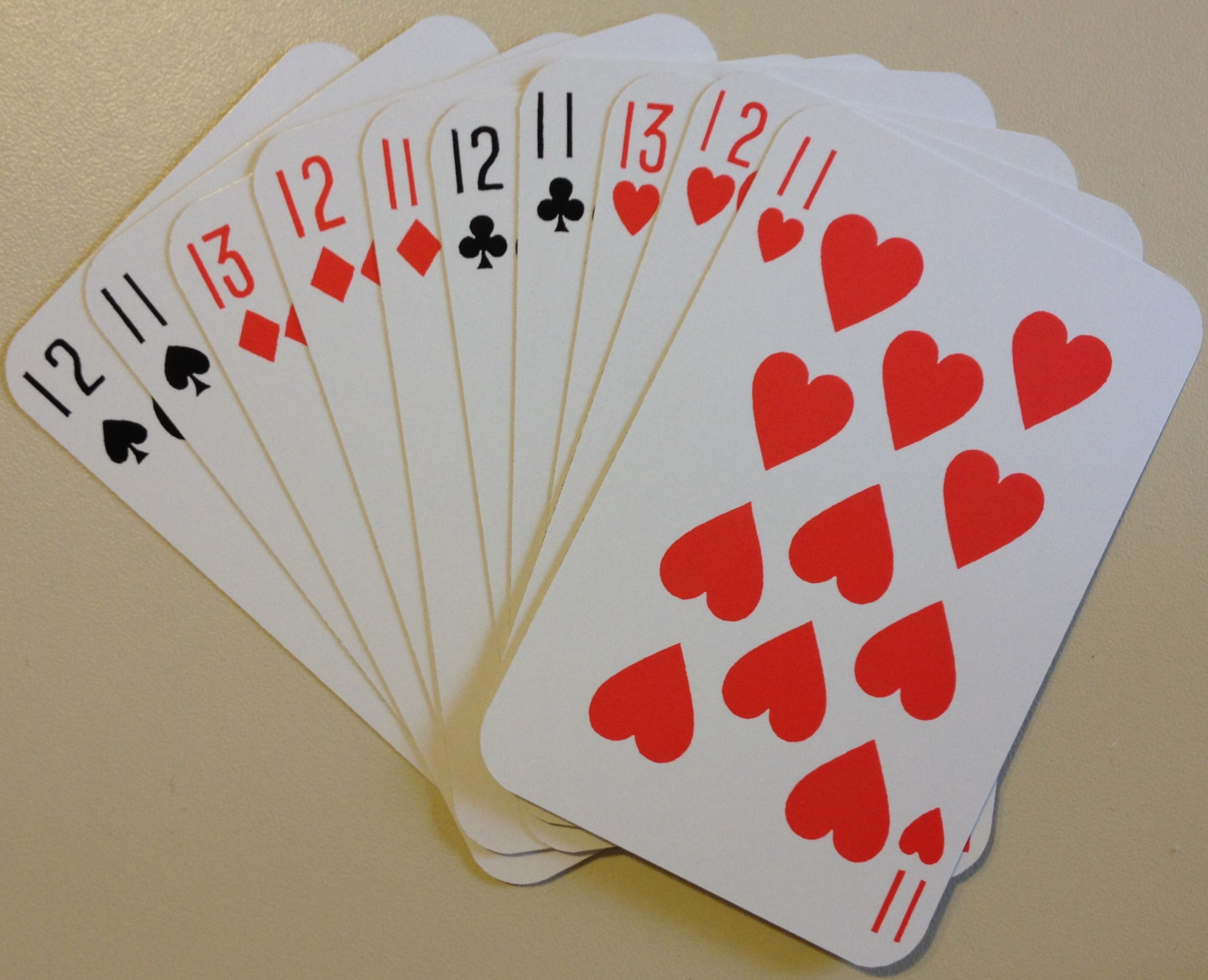
A card is lost from a pack of $52$ cards. From the remaining cards two cards are drawn at random.
Based on the above information, answer the following questions.
  1. The probability of drawing two diamonds, given that a card of diamond is missing, is:
  1. $\frac{21}{425}$
  2. $\frac{22}{425}$
  3. $\frac{23}{425}$
  4. $\frac{1}{425}$
  1. The probability of drawing two diamonds, given that a card of heart is missing, is:
  1. $\frac{26}{425}$
  2. $\frac{22}{425}$
  3. $\frac{19}{425}$
  4. $\frac{23}{425}$
  1. Let A be the event of drawing two diamonds from remaining $51$ cards and $E_1, E_2, E_3$ and $E_4$ be the events that lost card is of diamond, club, spade and heart respectively, then the approximate value of $\displaystyle\sum_{\text{i}=1}^{4}\text{P(A|E}_\text{i})$ is:
  1. $0.17$
  2. $0.24$
  3. $0.25$
  4. $0.18$
  1. AU of a sudden, missing card is found and, then two cards are drawn simultaneously without replacement. Probability that both drawn cards are king is:
  1. $\frac{1}{52}$
  2. $\frac{1}{221}$
  3. $\frac{1}{121}$
  4. $\frac{2}{221}$
  1. If two cards are drawn from a well shuffled pack of $52$ cards, one by one with replacement, then probability of getting not a king in $1^{st}$ and $2^{nd}$ draw is:
  1. $\frac{144}{169}$
  2. $\frac{12}{169}$
  3. $\frac{64}{169}$
  4. None of these
Order: The order of a differential equation is the order of the highest order derivative appearing in the differential equation.
Degree: The degree of differential equation is the power of the highest order derivative, when differential coefficients are made free from radicals and fractions. Also, differential equation must be a polynomial equation in derivatives for the degree to be defined.
Based on the above information, answer the following questions.
  1. Find the degree of the differential equation $2\frac{\text{d}^2\text{y}}{\text{dx}^2}+3\sqrt{1-\Big(\frac{\text{dy}}{\text{dx}}\Big)^2-\text{y}=0}.$
  1. $3$
  2. $4$
  3. $3$
  4. $1$
  1. Order and degree of the differential equation $\text{y}\frac{\text{dy}}{\text{dx}}=\frac{\text{x}}{\frac{\text{dy}}{\text{dx}}+\Big(\frac{\text{dy}}{\text{dx}}\Big)^3}$ are respectively.
  1. $1, 1$
  2. $1, 2$
  3. $1, 3$
  4. $1, 4$
  1. Find order and degree of the equation $y'" + y^2 + e^{y'} = 0.$
  1. Order $= 3,$ degree $=$ undefined.
  2. Order $= 1,$ degree $= 3.$
  3. Order $= 2,$ degree $=$ undefined.
  4. Order $= 1,$ degree $= 2.$
  1. Determine degree of the differential equation $(\sqrt{\text{a+x}})\times\Big(\frac{\text{dy}}{\text{dx}}\Big)+\text{x}=0.$
  1. $3$
  2. Not defined
  3. $1$
  4. $2$
  1. Order and degree of the differential equation $\Bigg(1+\Big(\frac{\text{dy}}{\text{dx}}\Big)^3\Bigg)^\frac{7}{3}=7\frac{\text{d}^2\text{y}}{\text{dx}^2}$ are respectively.
  1. $2, 1$
  2. $2, 3$
  3. $1, 3$
  4. $1,\ \frac{7}{3}$
Let x = f(t) and y = g(t) be parametric forms with t as a parameter, then
$\frac{\text{dy}}{\text{dx}}=\frac{\text{dy}}{\text{dt}}\times\frac{\text{dt}}{\text{dx}}=\frac{\text{g}'(\text{t})}{\text{f}'(\text{t})},$ where $\text{f}'(\text{t})\neq0.$
On the basis of above information, answer the following questions.
  1. The derivative of $\text{f}(\tan\text{x})\text{w.r.t.}\text{ g}(\sec\text{x})\text{ at}\text{ x}=\frac{\pi}{4},$ where f'(1) = 2 and $\text{g}'(\sqrt{2})=4,$ is:
  1. $\frac{1}{\sqrt{2}}$
  2. ${\sqrt{2}}$
  3. 1
  4. 0
  1. The derivative of $\sin^{-1}\Big(\frac{2\text{x}}{1+\text{x}^2}\Big)$ with respect to $\cos^{-1}\Big(\frac{1-\text{x}^2}{1+\text{x}^2}\Big)$ is:
  1. -1
  2. 1
  3. 2
  4. 4
  1. The derivative of $\text{e}^{\text{x}^3}$ with respect to log x is:
  1. $\text{e}^{\text{x}^3}$
  2. $3\text{x}^22\text{e}^{\text{x}^3}$
  3. $3\text{x}^3\text{e}^{\text{x}^3}$
  4. $3\text{x}^2\text{e}^{\text{x}^3}+3\text{x}$
  1. The derivative of $\cos^{-1}(2\text{x}^2-1)\text{w.r.t.}\cos^{-1}\text{x}$ is:
  1. $2$
  2. $\frac{-1}{2\sqrt{1-\text{x}^2}}$
  3. $\frac{2}{\text{x}}$
  4. $1-\text{x}^2$
  1. If $\text{y}=\frac{1}{4}\mu^4$ and $\mu=\frac{2}{3}\text{x}^3+5,$ then $\frac{\text{dy}}{\text{dx}}=$
  1. $\frac{2}{27}\text{x}^2(2\text{x}^3+15)^3$
  2. $\frac{2}{7}\text{x}^2(2\text{x}^3+15)^3$
  3. $\frac{2}{27}\text{x}(2\text{x}^3+5)^3$
  4. $\frac{2}{7}(2\text{x}^3+15)^3$
DETERMINANTS: A determinant is a square array of numbers (written within a pair of vertical lines) which represents a certain sum of We can solve a system of equations using determinants, but it becomes very tedious for large systems. We will only do 2 × 2 and 3 × 3 systems using determinants. Using the properties of determinants solve the problem given below and answer the questions that follow:
Three shopkeepers Ram Lal, Shyam Lal, and Ghansham are using polythene bags, handmade bags (prepared by prisoners), and newspaper's envelope as carry bags. It is found that the shopkeepers Ram Lal, Shyam Lal, and Ghansham are using (20, 30, 40), (30, 40, 20), and (40, 20, 30) polythene bags, handmade bags, and newspapers envelopes respectively. The shopkeepers Ram Lal, Shyam Lal, and Ghansham spent ₹250, ₹270, and ₹200 on these carry bags respectively.
  1. What is the cost of one polythene bag?
  1. ₹ 1
  2. ₹ 2
  3. ₹ 3
  4. ₹ 5
  1. What is the cost of one handmade bag?
  1. ₹1
  2. ₹2
  3. ₹3
  4. ₹5
  1. What is the cost of one newspaper bag?
  1. ₹1
  2. ₹2
  3. ₹3
  4. ₹5
  1. Keeping in mind the social conditions, which shopkeeper is better?
  1. Ram Lal
  2. Shyam Lal
  3. Ghansham
  4. None of these
  1. Keeping in mind the environmental conditions, which shopkeeper is better?
  1. Ram Lal
  2. Shyam Lal
  3. Ghansham
  4. None of these
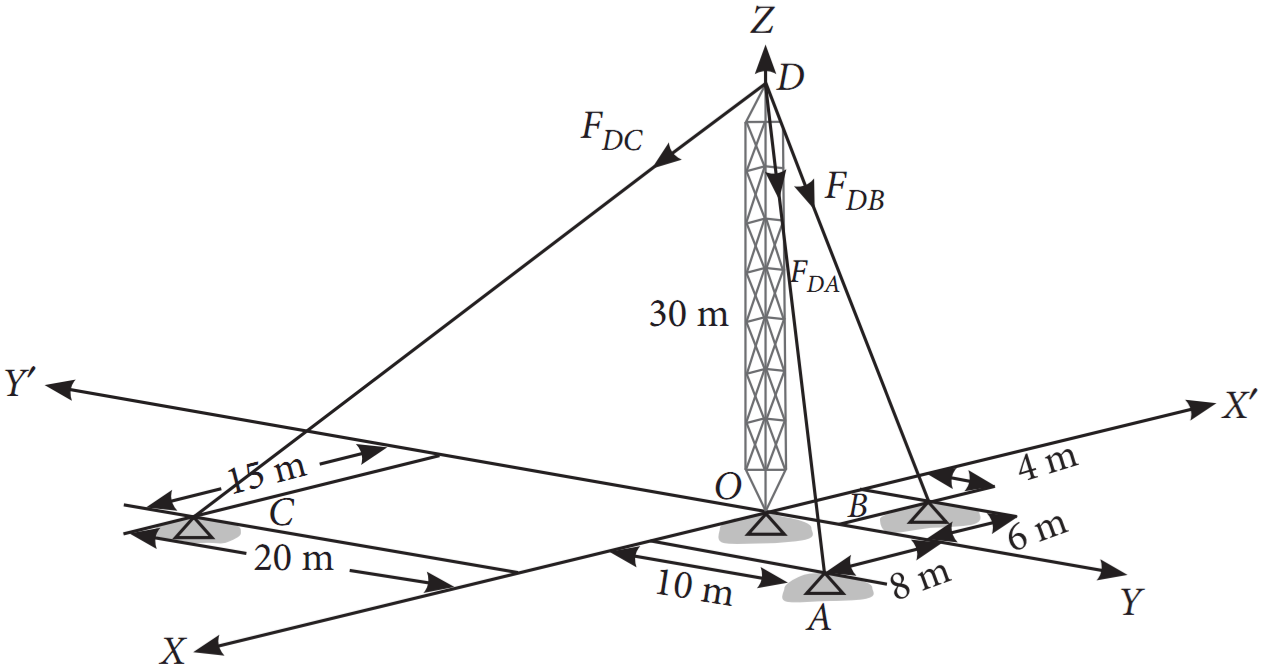
Consider the following diagram, where the forces in the cable are given. Based on the above information, answer the following questions.
  1. The equation of line along the cable AD is:
  1. $\frac{\text{x}}{5}=\frac{\text{y}}{4}=\frac{\text{z}-30}{15}$
  2. $\frac{\text{x}}{4}=\frac{\text{y}}{5}=\frac{\text{z}-30}{15}$
  3. $\frac{\text{x}}{5}=\frac{\text{y}}{4}=\frac{30-\text{z}}{15}$
  4. $\frac{\text{x}}{4}=\frac{\text{y}}{5}=\frac{30-\text{z}}{15}$
  1. The length of cable DC is:
  1. $4\sqrt{61}\text{m}$
  2. $5\sqrt{61}\text{m}$
  3. $6\sqrt{61}\text{m}$
  4. $7\sqrt{61}\text{m}$
  1. The vector DB is:
  1. $-6\hat{\text{i}}+4\hat{\text{j}}-30\hat{\text{k}}$
  2. $6\hat{\text{i}}-4\hat{\text{j}}+30\hat{\text{k}}$
  3. $6\hat{\text{i}}+4\hat{\text{j}}+30\hat{\text{k}}$
  4. None of these
  1. The sum of vectors along the cables is:
  1. $17\hat{\text{i}}+6\hat{\text{j}}+90\hat{\text{k}}$
  2. $17\hat{\text{i}}-6\hat{\text{j}}-90\hat{\text{k}}$
  3. $17\hat{\text{i}}+6\hat{\text{j}}-90\hat{\text{k}}$
  4. None of these
  1. The sum of distances of points A, B and C from the origin, i.e., OA + OB + OC is:
  1. $\sqrt{164}+\sqrt{52}+\sqrt{625}$
  2. $\sqrt{52}+\sqrt{625}+\sqrt{48}$
  3. $\sqrt{164}+\sqrt{625}+\sqrt{49}$
  4. None of these
A card is lost from a pack of $52$ cards. From the remaining cards two cards are drawn at random.
Based on the above information, answer the following questions.
  1. The probability of drawing two diamonds, given that a card of diamond is missing, is:
  1. $\frac{21}{425}$
  2. $\frac{22}{425}$
  3. $\frac{23}{425}$
  4. $\frac{1}{425}$
  1. The probability of drawing two diamonds, given that a card of heart is missing, is:
  1. $\frac{26}{425}$
  2. $\frac{22}{425}$
  3. $\frac{19}{425}$
  4. $\frac{23}{425}$
  1. Let $A$ be the event of drawing two diamonds from remaining $51$ cards and $E_1, E_2, E_3$ and $E_4$ be the events that lost card is of diamond, club, spade and heart respectively, then the approximate  value of $\displaystyle\sum_{\text{i}=1}^{4}\text{P(A|E}_\text{i})$ is:
  1. $0.17$
  2. $0.24$
  3. $0.25$
  4. $0.18$
  1. AU of a sudden, missing card is found and, then two cards are drawn simultaneously without replacement. Probability that both drawn cards are king is:
  1. $\frac{1}{52}$
  2. $\frac{1}{221}$
  3. $\frac{1}{121}$
  4. $\frac{2}{221}$
  1. If two cards are drawn from a well shuffled pack of $52$ cards, one by one with replacement, then probability of getting not a king in $1^{st}$ and $2^{nd}$ draw is:
  1. $\frac{144}{169}$
  2. $\frac{12}{169}$
  3. $\frac{64}{169}$
  4. None of these
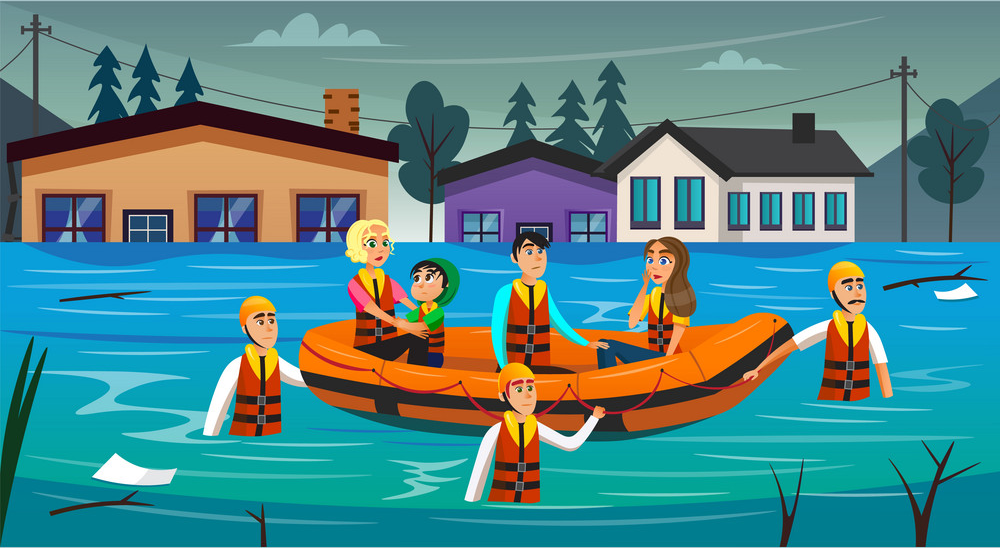
Three schools A, B and C organized a mela for collecting funds for helping the rehabilitation of flood victims. They sold hand made fans, mats and plates from recycled material at a cost of ₹ 25, ₹ 100 and ₹ 50 each. The number of articles sold by school A, B, C are given below.
Article
School
A
B
C
Fans
40
25
35
Mats
50
40
50
Plates
20
30
40
Based on above information, answer the following questions.
  1. If P be a 3 × 3 matrix represent the sale of handmade fans, mats and plates by three schools A, B and C, then
  1. $\begin{matrix}& \ \ \ \ \ \ \ \ \ \ \text{Fans}&\text{Mats}&\text{Plates}\end{matrix}\\\begin{matrix}\ \ \ \ \ \ \ \ \ \ \text{A}\\\text{P}\ =\text{B}\\\ \ \ \ \ \ \ \ \ \ \text{C}\end{matrix}\begin{bmatrix} \ \ 40 \ \ \ & 50 & \ \ \ \ \ 25\\25 & 40 & \ \ \ \ \ 30\\35& \ 50& \ \ \ \ \ 40\end{bmatrix}$
  2. $\begin{matrix}& \ \ \ \ \ \ \ \ \ \ \text{Fans}&\text{Mats}&\text{Plates}\end{matrix}\\\begin{matrix}\ \ \ \ \ \ \ \ \ \ \text{A}\\\text{P}\ =\text{B}\\\ \ \ \ \ \ \ \ \ \ \text{C}\end{matrix}\begin{bmatrix} \ \ 25 \ \ \ & 40 & \ \ \ \ \ 20\\35 & 40 & \ \ \ \ \ 30\\40& \ 50& \ \ \ \ \ 20\end{bmatrix}$
  3. $\begin{matrix}& \ \ \ \ \ \ \ \ \ \ \text{Fans}&\text{Mats}&\text{Plates}\end{matrix}\\\begin{matrix}\ \ \ \ \ \ \ \ \ \ \text{A}\\\text{P}\ =\text{B}\\\ \ \ \ \ \ \ \ \ \ \text{C}\end{matrix}\begin{bmatrix} \ \ 40 \ \ \ & 25 & \ \ \ \ \ 35\\50 & 40 & \ \ \ \ \ 50\\20& \ 30& \ \ \ \ \ 40\end{bmatrix}$
  4. $\begin{matrix}& \ \ \ \ \ \ \ \ \ \ \text{Fans}&\text{Mats}&\text{Plates}\end{matrix}\\\begin{matrix}\ \ \ \ \ \ \ \ \ \ \text{A}\\\text{P}\ =\text{B}\\\ \ \ \ \ \ \ \ \ \ \text{C}\end{matrix}\begin{bmatrix} \ \ 25 \ \ \ & 35 & \ \ \ \ \ 40\\40 & 40 & \ \ \ \ \ 50\\20& \ 30& \ \ \ \ \ 20\end{bmatrix}$
  1. If Q be a 3 x 1 matrix represent the sale prices (in ₹) of given products per unit, then
  1. $\text{Q}=\begin{bmatrix}25\\50\\100\end{bmatrix}\begin{matrix}\text{Fans}\\\text{Mats}\\\text{Plates}\end{matrix}$
  2. $\begin{matrix}\ \ \ \ \ \ \text{Fans}&\text{Mats}&\text{Plates}\end{matrix}\\\text{Q}=\begin{matrix}[25\ \ \ &50&\ \ \ 100]\end{matrix}\\$
  3. $\begin{matrix}\ \ \ \ \ \ \text{Fans}&\text{Mats}&\text{Plates}\end{matrix}\\\text{Q}=\begin{matrix}[25\ \ \ &100&\ \ \ 50]\end{matrix}\\$
  4. $\text{Q}=\begin{bmatrix}25\\100\\50\end{bmatrix}\begin{matrix}\text{Fans}\\\text{Mats}\\\text{Plates}\end{matrix}$
  1. The funds collected by school A by selling the given articles is:
  1. ₹ 7000
  2. ₹ 6125
  3. ₹ 7875
  4. ₹ 8000
  1. The funds collected by school B by selling the given articles is:
  1. ₹ 5125
  2. ₹ 6125
  3. ₹ 7125
  4. ₹ 8125
  1. The total funds collected for the required purpose is:
  1. ₹ 20000
  2. ₹ 21000
  3. ₹ 30000
  4. ₹ 35000
In a murder investigation, a corpse was found by a detective at exactly $8$ p.m. Being alert, the detective measured the body temperature and found it to be $70^\circ F$ Two hours later, the detective measured the body temperature again and found it to be $60^\circ F,$ where the room temperature is $50^\circ F$ Also, it is given the body temperature at the time of death was normal, i.e., $98.6^\circ F.$
Let $T$ be the temperature of the body at any time t and initial time is taken to be $8$ p.m.

Based on the above information, answer the following questions.
  1. By Newton's law of cooling, $\frac{\text{dT}}{\text{dt}}$ is proportional to:
  1. $T - 60$
  2. $T - 50$
  3. $T - 70$
  4. $T - 98.6$
  1. When $t = 0,$ then body temperature is equal to:
  1. $50^\circ F$
  2. $60^\circ F$
  3. $70^\circ F$
  4. $98.6^\circ F$
  1. When $t = 2,$ then body temperature is equal to:
  1. $50^\circ F$
  2. $60^\circ F$
  3. $70^\circ F$
  4. $98.6^\circ F$
  1. The value of T at any time t is:
  1. $50+20\Big(\frac{1}{2}\Big)^\text{t}$
  2. $50+20\Big(\frac{1}{2}\Big)^\text{t-1}$
  3. $50+20\Big(\frac{1}{2}\Big)^\frac{\text{t}}{2}$
  4. None of these
  1. If it is given that $\log_\text{e} (2.43) = 0.88789$ and $\log_\text{e} (0.5) = -0.69315,$ then the time at which the murder occur is:
  1. $7:30$ p.m.
  2. $5:30$ p.m.
  3. $6:00$ p.m.
  4. $5:00$ p.m.
Order: The order of a differential equation is the order of the highest order derivative appearing in the differential equation.
Degree: The degree of differential equation is the power of the highest order derivative, when differential coefficients are made free from radicals and fractions. Also, differential equation must be a polynomial equation in derivatives for the degree to be defined.
Based on the above information, answer the following questions.
  1. Find the degree of the differential equation $2\frac{\text{d}^2\text{y}}{\text{dx}^2}+3\sqrt{1-\Big(\frac{\text{dy}}{\text{dx}}\Big)^2-\text{y}=0}.$
  1. $3$
  2. $4$
  3. $3$
  4. $1$
  1. Order and degree of the differential equation $\text{y}\frac{\text{dy}}{\text{dx}}=\frac{\text{x}}{\frac{\text{dy}}{\text{dx}}+\Big(\frac{\text{dy}}{\text{dx}}\Big)^3}$ are respectively.
  1. $1, 1$
  2. $1, 2$
  3. $1, 3$
  4. $1, 4$
  1. Find order and degree of the equation $y'" + y^2 + e^{y'} = 0.$
  1. Order $= 3,$ degree $=$ undefined.
  2. Order $= 1,$ degree $= 3.$
  3. Order $= 2,$ degree $=$ undefined.
  4. Order $= 1,$ degree $= 2.$
  1. Determine degree of the differential equation $(\sqrt{\text{a+x}})\times\Big(\frac{\text{dy}}{\text{dx}}\Big)+\text{x}=0.$
  1. $3$
  2. Not defined
  3. $1$
  4. $2$
  1. Order and degree of the differential equation $\Bigg(1+\Big(\frac{\text{dy}}{\text{dx}}\Big)^3\Bigg)^\frac{7}{3}=7\frac{\text{d}^2\text{y}}{\text{dx}^2}$ are respectively.
  1. $2, 1$
  2. $2, 3$
  3. $1, 3$
  4. $1,\ \frac{7}{3}$