MCQ
S.I. unit of electric depole moment is :
  • A
    cm
  • B
    $cm^{2}$
  • $cm^{-1}$
  • D
    $cm^{-2}$

Answer

Correct option: C.
$cm^{-1}$
C

Need a full question paper?

Generate a complete, print-ready paper with questions like this in minutes — across 16+ boards, with answer keys.
Start Generating Free

Similar questions

In the following reaction the value of $‘X\ ’$ is $7^{\mathrm{N}^{14}}+2^{\mathrm{He}^4} \rightarrow \mathrm{X}+1^{\mathrm{H}^1}$
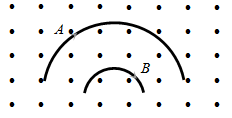
Two particles $A$ and $B$ of masses $\mathrm{m}_{\mathrm{A}}$ and $\mathrm{m}_{\mathrm{B}}$ respectively and having the same charge are moving in a plane. A uniform magnetic field exists perpendicular to this plane. The speeds of the particles are $\mathrm{v}_{\mathrm{A}}$ and $v_B$ respectively, and the trajectories are as shown in the figure. Then
 
Due to the flow of current in a circular loop of radius $R,$ the magnetic induction produced at the centre of the loop is $B.$ The magnetic moment of the loop is $\left(\mu_0=\right.$ permeability constant $)$
The number of turns of primary and secondary coils of a transformer are 5 and 10 respectively and the mutual inductance of the transformer is 25 henry. Now the number of turns in the primary and secondary of the transformer are made 10 and 5 respectively. The mutual inductance of the transformer in henry will be(a) 6.25(b) 12.5(c) 25       (d) 50
       
For a metallic wire, the ratio V/i   (V =  the applied potential difference, i = current flowing) is(a) Independent of temperature(b) Increases as the temperature rises(c) Decreases as the temperature rises(d) Increases or decreases as temperature rises, depending upon the metal


The electric potential decreases uniformly from $120V$ to $80V$ as one moves on the $x-$axis from $x = -1\ cm$ to $x = + 1\ cm$. The electric field at the origin.
  1. Must be equal to $20Vcm^{-1}$
  2. May be equal to $20Vcm^{-1}$
  3. May be greater than $20Vcm^{-1}$
  4. May be lees than $20Vcm^{-1}$
Force of attraction between two point charges $Q$ and $-Q$ separated by $d$ metre is $F_e$. When these charges are placed on two identical spheres of radius $R = 0.3d$ whose centres are $d$ metre apart, the force of attraction between them is
In a wire of circular cross-section with radius r, free electrons travel with a drift velocity V when a current I flows through the wire. What is the current in another wire of half the radius and of the same material when the drift velocity is 2V(a) 2I(b) I(c) I/2  (d) I/4
       
The $SI$ unit of surface charge density is:
A plane electromagnetic wave of frequency $20 \ MHz$ travels through a space along $x$ direction. If the electric field vector at a certain point in space is $6 \ Vm^{-1},$ what is the magnetic field vector at that point?