MCQ
$SI$ unit of pressure is
  • Pascal
  • B
    $Dynes/c{m^2}$
  • C
    $cm\,$ of $Hg$
  • D
    Atmosphere

Answer

Correct option: A.
Pascal
a
The SI unit of pressure is pascal (represented as $Pa$) which is equal to one newton per square metre $\left( N / m ^2\right.$ or $kg m ^{-1} s ^{-2}$ ). Interestingly, this name was given in $1971$ . Before that pressure in $SI$ was measured in $newtons$ $per$ $square$ $metre$.

Need a full question paper?

Generate a complete, print-ready paper with questions like this in minutes — across 16+ boards, with answer keys.

Start Generating Free

Similar questions

A block of mass $4\,kg$ is placed on a rough horizontal plane A time dependent force $F = kt^2$ acts on the block, where $k = 2\,N/s^2$. Coefficient of friction $\mu = 0.8$. Force of friction between block and the plane at $t = 2\,s$ is ....... $N$
A ball of mass $150\,g$ starts moving with an acceleration of $20m/{s^2}$. When hit by a force, which acts on it for $0.1\, sec$. The impulsive force is ........ $N-s$
A particle moves in a circle of radius $5 \;cm$ with constant speed and time period $0.2 \pi\; sec$. The acceleration of the particle is .... $m/sec^2$
At absolute zero temperature, pressure of a gas will be
One mole of an ideal gas at temperature $T_1$ expends according to the law $\frac{P}{{{V^2}}} =a$ (constant). The work  done by the gas till temperature of gas becomes $T_2 $ is 
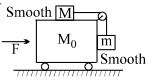
Imagine $a$ situation in which the horizontal surface of block $M_0$ is smooth and its vertical surface is rough with $a$ coefficient of friction $\mu$ Consider a special situation in which both the faces of the block $M_0$ are smooth, as shown in adjoining figure. Mark out the correct statement $(s)$
Two particles of mass $5\, kg$ and $10\, kg$ respectively are attached to the two ends of a rigid rod of length $1\, m$ with negligible mass. The centre of mass of the system from the $5\, kg$ particle is nearly at a distance of $..........\, cm$
If temperature of gas increases from $27°C$ to $927°C$ the $K.E.$ will be
If two metallic plates of equal thicknesses and thermal conductivities ${K_1}$ and ${K_2}$ are put together face to face and a common plate is constructed, then the equivalent thermal conductivity of this plate will be
Mark the correct statement

$(i)$ Escape velocity does not depend on mass of body

$(ii)$ If total energy of a satellite becomes positive, it escapes from earth

$(iii)$ Orbit of geostationary orbit is called parking orbit