Question
Significance of Natural selection

Answer

  1. Natural selection is the main driving force behind the evolution.
  2. Natural selection favours those genetic variations which have better fitness value.
  3. Such organisms are at selective advantage and they produce more offspring than the rest. Such organisms have greater survival and reproductive capacity.
  4. In this way natural selection helps in the evolution of new species.
  5. Natural selection favours differential reproduction of gene and brings about changes in the gene frequency.
  6. Natural selection brings about evolutionary changes.
  7. Natural selection also eliminates the genes carrying harmful mutations. This is called mutation balance in which allele frequency of harmful recessives remain constant generation after generation.

Need a full question paper?

Generate a complete, print-ready paper with questions like this in minutes — across 16+ boards, with answer keys.

Start Generating Free

Similar questions

Long Answer Questions
What are the reasons of Mendel’s success?
How were simple organic molecules formed on the earth?
Pragyan takes fruits, vegetables, bread and egg curry in a day's menu. While his teacher was giving a lecture on trophic level, he got fascinated and asked following questions from his teacher.
  1. How many trophic levels does he occupy in different food chains?
  2. Represent atleast three food chains.
  3. Which among them gives him the maximum amount of energy? Give reason.
  4. What values are shown by Pragyan?
Illustrate the design of a bioreactor. Highlight the difference between a flask in your laboratory and a bioreactor which allows cells to grow in a continuous culture system.
Give functions : The functions of forebrain.
What are plant growth regulators? Give the characteristics of plant growth regulators.
Complete the following chart :

Image

  1. A true breeding pea plant, homozygous for inflated green pods is crossed with another pea plant with constricted yellow pods (ffgg). What would be the phenotype and genotype of $F_1$​​​​​​​ and $F_2​​​​​​​$​​​​​​​ generations? Give the phenotype ratio of generation.
  2. State the generalisation proposed by Mendel on the basis of the above–Mentioned cross.
State and explain any three factors affecting allele frequency in populations.
Read the following and answer any four questions from (i) to (v) given below:
Gene therapy is the technique of genetic engineering to replace a faulty gene by a normal healthy functional gene. It is a way of treating genetic disease by introducing a piece of DNA into the cells of an affected individual. Liposomes can be used for gene therapy as they target the cells affected by a genetic disease.
  1. A patient suffers from adenosine deaminase (ADA) deficiency, an autosomal recessive immune deficiency in which bone marrow lymphoblasts cannot replicate to generate immuno-competent lymphocytes. The treatment option that would cure the patient is:
  1. Germ-line gene therapy to replace one ADA gene copy.
  2. Germ-line gene therapy to replace both ADA gene copies.
  3. Somatic cell gene therapy to replace both ADA gene copies in circulating lymphocytes.
  4. Somatic cell gene therapy to replace one ADA gene copy in bone marrow lymphoblasts.
  1. Which type of gene therapy is least effective in transferring DNA to the nucleus?
  1. Adenoviruses.
  2. DNA attached to a ligand.
  3. Liposomes.
  4. Retroviruses.
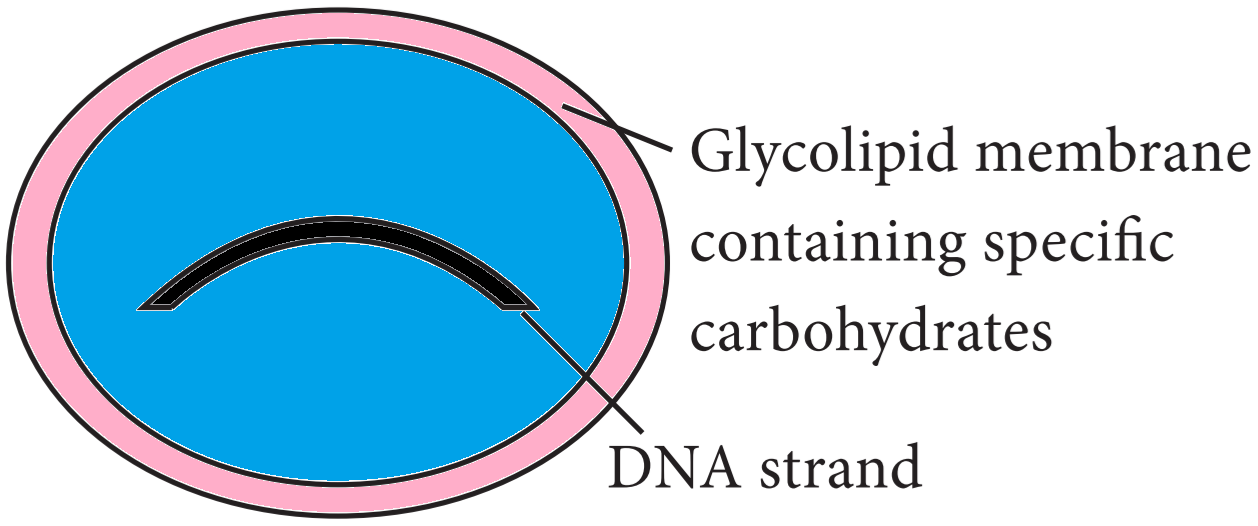
  1. Liposomes can be used for gene therapy as they target the cells affected by a genetic disease. The diagram shows the structure of a liposome.


What feature of a cell surface membrane allows the liposome to target cells affected by a genetic disease?
  1. Carrier molecules.
  2. Phosphate groups.
  3. Protein channels.
  4. Receptor molecules.
  1. Which of the following disorders would gene therapy be least effective?
  1. Cystic fibrosis.
  2. Huntington's disease.
  3. Sickle cell anaemia.
  4. Type II diabetes.
  1. Following are some reasons explaining why gene therapy is not yet fully an effective treatment for genetic diseases.
  1. Lack of knowledge of DNA sequences.
  2. Lack of efficient and safe gene delivery system.
  3. Cost of the technology.
  4. Some diseases involve multiple genes.
  5. Problems with appropriate gene regulation.
Select the correct option.
  1. I, III and V only
  2. II, IV and V only
  3. Ill, IV and V only
  4. I, III and IV only