Question
Simplify:
$\frac{2+\sqrt{3}}{2-\sqrt{3}}+\frac{2-\sqrt{3}}{2+\sqrt{3}}+\frac{\sqrt{3}-1}{\sqrt{3}+1}$

Answer

$\frac{2+\sqrt{3}}{2-\sqrt{3}}+\frac{2-\sqrt{3}}{2+\sqrt{3}}+\frac{\sqrt{3}-1}{\sqrt{3}+1}$
$=\frac{2+\sqrt{3}}{2-\sqrt{3}}\times\frac{2+\sqrt{3}}{2+\sqrt{3}}\times\frac{2+\sqrt{3}}{2-\sqrt{3}}+\frac{2-\sqrt{3}}{2-\sqrt{3}}+\frac{\sqrt{3}-1}{\sqrt{3}+1}\times\frac{\sqrt{3}-1}{\sqrt{3}-1}$
$=\frac{\big(2+\sqrt{3}\big)^2}{2^2-\big(\sqrt{3}\big)^2}+\frac{\big(2-\sqrt{3}\big)^2}{2^2-\big(\sqrt{3}\big)^2}+\frac{\big(\sqrt{3}-1\big)^2}{\big(\sqrt{3}\big)^2-1}$
$=\frac{2^2+2\times2\sqrt{3}+\big(\sqrt{3}\big)^2}{4-3}+\frac{2^2-2\times2\sqrt{3}+\big(\sqrt{3}\big)^2}{4-3}+\frac{\big(\sqrt{3}\big)^2-2\sqrt{3}+1}{3-1}$
$=\frac{4+4\sqrt{3}+3}{1}+\frac{4-4\sqrt{3}+3}{1}+\frac{3-2\sqrt{3}+1}{2}$
$=7+4\sqrt{3}+7-4\sqrt{3}+\frac{4-2\sqrt{3}}{2}$
$=14+2-\sqrt{3}$
$=16-\sqrt{3}$

Need a full question paper?

Generate a complete, print-ready paper with questions like this in minutes — across 16+ boards, with answer keys.

Start Generating Free

Similar questions

$P$ and $Q$ are the mid-points of the opposite sides $AB$ and $CD$ of a parallelogram $ABCD. AQ$ intersects $DP$ at $S$ and $BQ$ intersects $CP$ at $R.$ Show that $PRQS$ is a parallelogram.
Each edge of a cube is increased by $50\%$. Find the percentage increase in the surface area of the cube.
In a $\triangle\text{ABC},$ $BM$ and $CN$ are perpendiculars from $B$ and $C$ respectively on any line passing through $A$. If $L$ is the mid-point of $BC$, prove that $ML = NL$.
The production of oil (in lakh tonnes) in some of the refineries in India during $1982$ was given below:
Refinery
Barauni
Koyali
Mathura
Mumbai
Florida
Production of oil (in lakh tonnes)
$30$
$70$
$40$
$45$
$25$
Construct a bar graph to represent the above data so that the bars are drawn horizontally.
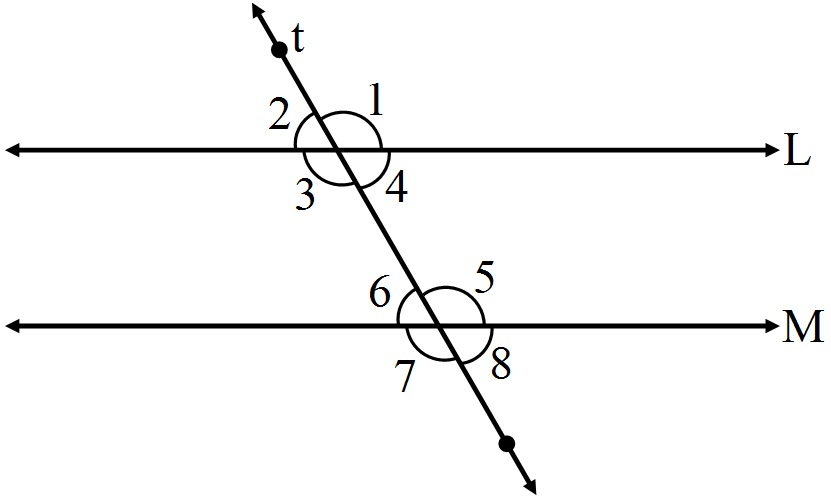
In the given figure, $l || m$ and a transversal $t$ cuts them, If $\angle1=120^\circ,$ find the measure of each of the remaining marked angles.
P and Q are the mid-points of the opposite sides AB and CD of a parallelogram ABCD. AQ intersects DP at S and BQ intersects CP at R. Show that PRQS is a parallelogram.
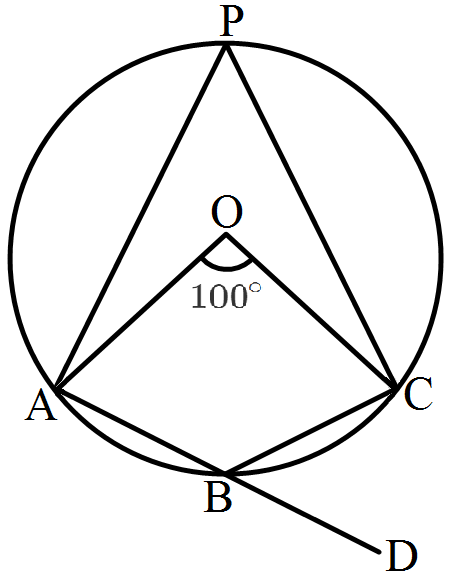
In the given figure, $O$ is the center of the circle. Find $\angle\text{CBD}.$
In the following, using the remainder theorem, find the remainder when $f(x)$ is divided by $g(x)$ and verify the by actual division: $f(x) = 2x^4 - 6x^3 + 2x^2 - x + 2, g(x) = x + 2$
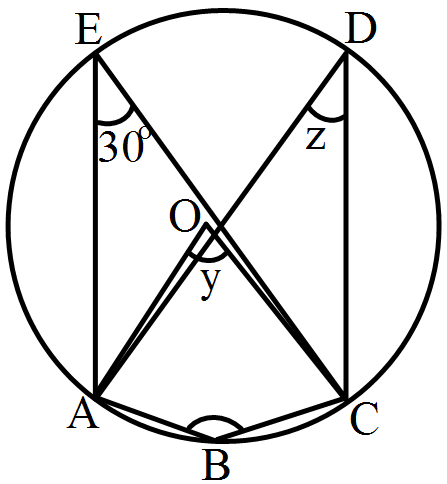
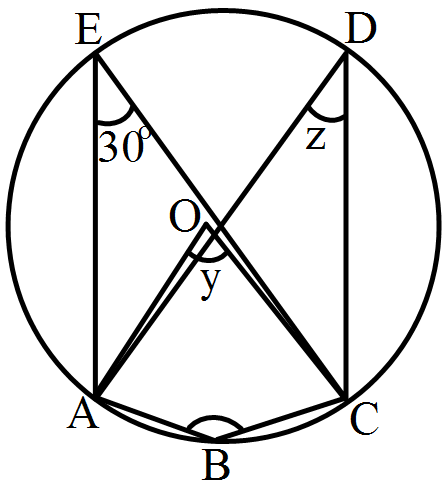
In the given figure, $O$ is the center of the circle. If $\angle\text{CEA}=30^\circ,$ find the value of $x, y$ and $z$.