Question
Simplify: $\frac{2\sqrt{6}}{{\sqrt2}+\sqrt{3}}+\frac{6\sqrt{2}}{{\sqrt6}+\sqrt{3}}-\frac{8\sqrt{3}}{{\sqrt6}+\sqrt{2}}$

Answer

$\frac{2\sqrt{6}}{{\sqrt2}+\sqrt{3}}+\frac{6\sqrt{2}}{{\sqrt6}+\sqrt{3}}-\frac{8\sqrt{3}}{{\sqrt6}+\sqrt{2}}$
$=\frac{2\sqrt{6}}{{\sqrt2}+\sqrt{3}}\times\frac{{\sqrt2}-\sqrt{3}}{{\sqrt2}-\sqrt{3}}+\frac{6\sqrt{2}}{{\sqrt6}+\sqrt{3}}\times\frac{{\sqrt6}-\sqrt{3}}{{\sqrt6}-\sqrt{3}}-\frac{8\sqrt{3}}{{\sqrt6}+\sqrt{2}}\times\frac{{\sqrt6}-\sqrt{2}}{{\sqrt6}-\sqrt{2}}$
$=\frac{2\sqrt{6}\times\sqrt{3}-2\sqrt{6}\times\sqrt{2}}{\big(\sqrt{3}\big)^2-\big(\sqrt{2}\big)^2}+\frac{6\sqrt{2}\times\sqrt{6}-6\sqrt{2}\times\sqrt{3}}{\big(\sqrt{6}\big)^2-\big(\sqrt{3}\big)^2}-\frac{8\sqrt{3}\times\sqrt{6}-8\sqrt{3}\times\sqrt{2}}{\big(\sqrt{6}\big)^2-\big(\sqrt{2}\big)^2}$
$=\frac{2\sqrt{18}-2\sqrt{12}}{3-2}+\frac{6\sqrt{12}-6\sqrt{6}}{6-3}-\frac{8\sqrt{18}-8\sqrt{6}}{6-2}$
$=2\sqrt{18}-2\sqrt{12}+\frac{6\sqrt{12}-6\sqrt{6}}{3}-\frac{8\sqrt{18}-8\sqrt{6}}{4}$
$=2\sqrt{18}-2\sqrt{12}+2\sqrt{12}-2\sqrt{6}-2\sqrt{18}+2\sqrt{6}$ $=0$

Need a full question paper?

Generate a complete, print-ready paper with questions like this in minutes — across 16+ boards, with answer keys.
Start Generating Free

Similar questions

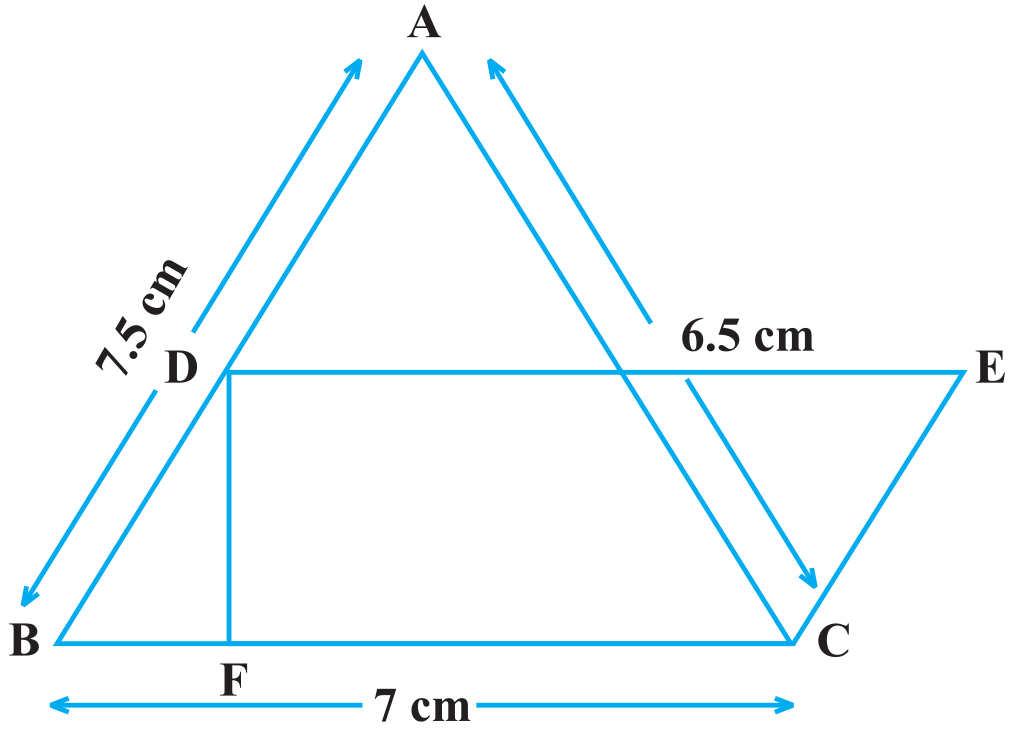
In $\triangle\text{ABC}$ has sides $AB = 7.5\ cm, AC = 6.5\ cm$ and $BC = 7\ cm$. On base $BC$ a parallelogram $DBCE$ of same area as that of $\triangle\text{ABC}$ is constructed. Find the height $DF$ of the parallelogram.
Draw a histogram to represent the following grouped frequency distribution:
Ages (in years)
Number of teachers
$20-24$
$25-29$
$30-34$
$35-39$
$40-44$
$45-49$
$50-54$
$10$
$28$
$32$
$48$
$50$
$35$
$12$
The mean marks (out of $100$) of boys and girls in an examination are $70$ and $73$, respectively. If the mean marks of all the students in that examination is $71$, find the ratio of the number of boys to the number of girls.
Find the values of $n$ and $\overline{\text{X}}$ in the following case:$\sum\limits^\text{n}_{\text{i}=1}(\text{x}_\text{i}-10)=30$ and $\sum\limits^\text{n}_{\text{i}=1}(\text{x}_\text{i}-6)=150$
Prove that $\sqrt{3}+\sqrt{5}$ is an irrational number.
Find the value of the following correct to three place of decimals, it begin that $\sqrt2=1.4142, \sqrt3=1.732,\ \sqrt5=2.2360,\ \sqrt6=2.4495$ and $\sqrt{10}=3.162.$ $\frac{1+\sqrt2}{3-2\sqrt2}$
Find the values of $a$ and $b$ if:
$\frac{7+3\sqrt{5}}{3+\sqrt{5}}-\frac{7-3\sqrt{5}}{3-\sqrt{5}}=\text{a}+\text{b}\sqrt{5}$
The marks obtained (out of $100$) by a class of $80$ students are given below:
Marks
Number of Student
$10-20$
$20-30$
$30-50$
$50-70$
$70-100$
$6$
$17$
$15$
$16$
$26$
Construct a histogram to represent the data above.
The perimeter of a triangullar field is $144\ m$ and the ratio of the sides is $3 : 4 : 5$. Find the area of the field.