Question
Simplify $3 x(4 x-5)+3$ and find its values for
(a) $x=3$ $\quad$ (b) $x=\frac{1}{2}$

Answer

(i) We have, $3 x(4 x-5)+3$
$=(3 x) \times(4 x)-(3 x) \times(5)+3\qquad$ [by distributive law]
$=(3 \times 4) \times(x \times x)-(3 \times 5) \times(x)+3 $
$ =12 x^2-15 x+3$
(a) When $x=3$ then
$12 x^2-15 x+3 =12(3)^2-15(3)+3 $
$ =(12 \times 9)-45+3 $
$ =108-45+3=111-45=66$
(b) When $x=\frac{1}{2},$ then
$12x^{2}-15x+3=12(\frac{1}{2})^{2}-15(\frac{1}{2})+3$
$=12 \times \frac{1}{4}-\frac{15}{2}+3=3-\frac{15}{2}+3$
$=6-\frac{15}{2}=\frac{12-15}{2}=-\frac{3}{2}$

Need a full question paper?

Generate a complete, print-ready paper with questions like this in minutes — across 16+ boards, with answer keys.
Start Generating Free

Similar questions

Add the following
$a-b+a b, b-c+b c, c-a+a c$
Huma, Hubna and Seema received a total of Rs. $2,016$ as monthly allowance from their mother such that Seema gets $\frac{1}{2}$ of what Huma gets and Hubna gets $1\frac{2}{3}$ times Seema’s share. How much money do the three sisters get individually?
Kusum always forgets how to convert miles to kilometres and back again. However she remembers that her car’s speedometer shows both miles and kilometres. She knows that travelling $50$miles per hour is same as travelling $80$ kilometres per hour. To cover a distance of $200\ km$, how many miles Kusum would have to go?
Write five numbers for which you cannot decide whether they are squares.
Add the following rational number: $\frac{7}{-18}$ and $\frac{8}{27}$
Prepare a frequency table of the following scores obtained by $50$ students in a test: $42, 51, 21, 42, 37, 37, 42, 49, 38, 52, 7, 33, 17, 44, 39, 7, 14, 27, 39, 42, 42, 62, 37, 39, 67, 51, 53, 53, 59, 41, 29, 38,$ $ 27, 31, 64, 19, 53,51, 22, 61, 42, 39, 59, 47, 33, 34, 16, 37, 57, 43.$
Using commutativity and associativity of addition of rational numbers, express the following as a rational number: $\frac{4}{7}+0+\frac{-8}{9}+\frac{-13}{7}+\frac{17}{21}$
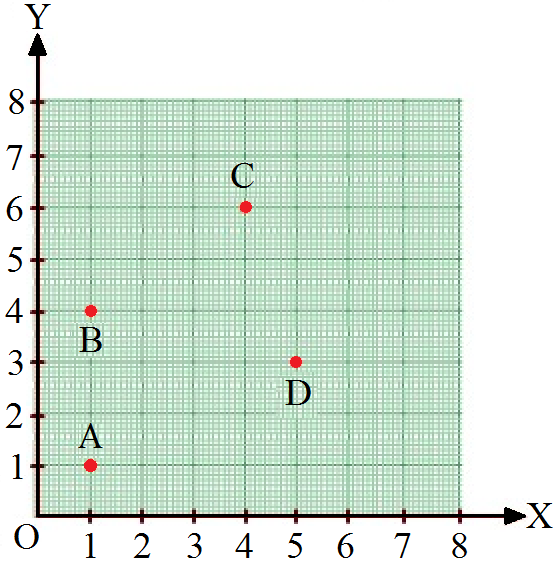
Find the coordinates of points $A, B, C, D$ in Figure.
State which property is in the following and verify it.
(i) $\frac{2}{5}+\left\{\left(-\frac{6}{7}\right)+\frac{7}{6}\right\} \neq\left\{\frac{2}{5}+\left(\frac{-6}{7}\right)\right\} + \frac{7}{6}$
(ii) $\frac{3}{4}-\left(\frac{9}{16}-\frac{19}{8}\right) \neq\left(\frac{3}{4}-\frac{9}{16}\right)-\frac{9}{8}$
(iii) $4 \div(8\div16) \neq(4 \div 8) \div 16$
The following table shows the dimensions of cuboids such that, their volumes remain the same. Extend the table with as many more dimensions such that all the cuboids thus formed have the same volume.
Complete the table and write your conclusion on surface area and volume of each cuboid.
Dimensions of Cuboid (in units)Surface Area (sq unit)Volume (cu unit)
15, 10, 8___1200
6, 10, 20___1200
_________
_________
_________
_________