Question 13 Marks
Find $4 x \times 5 y \times 7 z.$ First, find $4 x \times 5 y$ and multiply it by $7 z$; or first find $5 y \times 7 z$ and multiply it by $4 x$. Is the result same? What do you observe? Does the order in which you carry out the multiplication matter?
Answer
$\begin{aligned}\text{We have,}~ 4 x \times 5 y \times 7 z & =(4 x \times 5 y) \times 7 z=(20 x y) \times(7 z) \\ & =(20 \times 7) \times(x y z)=140 x y z \end{aligned} $
$\begin{aligned}\text{Also, } 4 x \times 5 y \times 7 z & =4 x \times(5 y \times 7 z)=4 x \times(35 y z) \\ & =(4 \times 35) \times(x y z)=140 x y z\end{aligned}$
We observe that the result is same
i.e. $(4 x \times 5 y) \times 7 z=4 x \times(5 y \times 7 z)$
Hence, the product of monomials is associative
i.e. the order, in which we multiply the monomials does not matter.
View full question & answer→Question 23 Marks
Can you think of two more such situations, where we may need to multiply algebraic expressions?
Hint Think of speed and tirne.
Think of interest to be paid, the principal and the rate of simple interest etc.
AnswerHere are two more situations where we may need to multiply algebraic expressions:
(i) Area of Rectangular Field Let's suppose you have a rectangular field with length $(x+3)\text m$ and width $(2 x-1)\text m$.
$\begin{aligned}\text{Area of rectangular field,}~ A & =(L \times W) m ^2 \\ & =(x+3) \times(2 x-1) \\ & =2 x^2+5 x-3 m^2\end{aligned}$
(ii) Cost and Expenses For an instance, to calculate the total cost of purchasing x items, each priced at ₹ $(a+b)$, then total cost $=x \times(a+b)=$ ₹ $(a x+b x)$
View full question & answer→Question 33 Marks
Simplify $a\left(a^2+a+1\right)+5$ and find its value for
(a) $a=0$ $\quad$ (b) $a=1$ $\quad$ (c) $a=-1$
Answer(ii) (a) 5 $\quad$ (b) 8 $\quad$ (c) 4
View full question & answer→Question 43 Marks
Simplify $3 x(4 x-5)+3$ and find its values for
(a) $x=3$ $\quad$ (b) $x=\frac{1}{2}$
Answer(i) We have, $3 x(4 x-5)+3$
$=(3 x) \times(4 x)-(3 x) \times(5)+3\qquad$ [by distributive law]
$=(3 \times 4) \times(x \times x)-(3 \times 5) \times(x)+3 $
$ =12 x^2-15 x+3$
(a) When $x=3$ then
$12 x^2-15 x+3 =12(3)^2-15(3)+3 $
$ =(12 \times 9)-45+3 $
$ =108-45+3=111-45=66$
(b) When $x=\frac{1}{2},$ then
$12x^{2}-15x+3=12(\frac{1}{2})^{2}-15(\frac{1}{2})+3$
$=12 \times \frac{1}{4}-\frac{15}{2}+3=3-\frac{15}{2}+3$
$=6-\frac{15}{2}=\frac{12-15}{2}=-\frac{3}{2}$
View full question & answer→Question 53 Marks
Find the product.
$\left(\frac{2}{3} x y\right) \times\left(\frac{-9}{10} x^2 y^2\right)$
AnswerWe have, $\left(\frac{2}{3} x y\right) \times\left(\frac{-9}{10} x^2 y^2\right)$
$=\left[\frac{2}{3} \times\left(-\frac{9}{10}\right)\right] \times\left(x \times x^2\right) \times\left(y \times y^2\right) $
$ =-\left(\frac{2}{3} \times \frac{9}{10}\right) \times\left(x^3\right) \times\left(y^3\right) $
$ =-\frac{3}{5} x^3 y^3$
View full question & answer→Question 63 Marks
Obtain the product of
$2,4 y, 8 y^2, 16 y^3$
AnswerWe have, $2,4 y, 8 y^2$ and $16 y^3$
$\begin{aligned} \text { Required product } & =2 \times(4 y) \times\left(8 y^2\right) \times\left(16 y^3\right) \\ & =(8 y) \times\left(8 y^2\right) \times\left(16 y^3\right) \\ & =(8 \times 8) \times\left(y \times y^2\right) \times\left(16 y^3\right) \\ & =\left(64 y^3\right) \times\left(16 y^3\right) \\ & =(64 \times 16) \times\left(y^3 \times y^3\right) \\ & =1024 y^6\end{aligned}$
View full question & answer→Question 73 Marks
Obtain the volume of rectangular boxes with the following length, breadth and height, respectively.
$5 a, 3 a^2, 7 a^4$
AnswerWe have, length $=5 a$, breadth $=3 a^2$ and height $=7 a^4$
$\therefore \text { Volume of rectangular box } $
$=\text { Length } \times \text { Breadth } \times \text { Height } $
$=(5 a) \times\left(3 a^2\right) \times\left(7 a^4\right) $
$=(5 \times 3 \times 7) \times\left(a \times a^2 \times a^4\right)=105 a^7$
View full question & answer→Question 83 Marks
Find the areas of rectangles with the following pairs of monomials as their lengths and breadths respectively.
$(p, q),(10 m, 5 n),\left(20 x^2, 5 y^2\right),\left(4 x, 3 x^2\right),(3 m n, 4 n p)$
Answer
$\begin{array}{l}\text { (i) We have, length }=p \text { and breadth }=q \\ \begin{aligned} \therefore \text { Area of rectangle } & =\text { Length } \times \text { Breadth } \\ & =p \times q=p q\end{aligned}\end{array}$
(ii) We have, length = 10m and breadth = 5n
$\begin{aligned} \therefore \text { Area of rectangle } & =\text { Length } \times \text { Breadth } \\ & =(10 m) \times(5 n) \\ & =(10 \times 5) \times(m \times n) \\ & =50 \times(m n)=50 mn \end{aligned}$
(iii) We have, length $=20 x^2$ and breadth $=5 y^2$
$\begin{aligned} \therefore \text { Area of rectangle } & =\text { Length } \times \text { Breadth } \\ & =\left(20 x^2\right) \times\left(5 y^2\right) \\ & =(20 \times 5) \times\left(x^2 \times y^2\right) \\ & =100 x^2 y^2\end{aligned}$
(iv) We have, length $=4 x$ and breadth $=3 x^2$
$\begin{aligned} \therefore \text { Area of rectangle } & =\text { Length } \times \text { Breadth } \\ & =(4 x) \times\left(3 x^2\right) \\ & =(4 \times 3) \times\left(x \times x^2\right) \\ & =12 \times\left(x^3\right)=12 x^3\end{aligned}$
(v) We have, length $=3 m n$ and breadth $=4 n p$
$\begin{aligned} \therefore \text { Area of rectangle } & =\text { Length } \times \text { Breadth } \\ & =(3 m n) \times(4 n p) \\ & =(3 \times 4) \times(m n) \times(n p) \\ & =12 \times m \times(n \times n) \times p \\ & =12 m n^2 p\end{aligned}$
View full question & answer→Question 93 Marks
Subtract $3 x y+5 y z-7 z x$ from $5 x y-2 y z-2 z x+10 x y z$
AnswerFor subtraction, write the like terms one below the other, we get
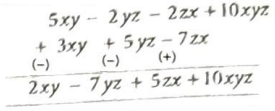
Thus, the required answer is 2xy - 7yz + 5zx + 10xyz
View full question & answer→Question 103 Marks
Subtract $4 a-7 a b+3 b+12$ from $12 a-9 a b+5 b-3.$
AnswerFor subtraction, write the like terms one below the other, we get
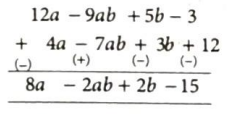
Thus, the required answer is 8a - 2ab + 2b - 15.
View full question & answer→Question 113 Marks
Add the following
$a-b+a b, b-c+b c, c-a+a c$
AnswerWe have, a – b + ab, b – c + bc, c - a + ac
On writing the given expressions in separate rows with like terms one below the other, we get
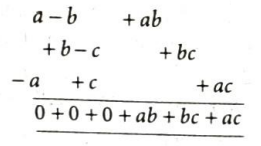
Thus, the sum of the expressions is ab + bc + cа.
View full question & answer→Question 123 Marks
Add the following
$a b-b c, b c-c a, c a-a b$
AnswerWe have, $a b-b c, b c-c a, c a-a b$
On writing the given expressions in separate rows with like terms one below the other, we get
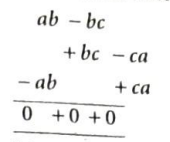
Thus, the sum of the expressions is 0. View full question & answer→Question 133 Marks
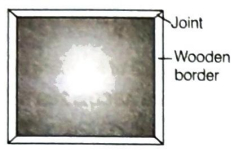
The border of the painting has been made in such a way that the joints of the border are as shown in the diagram below
Simplify the following algebraic expression.
$(4\text{g}+\text{h})(4\text{h}+\text{g})-2\text{gh}$ Answer9. We have,
$(4 \text{g}+\text{h})(4 \text{h}+\text{g})-2 \text{g} \text{h}$
$=4 \text{g} \times(4 \text{h}+\text{g})+\text{h} \times(4 \text{h}+\text{g})-2 \text{g} \text{h}\quad$ [by distributive property]
$=4 \text{g} \times 4 \text{h}+4 \text{g} \times \text{g}+\text{h} \times 4 \text{h}+\text{h} \times \text{g}-2 \text{g} \text{h}$
$=4 \times 4 \times \text{g} \times \text{h}+4 \text{g}^2+4 \times \text{h} \times \text{h}+\text{g} \text{h}-2 \text{g} \text{h}$
$=16 \text{g} \text{h}+4 \text{g}^2+4 \text{h}^2+\text{g} \text{h}-2 \text{g} \text{h}$
$=4 \text{g}^2+4 \text{h}^2+16 \text{g} \text{h}+\text{g} \text{h}-2 \text{g} \text{h}$
$=4 \text{g}^2+4 \text{h}^2+15 \text{g} \text{h}$
View full question & answer→Question 143 Marks
If two adjacent sides of a rectangle are $\left(\text x^2+\text x-1\right)$ and $\left(2\text x^2-3\text x+1\right).$ Find its area.
AnswerWe know that
Area of rectangle $=$ Length $\times$ Breadth
$\because$ Length $=\text x^2+\text x-1$
and breadth $=2\text x^2-3\text x+1$
$\therefore$ Area $=\left(\text x^2+\text x-1\right) \times\left(2\text x^2-3\text x+1\right)$
$=\text x^2 \times\left(2\text x^2-3\text x+1\right)+\text x \times\left(2\text x^2-3\text x+1\right)$ $-1 \times\left(2\text x^2-3\text x+1\right)$
$=2\text x^4-3\text x^3+\text x^2+2\text x^3-3\text x^2+\text x-2\text x^2+3\text x-1$
$=2\text x^4+\left(-3\text x^3+2\text x^3\right)+\left(\text x^2-3\text x^2-\right. \left.2\text x^2\right) +(\text x+3\text x)-1\quad$ [by grouping the like terms]
$=2\text x^4-\text x^3-4\text x^2+4\text x-1$
View full question & answer→Question 153 Marks
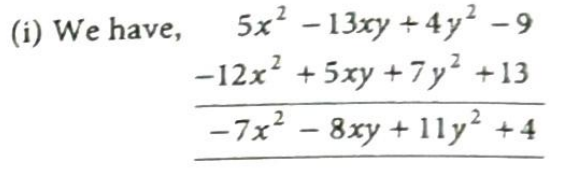
(i) Add $5 \text{x}^2-13 \text{x} \text{y}+4 \text{y}^2-9$ and $7 \text{y}^2+5 \text{x} \text{y}-12 \text{x}^2+13.$
(ii) Subtract $-3 \text{p}^2+3 \text{pq}+3 \text{p} \text{x}$ from $3 \text{p}(-\text{p}-\text{a}-\text{r}).$
Answer
(ii) Given, $3 \text{p}(-\text{p}-\text{a}-\text{r})-(-3 \text{p}^2+3 \text{p} \text{q}+3 \text{px})$
$\therefore(-3 \text{p}^2-3 \text{a} \text{p}-3 \text{p} \text{r})-(-3 \text{p}^2+3 \text{p} \text{q}+3 \text{px})$
$=-3 \text{p}^2-3 \text{a} \text{p}-3 \text{p} \text{r}+3 \text{p}^2-3 \text{p} \text{q}-3 \text{px}$
$=-3 \text{a} \text{p}-3 \text{p} \text{r}-3 \text{p} \text{q}-3 \text{px}$ View full question & answer→Question 163 Marks
Find the volume of rectangular boxes with the following length, breadth and height.
(i) $8\text m, 4\text n, 5\text p$ $\quad$ (ii) $0.5\text a , 4\text b, 1.5\text c$
AnswerWe know that,
Volume $=$ Length $\times$ Breadth $\times$ Height
Hence, for (i) Volume $=8\text m \times 4 \text n \times 5\text p$
$=8 \times 4 \times 5 \times\text m \times\text n \times\text p$
$= 160\text{ mmp}$
For (ii) Volume $=0.5\text a \times 4\text b \times 1.5\text c$
$=0.5 \times 4 \times 1.5 \times\text a \times\text b \times\text c$
$=3\text{abc}$
View full question & answer→Question 173 Marks
Solve $\left(\frac{3}{4}\text x+\frac{4}{3}\text y\right) \times\left(\frac{3}{4}\text x+\frac{3}{4}\text z\right).$
AnswerWe know that $(\text x+\text a)(\text x+\text{b})=\text x^2+(\text a+\text{b}) \text x+\text a \text{b}$,
$\therefore\left(\frac{3}{4} \text x+\frac{4}{3} \text{y}\right)\left(\frac{3}{4} \text x+\frac{3}{4} \text{z}\right)$
$=\left(\frac{3}{4} \text x\right)^2+\left(\frac{4}{3} \text{y}+\frac{3}{4} \text{z}\right) \frac{3}{4} \text x+\frac{4}{3} \text{y} \times \frac{3}{4} \text{z}$
$=\frac{9}{16} \text x^2+\frac{4}{3} \text{y} \times \frac{3}{4} \text x+\frac{3}{4} \text{z} \times \frac{3}{4} \text x+\text{y} \text{z}$
$=\frac{9}{16} \text x^2+\text x \text{y}+\frac{9}{16} \text{z} \text x+\text{y} \text{z}$
View full question & answer→Question 183 Marks
Multiply the following
(i) $-7 \text{p} \text{q}^2 \text{r}^3,-26 \text{p}^3 \text{q} \text{r}^2$
(ii) $-5 \text{a} \text{b} \text{c}^2, 11 \text{a} \text{b}^2, 13 \text{a}^2 \text{b} \text{c}$
Answer(i) We have, $ -7 \text{p} \text{q}^2 \text{r}^3 \times(-26 \text{p}^3 \text{q} \text{r}^2)$
$ = (-7) \times(-26) \times \text{p} \times \text{q}^2 \times \text{r}^3 \times \text{p}^3 \times \text{q} \times \text{r}^2 $
$ = 182 \text{ p}^4 \text{ q}^3 \text{ r}^5$
(ii) We have, $-5 \text{a} \text{b} \text{c}^2 \times 11 \text{a} \text{b}^2 \times 13 \text{a}^2 \text{b} \text{c}$
$=(-5 \times 11 \times 13) \times \text{a} \text{b} \text{c}^2 \times \text{a} \text{b}^2 \times \text{a}^2 \text{b} \text{c}$
$=-715 \times \text{ a}^4 \text{ b}^4 \text{ c}^3$
View full question & answer→Question 193 Marks
Simplify $\text{x}(3 \text{x}+2 \text{y})-\text{y}(3 \text{x}-2 \text{y}).$
AnswerWe have, $\text{x}(3 \text{x}+2 \text{y})-\text{y}(3 \text{x}-2 \text{y})\quad$ [using distributive law]
$=\text{x} \times 3 \text{x}+\text{x} \times 2 \text{y}-\text{y} \times 3 \text{x}+\text{y} \times 2 \text{y}$
$=3 \text{x}^2+2 \text{x} \text{y}-3 \text{x} \text{y}+2 \text{y}^2$
$=3 \text{x}^2+2 \text{y}^2-\text{x} \text{y}$
View full question & answer→Question 203 Marks
Subtract the following
(i) $3 \text{t}^4-4 \text{t}^3+2 \text{t}^2-6 \text{t}+6$ from $-4 \text{t}^4+8 \text{t}^3-4 \text{t}^2-2 \text{t}+11$
(ii) $2 \text{a} \text{b}+5 \text{b} \text{c}-7 \text{a} \text{c}$ from $5 \text{a} \text{b}-2 \text{a} \text{c}+10 \text{a} \text{b} \text{c}$
Answer(i) We have, $(-4 \text{t}^4+8 \text{t}^3-4 \text{t}^2-2 \text{t}+11)$ $-(3 \text{t}^4-4 \text{t}^3+2 \text{t}^2-6 \text{t}+6)$
$=-4 \text{t}^4+8 \text{t}^3-4 \text{t}^2-2 \text{t}+11-3 \text{t}^4+4 \text{t}^3-2 \text{t}^2 +6 \text{t}-6$
$=-7 \text{t}^4+12 \text{t}^3-6 \text{t}^2+4 \text{t}+5$
(ii) We have,
$(5 \text{a} \text{b}- 2 \text{a} \text{c}+10 \text{a} \text{b} \text{c})-(2 \text{a} \text{b}+5 \text{b} \text{c}-7 \text{a} \text{c}) $
$ =5 \text{a} \text{b}-2 \text{a} \text{b}-2 \text{a} \text{c}+7 \text{a} \text{c}+10 \text{a} \text{b} \text{c}-5 \text{b} \text{c} $
$ =3 \text{a} \text{b}+5 \text{a} \text{c}+10 \text{a} \text{b} \text{c}-5 \text{b} \text{c}$
View full question & answer→Question 213 Marks
Add the following:
(i) $7 \text{a}^2 \text{b} \text{c},-13 \text{a} \text{b} \text{c}^2, 13 \text{a}^2 \text{b} \text{c}, 2 \text{a} \text{b} \text{c}^2$
(ii) $21 \text{a}^2 \text{b} \text{c},-45 \text{a} \text{b} \text{c}^2, 18 \text{a}^2 \text{b} \text{c}, 21 \text{a} \text{b} \text{c}^2$
Answer(i) We have,
$\left(7 \text{a}^2 \text{b} \text{c}\right)+\left(-13 \text{a} \text{b} \text{c}^2\right)+\left(13 \text{a}^2 \text{b} \text{c}\right)+\left(2 \text{a} \text{b} \text{c}^2\right)$
$=7 \text{a}^2 \text{b} \text{c}+13 \text{a}^2 \text{b} \text{c}-13 \text{a} \text{b} \text{c}^2+2 \text{a} \text{b} \text{c}^2$
$=20 \text{a}^2 \text{b} \text{c}-11 \text{a} \text{b} \text{c}^2$
(ii) We have,
$(21 \text{a}^2 \text{b} \text{c})+(-45 \text{a} \text{b} \text{c}^2)+(18 \text{a}^2 \text{b} \text{c})+(21 \text{a} \text{b} \text{c}^2)$
$=21 \text{a}^2 \text{b} \text{c}-45 \text{a} \text{b} \text{c}^2+18 \text{a}^2 \text{b} \text{c}+21 \text{a} \text{b} \text{c}^2$
$=21 \text{a}^2 \text{b} \text{c}+18 \text{a}^2 \text{b} \text{c}-45 \text{a} \text{b} \text{c}^2+21 \text{a} \text{b} \text{c}^2$
$=39 \text{a}^2 \text{b} \text{c}-24 \text{a} \text{b} \text{c}^2$
View full question & answer→