Question
Simplify:$\Big(16^{-\frac{1}{5}}\Big)^{\frac{5}{2}}$

Answer

We have,$\Big(16^{-\frac{1}{5}}\Big)^{\frac{5}{2}}=16^{-\frac{1}{5}\times\frac{5}{2}}$
$=16^{-\frac{1}{2}}$
$=\frac{1}{16^{\frac{1}{2}}}$
$=\frac{1}{(4^{2})^{\frac{1}{2}}}$
$=\frac{1}{(4^2)^{\frac{1}{2}}}$
$=\frac{1}{4}$
$\Rightarrow\Big(16^{-\frac{1}{5}}\Big)^{\frac{5}{2}}=\frac{1}{4}$

Need a full question paper?

Generate a complete, print-ready paper with questions like this in minutes — across 16+ boards, with answer keys.
Start Generating Free

Similar questions

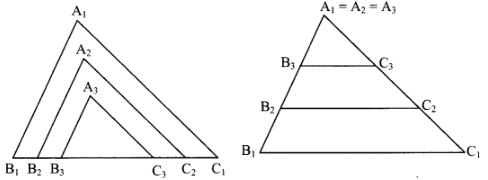
Draw a triangle $\Delta A _1 B_1 C _1$ on a card-sheet and cut it out.
Measure $\angle A _1, \angle B_1, \angle C _1$
Draw two more triangles $AA _2 B_2 C _2$ and $AA _3 B_3 C _3$ such that
$\angle A _1=\angle A _2=\angle A _3, \angle B_1=\angle B _2=\angle B _3, \angle C _1=\angle C _2=\angle C _3$ and $B _1 C _1> B _2 C _2> B _3 C _3$.
Now cut these two triangles also.
Measure the lengths of the three triangles. Arrange the triangles in two ways as shown in the figure.

Image

Check the ratios $\frac{A_1 B_1}{A_2 B_2}, \frac{B_1 C_1}{B_2 C_2}, \frac{A_1 C_1}{A_2 C_2}$.
You will notice that the ratios are equal.
Similarly, see whether the ratios $\frac{A_1 C_1}{A_3 C_3}, \frac{B_1 C_1}{B_3 C_3}, \frac{A_1 B_1}{A_3 B_3}$ are equal.
What do you observe?
Write the antecedent (given part) and the consequent (part to be proved) in the following statements : If all sides of a triangle are congruent, then its all angles are congruent.
Find the measure of an angle which is 36º more than its complement.
Factorise:
$x^3-512$
Find the laterall surface area and total surface area of a cuboid of length $80 cm$ , breadth $40 cm$ and height $20 cm .$
Find the value to three place of decimals of each of the following. It is given that $\sqrt2=1.414,\ \sqrt3=1.732,\ \sqrt5=2.236,\ \sqrt10=3.162.$$\frac{3}{\sqrt{10}}$
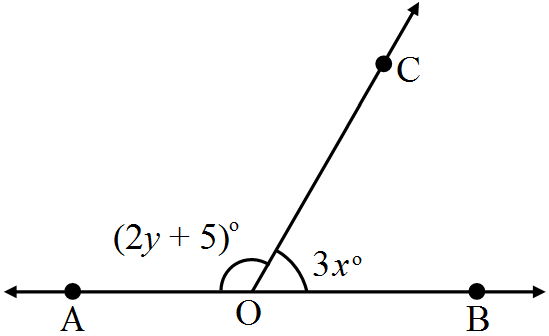
In figure, OA and OB are opposite rays: If y = 35°, what is the value of x?
Sin θ =$\frac{1}{2}$.Find Cos θ= , Tan θ= ?
Solve the equation 3x - 2 = 2x + 3 and represent the solulion on the number line.
Find the value of a for which $(x + 2a)$ is a factor of $(x^5 - 4a^2x^3 + 2x + 2a + 3)$.