Question
Simplify by rationalising the denominator:$\frac{2\sqrt{6}-\sqrt{5}}{3\sqrt{5}-2\sqrt{6}}$
Answer

$\frac{2\sqrt{6}-\sqrt{5}}{3\sqrt{5}-2\sqrt{6}}$$=\frac{2\sqrt{6}-\sqrt{5}}{3\sqrt{5}-2\sqrt{6}}\times\frac{3\sqrt{5}+2\sqrt{6}}{3\sqrt{5}+2\sqrt{6}}$
$=\frac{2\sqrt{6}\times3\sqrt{5}+\big(2\sqrt{6}\big)^2-\sqrt{5}\times3\sqrt{5}-\sqrt{5}\times2\sqrt{6}}{\big(3\sqrt{5}\big)^2-\big(2\sqrt{6}\big)^2}$
$=\frac{6\sqrt{30}+24-15-2\sqrt{30}}{45-24}$
$=\frac{4\sqrt{30}+9}{21}$

Need a full question paper?

Generate a complete, print-ready paper with questions like this in minutes — across 16+ boards, with answer keys.

Start Generating Free

Similar questions

Find the surface area of a sphere, if its volume is $38808$ cubic $cm .\left(\pi=\frac{22}{7}\right)$
Given: Volume of sphere $= 38808$ cubic cm.
To find: Surface area of sphere
Draw a labelled figure showing information in each of the following statements and write the antecedent and the consequent : If angles in a linear pair are congruent, then each of them is a right angle.
On a common hypotenuse AB, two right triangles ACB and ADB are situated on opposite sides. Prove that $\angle\text{BAC}=\angle\text{BDC}.$
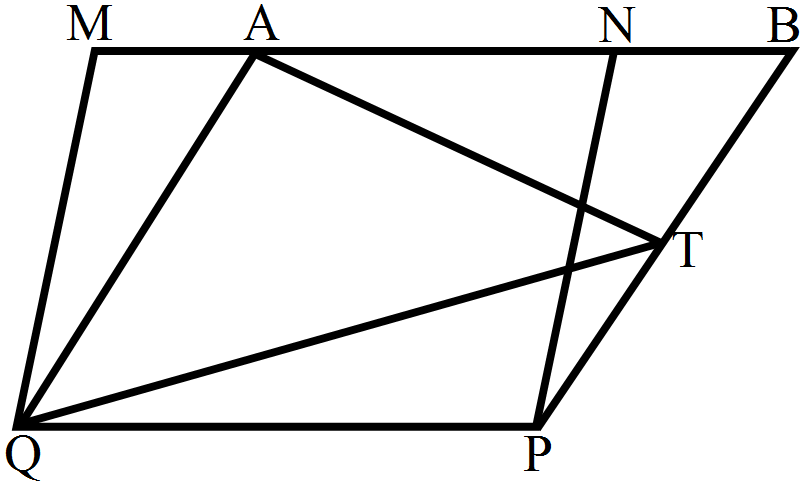
In the adjoining figure, MNPQ and ABPQ are parallelograms and T is any point on the side BP. Prove that
  1. $\text{ar}(\text{MNPQ})=\text{ar}(\text{ABPQ})$
  2. $\text{ar}(\triangle\text{ATQ})=\frac{1}{2}\text{ar}\text{(MNPQ}).$
Evaluate the following:
$(10.4)^3$
If $3^{4\text{x}}=(81)^{-1}$ and $10^{\frac{1}{\text{y}}}0.0001,$ find the value of $2^{-\text{x}+4\text{y}}.$
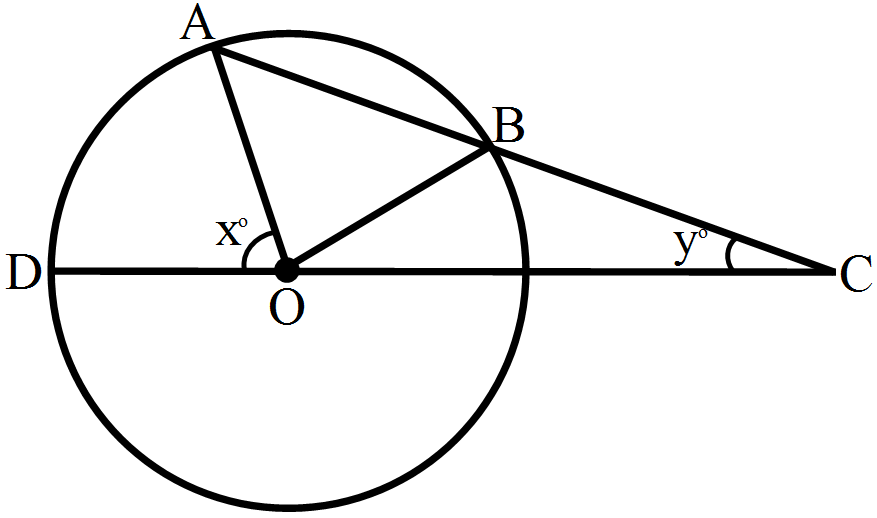
In the given figure, AB is a chord of a circle with centre O and AB is produced to C such that BC = OB. Also, CO is joined and produced to meet the circle in D. If $\angle\text{ACD}=\text{y}^\circ$ and $\angle\text{AOD}=\text{x}^\circ,$ prove that x = 3y.
If $a, b, c$ are in continued proportion then show that $\frac{a}{c}=\frac{a^2+a b+b^2}{b^2+b c+c^2}$
Simplify:$\Big(\frac{5^{-1}\times7^2}{5^2\times7^{-4}}\Big)^{\frac{7}{2}}\times\Big(\frac{5^{-2}\times7^3}{5^3\times7^{-5}}\Big)^{-\frac{5}{2}}$
Diagonals of a parallelogram WXYZ intersect each other at point O. If ∠XYZ∠ = 135°, then measure of ∠XWZ and ∠YZW? If l(OY) = 5 cm, then l(WY) = ?