Question
Simplify the following:$\Big(\frac{\text{x}}{2}+\frac{\text{y}}{3}\Big)^3-\Big(\frac{\text{x}}{2}-\frac{\text{y}}{3}\Big)^3$

Answer

Given $\Big(\frac{\text{x}}{2}+\frac{\text{y}}{3}\Big)^3-\Big(\frac{\text{x}}{2}-\frac{\text{y}}{3}\Big)^3$
We shall use the identity $a^3 - b^3 = (a - b)(a^2 + b^2+ ab)$
Here $\text{a}=\Big(\frac{\text{x}}{2}+\frac{\text{y}}{3}\Big),\ \text{b=}\Big(\frac{\text{x}}{2}-\frac{\text{y}}{3}\Big)$
By applying identity we get$=\bigg(\Big(\frac{\text{x}}{2}+\frac{\text{y}}{3}\Big)-\Big(\frac{\text{x}}{2}-\frac{\text{y}}{3}\Big)\bigg)\\\bigg[\Big(\frac{\text{x}}{2}+\frac{\text{y}}{3}\Big)^2+\Big(\frac{\text{x}}{2}-\frac{\text{y}}{3}\Big)^2-\Big(\frac{\text{x}}{2}+\frac{\text{y}}{3}\Big)\Big(\frac{\text{x}}{2}-\frac{\text{y}}{3}\Big)\bigg]$
$=\Big(\frac{\text{x}}{2}+\frac{\text{y}}{3}-\frac{\text{x}}{2}+\frac{\text{y}}{3}\Big)\Bigg[\bigg(\Big(\frac{\text{x}}{2}\Big)^2+\Big(\frac{\text{y}}{3}\Big)^2+\frac{2\text{xy}}{6}\Big)\\+\bigg(\Big(\frac{\text{x}}{2}\Big)^2+\Big(\frac{\text{y}}{3}\Big)^2-\frac{2\text{xy}}{6}\bigg)+\bigg(\Big(\frac{\text{x}}{2}\Big)^2-\Big(\frac{\text{y}}{3}\Big)^2\bigg)\Bigg]$
$=\frac{2\text{y}}{3}\Big[\Big(\frac{\text{x}^2}{4}+\frac{\text{y}^2}{9}+\frac{2\text{xy}}{6}\Big)+\Big(\frac{\text{x}^2}{4}+\frac{\text{y}^2}{9}-\frac{2\text{xy}}{6}\Big)+\frac{\text{x}^2}{4}-\frac{\text{y}^2}{9}\Big]$
$=\frac{2\text{y}}{3}\Big[\frac{\text{x}^2}{4}+\frac{\text{y}^2}{9}+\frac{2\text{xy}}{6}+\frac{\text{x}^2}{4}+\frac{\text{y}^2}{9}-\frac{2\text{xy}}{6}+\frac{\text{x}^2}{4}-\frac{\text{y}^2}{9}\Big]$
$$By rearranging the variable we get$=\frac{2\text{y}}{3}\Big[\frac{\text{x}^2}{4}+\frac{\text{y}^2}{9}+\frac{\text{x}^2}{4}+\frac{\text{x}^2}{9}\Big]$
$=\frac{2\text{xy}}{3}\Big[\frac{3\text{x}^2}{4}+\frac{\text{y}^2}{9}\Big]$
$=\frac{\text{x}^2\text{y}}{2}+\frac{2\text{y}^3}{27}$
Hence the simplified value of$\Big(\frac{\text{x}}{2}+\frac{\text{y}}{3}\Big)^3-\Big(\frac{\text{x}}{2}-\frac{\text{y}}{3}\Big)^3$ is $\frac{\text{x}^2\text{y}}{2}+\frac{2\text{y}^3}{27}.$

Need a full question paper?

Generate a complete, print-ready paper with questions like this in minutes — across 16+ boards, with answer keys.

Start Generating Free

Similar questions

In the following, use factor theorem to find whether polynomial g(x) is a factor of polynomial f(x) or, not:
$f(x) = x^3 - 6x^2 + 11x - 6, $
$g(x)=x^2 - 3x + 2$
If the mean of the following data is 20.2, then find the value of p.

Image

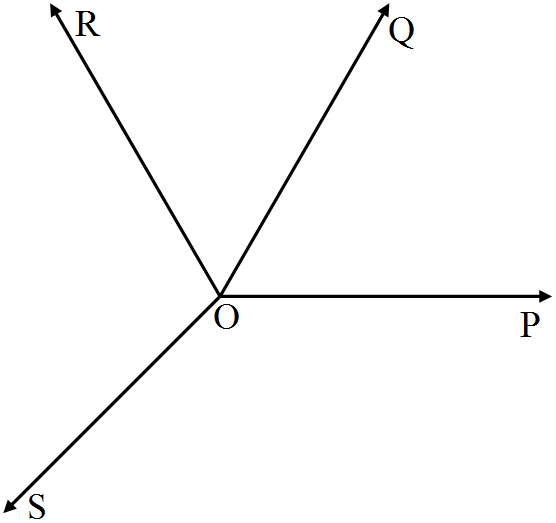
In figure, OP, OQ, OR and OS are four rays. Prove that: $\angle\text{POQ}+\angle\text{QOR}+\angle\text{SOR}+\angle\text{POS}=360^\circ$
Given below is the frequency distribution of wages (in ₹) of 30 workers in certain factory:
Wages(in ₹)
110-130
130-150
150-170
170-190
190-210
210 -230
230-250
No of workers
3
4
5
6
5
4
3
A worker is selected at random. Find the probability that his wages are:
  1. Less than ₹ 150
  2. At least ₹ 210
  3. More than or equal to 150 but less than ₹ 210
In the following, using the remainder theorem, find the remainder when $f(x)$ is divided by $g(x)$ and verify the by actual division:
$f(x) = x^3 + 4x^2 - 3x + 10, g(x) = x + 4$
$x^4 + 10x^3 + 35x^2 + 50x + 24.$
Divide first polynomial by second polynomial and write the answer in the form ‘Dividend = Divisor x Quotient + Remainder’ :
$x^3 – 64; x – 4$
Prove that in a quadrilateral the sum of all the sides is geater than the sum of its diagonals.
The income and expenditure for 5 years of a family is given in the following data:
Years
1995–96
1996–97
1997–98
1998–99
1999–2000
Income (Rs. In thousands)
100
140
150
170
210
Expenditure (Rs. in thousands)
80
130
145
160
190
Represent the above data by a bar graph.
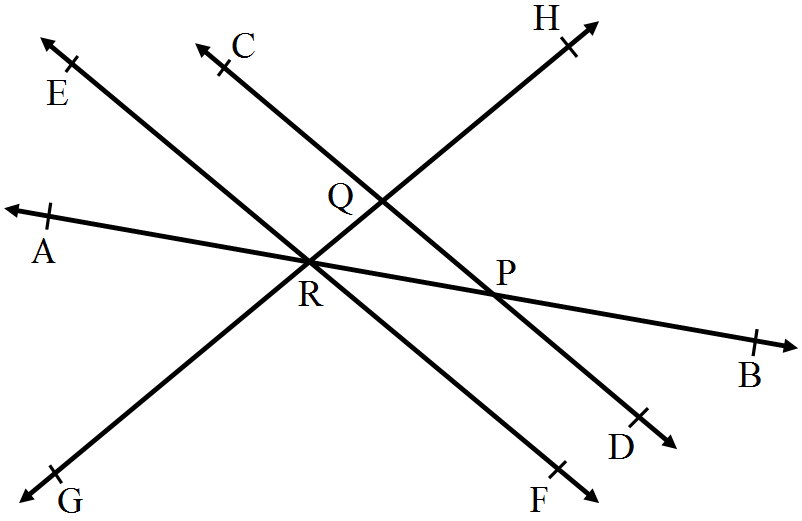
In the adjoining figure, name:
  1. Two pairs of intersecting lines and their corresponding points of intersection.
  2. Three concurrent lines and their points of intersection.
  3. Three rays.
  4. Two line segments.