Question
Simplify the following: $\Big(\frac{\text{x}}{2}+\frac{\text{y}}{3}\Big)^3-\Big(\frac{\text{x}}{2}-\frac{\text{y}}{3}\Big)^3$

Answer

Given $\Big(\frac{\text{x}}{2}+\frac{\text{y}}{3}\Big)^3-\Big(\frac{\text{x}}{2}-\frac{\text{y}}{3}\Big)^3$
We shall use the identity $a^3 - b^3 = (a - b)(a^2 + b^2+ ab)$
Here $\text{a}=\Big(\frac{\text{x}}{2}+\frac{\text{y}}{3}\Big),\ \text{b=}\Big(\frac{\text{x}}{2}-\frac{\text{y}}{3}\Big)$ By applying identity we get $=\bigg(\Big(\frac{\text{x}}{2}+\frac{\text{y}}{3}\Big)-\Big(\frac{\text{x}}{2}-\frac{\text{y}}{3}\Big)\bigg)$
$\bigg[\Big(\frac{\text{x}}{2}+\frac{\text{y}}{3}\Big)^2+\Big(\frac{\text{x}}{2}-\frac{\text{y}}{3}\Big)^2-\Big(\frac{\text{x}}{2}+\frac{\text{y}}{3}\Big)\Big(\frac{\text{x}}{2}-\frac{\text{y}}{3}\Big)\bigg]$
$=\Big(\frac{\text{x}}{2}+\frac{\text{y}}{3}-\frac{\text{x}}{2}+\frac{\text{y}}{3}\Big)\Bigg[\bigg(\Big(\frac{\text{x}}{2}\Big)^2+\Big(\frac{\text{y}}{3}\Big)^2+\frac{2\text{xy}}{6}\Big)$
$+\bigg(\Big(\frac{\text{x}}{2}\Big)^2+\Big(\frac{\text{y}}{3}\Big)^2-\frac{2\text{xy}}{6}\bigg)+\bigg(\Big(\frac{\text{x}}{2}\Big)^2-\Big(\frac{\text{y}}{3}\Big)^2\bigg)\Bigg]$
$=\frac{2\text{y}}{3}\Big[\Big(\frac{\text{x}^2}{4}+\frac{\text{y}^2}{9}+\frac{2\text{xy}}{6}\Big)+\Big(\frac{\text{x}^2}{4}+\frac{\text{y}^2}{9}-\frac{2\text{xy}}{6}\Big)+\frac{\text{x}^2}{4}-\frac{\text{y}^2}{9}\Big]$
$=\frac{2\text{y}}{3}\Big[\frac{\text{x}^2}{4}+\frac{\text{y}^2}{9}+\frac{2\text{xy}}{6}+\frac{\text{x}^2}{4}+\frac{\text{y}^2}{9}-\frac{2\text{xy}}{6}+\frac{\text{x}^2}{4}-\frac{\text{y}^2}{9}\Big]$
By rearranging the variable we get $=\frac{2\text{y}}{3}\Big[\frac{\text{x}^2}{4}+\frac{\text{y}^2}{9}+\frac{\text{x}^2}{4}+\frac{\text{x}^2}{9}\Big]$
$=\frac{2\text{xy}}{3}\Big[\frac{3\text{x}^2}{4}+\frac{\text{y}^2}{9}\Big]$
$=\frac{\text{x}^2\text{y}}{2}+\frac{2\text{y}^3}{27}$ Hence the simplified value of $\Big(\frac{\text{x}}{2}+\frac{\text{y}}{3}\Big)^3-\Big(\frac{\text{x}}{2}-\frac{\text{y}}{3}\Big)^3$ is $\frac{\text{x}^2\text{y}}{2}+\frac{2\text{y}^3}{27}.$

Need a full question paper?

Generate a complete, print-ready paper with questions like this in minutes — across 16+ boards, with answer keys.

Start Generating Free

Similar questions

If $\text{a}=\frac{\sqrt{5}+\sqrt{2}}{\sqrt{5}-\sqrt{2}}$ and $\text{b}=\frac{\sqrt{5}-\sqrt{2}}{\sqrt{5}+\sqrt{2}},$ show that $3\text{a}^2+4\text{ab}-3\text{b}^2=4+\frac{56}{3}\sqrt{10}.$
ABC is a triangle in which $\angle\text{A}=72^\circ,$ the internal bisectors of angles $B$ and $C$ meet in $O$. Find the magnitude of $\angle\text{BOC}.$
The following table shows the daily production of $T.V.$ sets in an industry for $7$ days of a week:
Day
Mon
Tue
Wed
Thurs
Fri
Sat
Sun
Number of T.V. Sets
$300$
$400$
$150$
$250$
$100$
$350$
$200$
Represent the above information by a pictograph.
Simplify: $\frac{2\sqrt{6}}{{\sqrt2}+\sqrt{3}}+\frac{6\sqrt{2}}{{\sqrt6}+\sqrt{3}}-\frac{8\sqrt{3}}{{\sqrt6}+\sqrt{2}}$
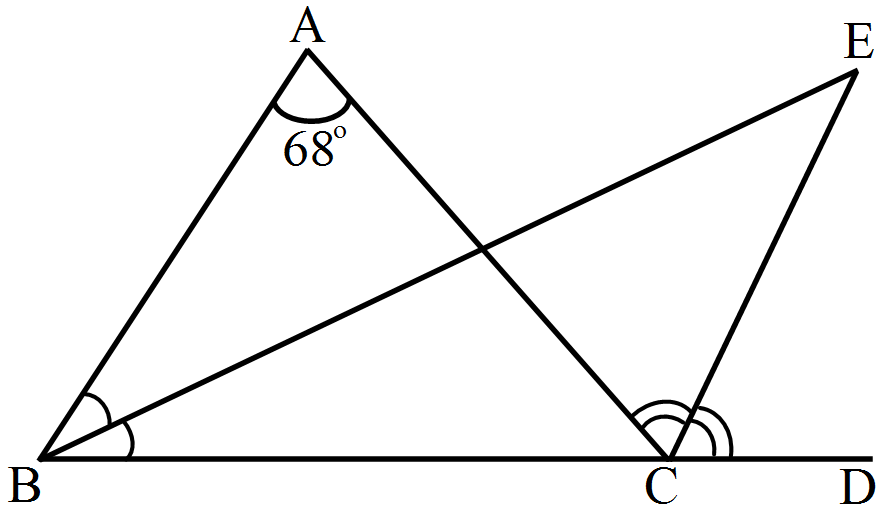
In the given figure, side $BC$ of $\triangle\text{ABC}$ is produced to point $D$ such that bisectors of $\angle\text{ACD}$ meet at a point $E$. If $\angle\text{BAC}=68^\circ,$ find $\angle\text{BEC}.$
ABCD is a quadrilateral in which AB || DC and AD = BC. Prove that $\angle\text{A}=\angle\text{B}$ and $\angle\text{C}=\angle\text{D}.$
A cuboidal vessel is 10m long and 8m wide. How high must it be made to hold 380 cubic metres of a liquid?
Bisectors of the angles $B$ and $C$ of an isosceles triangle with $AB = AC$ intersect each other at $O.\ BO$ is produced to a point M. Prove that $\angle\text{MOC}=\angle\text{ABC}.$
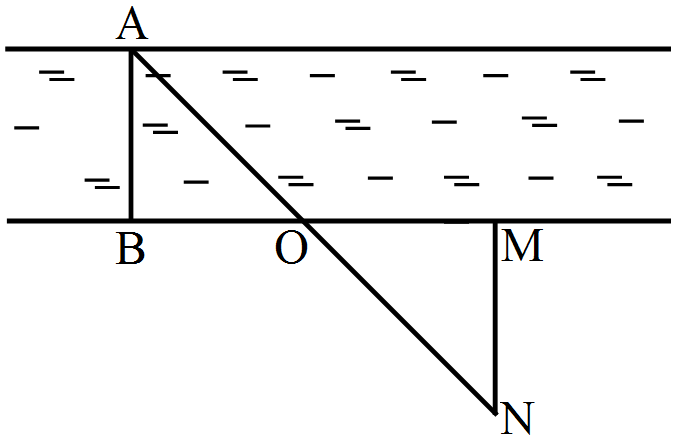
In the adjoining figure, explain how one can find the breadth of the river without crossing it.
In a $\triangle ABC$, if $L$ and $M$ are points on $AB$ and $AC$ respectively such that $LM \| BC$. Prove that:
$i. \text{ar}(\triangle\text{LCM})=\text{ar}(\triangle\text{LBM})$
$ii. \text{ar}(\triangle\text{LBC})=\text{ar}(\triangle\text{MBC})$
$iii. \text{ar}(\triangle\text{ABM})=\text{ar}(\triangle\text{ACL})$
$iv. \text{ar}(\triangle\text{LOB})=\text{ar}(\triangle\text{MOC})$