Question
Simplify the following: $\Big(\text{x}+\frac{2}{\text{x}}\Big)^3+\Big(\text{x}-\frac{2}{\text{x}}\Big)^3$

Answer

Given $\Big(\text{x}+\frac{2}{\text{x}}\Big)^3+\Big(\text{x}-\frac{2}{\text{x}}\Big)^3$ We shall use the identity $a^3 + b^3 = (a - b)(a^2 + b^2- ab)$ Here $\text{a}=\Big(\text{x}+\frac{2}{\text{x}}\Big),\ \text{b}=\Big(\text{x}-\frac{2}{\text{x}}\Big)$ By applying identity we get $​​=\Big(\text{x}+\frac{2}{\text{x}}+\text{x}-\frac{2}{\text{x}}\Big)\Bigg[\Big(\text{x}+\frac{2}{\text{x}}\Big)^2+\Big(\text{x}-\frac{2}{\text{x}}\Big)^2$
$-\bigg(\Big(\text{x}+\frac{2}{\text{x}}\Big)\times\Big(\text{x}-\frac{2}{\text{x}}\Big)\bigg)\Bigg]$
$=\Big(\text{x}+\frac{2}{\text{x}}+\text{x}-\frac{2}{\text{x}}\Big)\bigg[\Big(\text{x}\times\text{x}+\frac{2}{\text{x}}\times\frac{2}{\text{x}}+2\times\text{x}\times\frac{2}{\text{x}}\Big)$
$+\Big(\text{x}\times\text{x}+\frac{2}{\text{x}}\times\frac{2}{\text{x}}-2\times\text{x}\times\frac{2}{\text{x}}\Big)-\Big(\text{x}^2+\frac{4}{\text{x}^2}\Big)\bigg]$
$=(2\text{x})\bigg[\Big(\text{x}^2+\frac{4}{\text{x}^2}+\frac{4\text{x}}{\text{x}}\Big)+\Big(\text{x}^2+\frac{4}{\text{x}^2}-\frac{4\text{x}}{\text{x}}\Big)-\Big(\text{x}^2-\frac{4}{\text{x}^2}\Big)\bigg]$
$=(2\text{x})\bigg[\text{x}^2+\frac{4}{\text{x}^2}+\frac{4\text{x}}{\text{x}}+\text{x}^2+\frac{4}{\text{x}^2}-\frac{4\text{x}}{\text{x}}-\text{x}^2+\frac{4}{\text{x}^2}\bigg]$ By rearranging the variable we get, $=(2\text{x})\Big[\text{x}^2+\frac{4}{\text{x}^2}+\frac{4}{\text{x}^2}+\frac{4}{\text{x}}^2\Big]$
$=2\text{x}\times\Big[\text{x}^2+\frac{12}{\text{x}^2}\Big]$
$=2\text{x}^2+\frac{24}{\text{x}}$ Hence the simplified value of $\Big(\text{x}+\frac{2}{\text{x}}\Big)^3+\Big(\text{x}-\frac{2}{\text{x}}\Big)^3$ is $2\text{x}^2+\frac{24}{\text{x}}.$

Need a full question paper?

Generate a complete, print-ready paper with questions like this in minutes — across 16+ boards, with answer keys.
Start Generating Free

Similar questions

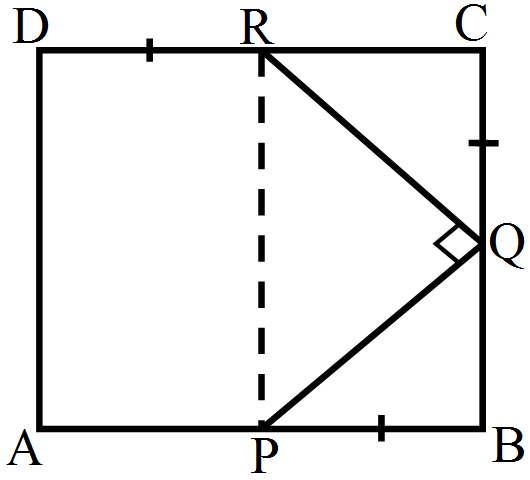
In the given figure, $\text{ABCD}$ is a square and $\angle\text{PQR}=90^{\circ}.$ If $PB = QC = DR,$ prove that:
$i. QB = RC$,
$ii. PQ = QR$,
$iii. \angle\text{QPR}=45^{\circ}$

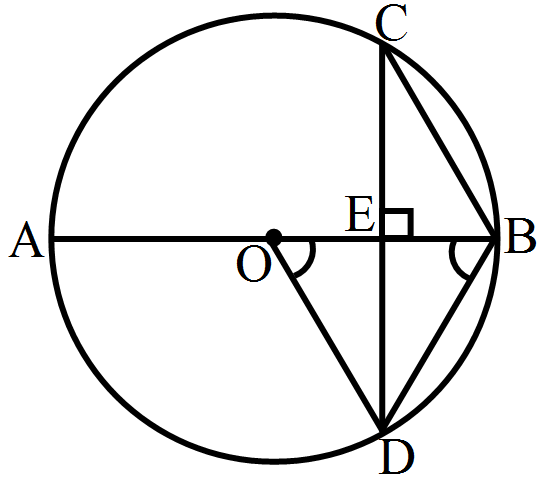
In the given figure, $O$ is the centre of the circle, $BD = OD$ and $\text{CD}\perp\text{AB}.$ Find $\angle\text{CAB}.$
The follwoing table shows the average daily earnings of $40$ general stores in a market, during a certain week.
Daily wages (in Rs.)
$700-750$
$750-800$
$800-850$
$850-900$
$900-950$
$950-1000$
Number of stores
$6$
$9$
$2$
$7$
$11$
$5$
Draw a histogram to represent the above data.
In a $\triangle\text{ABC},$ the internal bisectors of $\angle\text{B}$ and $\angle\text{E}$ meet at $P$ and the external bisectors of $\angle\text{B}$ and $\angle\text{C}$ meet at $Q.$ Prove that $\angle\text{BPC}+\angle\text{BQC}=180^\circ.$
Find the missing frequency p for the following frequency distribution whose mean is $28.25$.
x
$15$
$20$
$25$
$30$
$35$
$40$
f
$8$
$7$
$p$
$14$
$15$
$6$
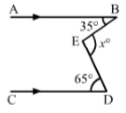
In each of the figures given below, $AB \| CD$. Find the value of $x ^{\circ}$ in each case.
Image
If the mean of the following data is $20.2$, find the value of $p$.
Variable $(x_i)$
$10$
$15$
$20$
$25$
$30$
Frequency $(f_i)$
$6$
$8$
$p$
$10$
$6$
If $O$ is a point within $\triangle\text{ABC,}$ show that:
$i. AB + AC > OB + OC$
$ii. AB + BC + CA > OA + OB + OC$
$iii. OA + OB + OC >\frac{1}{2}(AB + BC + CA)$.
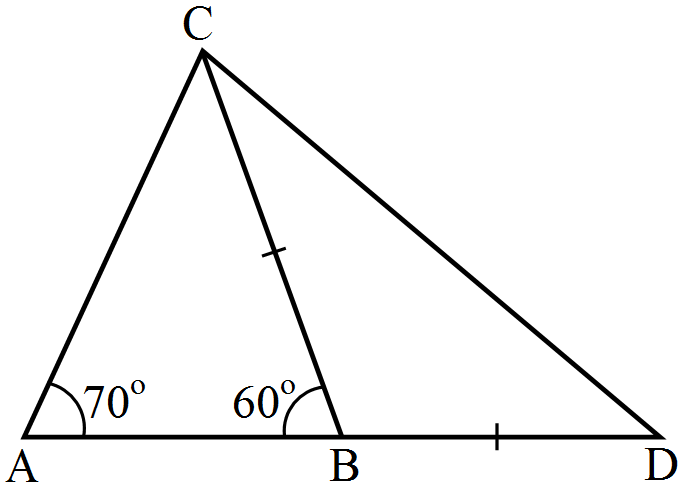
In $\triangle\text{ABC,}$ side $AB$ is produced to $D$ such that $BD = BC$. If $\angle\text{B}=60^{\circ},$ and $\angle\text{B}=60^{\circ},$ prove that:
$i. AD > CD$ and
$ii. AD > AC$.
If two lines intersect, prove that the vertically opposite angles are equal.