Question
Simplify:
$(x^2 + y^2 - z^2)^2 - (x^2 - y^2 + z^2)^2$

Answer

We have $\left(x^2+y^2-z^2\right)^2-\left(x^2-y^2+z^2\right)^2$
Using formula $(x+y+z)^2=x^2+y^2+z^2+2 x y+2 y z+2 z x$,
we get $\left(x^2+y^2-z^2\right)^2-\left(x^2-y^2+z^2\right)^2$
$=(\text{x}^2)^2+(\text{y}^2)^2+(-\text{z}^2)^2+2(\text{x}^2)(\text{y}^2)+2(\text{y}^2)(-\text{z}^2)+2(-\text{z}^2)(\text{x}^2)\\-\Big[(\text{x}^2)^2+(-\text{y}^2)^2+(\text{z}^2)^2+2(\text{x}^2)(-\text{y}^2)+2(-\text{y}^2)(\text{z}^2)+2(\text{z}^2)(\text{x}^2)\Big]$
$=\text{x}^4+\text{y}^4+\text{z}^4+2\text{x}^2\text{y}^2-2\text{y}^2\text{z}^2-2\text{z}^2\text{x}^2\\-\big[\text{x}^4+\text{y}^4+\text{z}^4-2\text{x}^2\text{y}^2-2\text{y}^2\text{z}^2+2\text{z}^2\text{x}^2\big]$
By canceling the opposite terms,
we get$\big(\text{x}^2 +\text{y}^2 -\text{z}^2\big)^2 -\big(\text{x}^2 -\text{y}^2+\text{z}^2)^2=\not\text{x}^4+\not\text{y}^4+\not\text{z}^4\\+2\text{x}^2\text{y}^2-2\text{y}^2\text{z}^2-2\text{z}^2\text{x}^2\not\text{x}^4-\not\text{y}^4-\not\text{z}^4+2\text{x}^2\text{y}^2+2\text{y}^2\text{z}^2-2\text{z}^2\text{x}^2$
$=4\text{x}^2\text{y}^2-4\text{z}^2\text{x}^2$
Talking $4x^2​​​​​​​$ as common factor we get$\big(\text{x}^2 +\text{y}^2 -\text{z}^2\big)^2 -\big(\text{x}^2 -\text{y}^2+\text{z}^2)^2=4\text{x}^2(\text{y}^2-\text{z}^2)$
Hence the value of $\big(\text{x}^2 +\text{y}^2 -\text{z}^2\big)^2 -\big(\text{x}^2 -\text{y}^2+\text{z}^2)^2$ is $4\text{x}^2(\text{y}^2-\text{z}^2).$

Need a full question paper?

Generate a complete, print-ready paper with questions like this in minutes — across 16+ boards, with answer keys.
Start Generating Free

Similar questions

P is a point on the bisector of an $\angle\text{ABC}.$ If the line through P parallel to AB meets BC at Q, prove that triangle BPQ is isosceles.
Using factor theorem, factorize the following polynomials:
$2y^3 + y^2 - 2y - 1$
The base BC of $\triangle\text{ABC}$ is divided at D such that $\text{BD}=\frac{1}{2}\text{DC}.$ Prove that $\text{ar}(\triangle\text{ABD})=\frac{1}{3}\times\text{ar}(\triangle\text{ABC}).$
Circles are described on the sides of a triangle as diameters. Proved that the circle on any two sides intersect each other on the third side (or third side produced).
Find rational numbers a and b such that:$\frac{\sqrt{3}+\sqrt{2}}{\sqrt{3}-\sqrt{2}}=\text{a}+\text{b}\sqrt{6}$
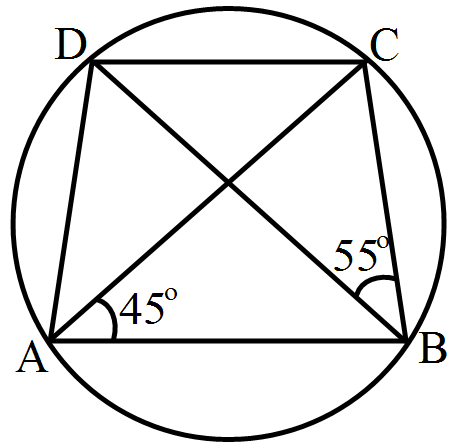
In the given figure, ABCD is a cyclic quadrilateral in which AC and BD are its diagonals. If $\angle\text{DBC}=55^\circ$ and $\angle\text{BAC}=45^\circ,$ find $\angle\text{BCD}.$
The production of saleable steel in some of the steel plants of our country during 1999 is given below:
Plant
Bhilai
Durgapur
Rourkela
Bokaro
Production (in thousands)
160
80
200
150
Construct a bar graph to represent the above data on a graph paper by using the scale 1 big divisions = 20 thousand tones.
The length of a hall is 18m and the width 12m. The sum of the areas of the floor and the flat roof is equal to the sum of the areas of the four walls. Find the height of the hall.
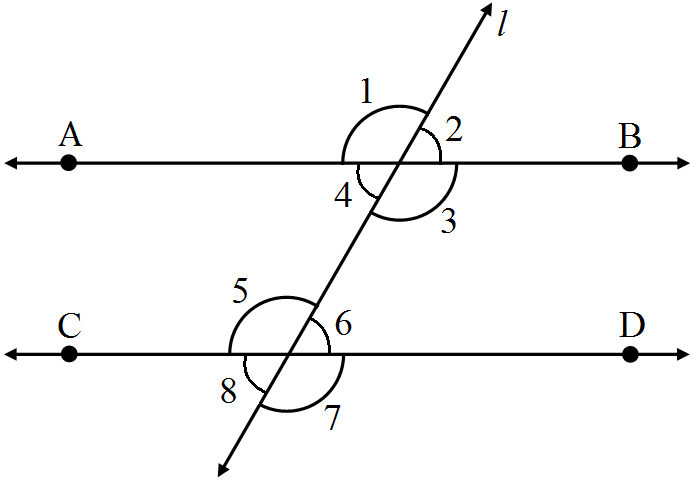
In figure AB || CD and $\angle\text{1}$ and $\angle\text{2}$ are in the ratio 3 : 2. Determine all angles from 1 to 8.
Suppose you are given a circle. Give a construction to find its centre.