Question
Simplify:
$(5 a+3 b)^2-(5 a-3 b)^2-60 a b$

Answer

$0$

Need a full question paper?

Generate a complete, print-ready paper with questions like this in minutes — across 16+ boards, with answer keys.
Start Generating Free

Similar questions

In a parallelogram $\text{ABCD}, E$ is the midpoint of $AB$ and $DE$ bisects angle $D$. Prove that:$CE$ is the bisector of $\angle C$ and $\angle DEC$ is a right angle.
Calculate the amount and the compound interest on ₹ 25000 for 3 years, the rates of interest for the successive years being 8%, 9% and 10%, compounded annually.
In square $\text{ABCD}; A = (3, 4), B = (-2, 4)$ and $C = (-2, -1).$ By plotting these points on a graph paper, find the co$-$ordinates of vertex $D.$ Also, find the area of the square.
If $8 \tan\theta = 15$, find$(i) \sin\theta , (ii) \cot\theta , (iii) \sin^2\theta - \cot^2\theta$
If $\log 2 = 0.3010$ and $\log 3 = 0.4771 ;$ find the value of $: \log 1.2$
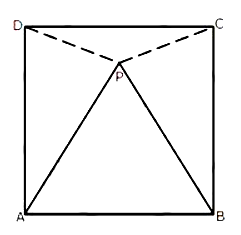
In the following diagram, $\text{ABCD}$ is a square and $\text{APB}$ is an equilateral triangle.

$(i)$ Prove that: $\triangle \mathrm{APD} \cong \triangle \mathrm{BPC}$
$(ii)$ Find the angles of $\triangle \mathrm{DPC}$.
If (a2 +b2 +c2) = 89 and (ab - bc - ca) = 16, find the value of (a + b - c).
[Hint. (a + b - c)2 = (a2 + b2 + c2) + 2 (ab - bc - ca).]
In a parallelogram $\text{ABCD, E}$ and $F$ are the midpoints of the sides $AB$ and $CD$ respectively. The line segments $AF$ and $BF$ meet the line segments $DE$ and $CE$ at points $G$ and $H$ respectively Prove that:$\text{EGFH}$ is a parallelogram.
Samidha and Shreya have pocket money $Rs.x$ and $Rs.y$ respectively at the beginning of a week. They both spend money throughout the week. At the end of the week, Samidha spends $Rs. 500$ and is left with as much money as Shreya had in the beginning of the week. Shreya spends $Rs. 500$ and is left with $\frac{3}{5}$ of what Samidha had in the beginning of the week. Find their pocket money.
In a parallelogram $\text{ABCD}, E$ is the midpoint of $AB$ and $DE$ bisects $\angle D$. Prove that: $BC = BE.$