Question
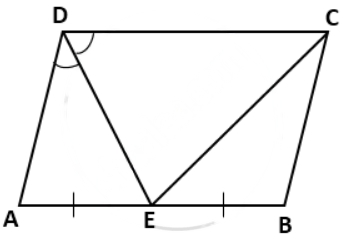
In a parallelogram $\text{ABCD}, E$ is the midpoint of $AB$ and $DE$ bisects angle $D$. Prove that:$CE$ is the bisector of $\angle C$ and $\angle DEC$ is a right angle.
Answer


Since $B C=B E$
$\Rightarrow \angle B E C=\angle B C E \quad\dots...($Angles opposite to equal sides are equal$)$
$\angle B E C=\angle E C D \quad\dots...($Alternate angles$)$
$\Rightarrow \angle B C E=\angle E C D$
$\Rightarrow CE$ is the bisector of $\angle C\dots....($proved$)$
$\angle DCE =\frac{1}{2} \angle C \quad\dots... ($Given $CE$ bisects $\left.\angle D \right)$
$\angle CDE =\frac{1}{2} \angle D \ldots($Given $DE$ bisects $\angle D)$
$\angle DCE +\angle CDE$
$=\frac{1}{2}(\angle C +\angle D)$
$=\frac{1}{2} \times 180^{\circ}=90^{\circ}$
Thus, in $\triangle DCE$,
$ \angle DEC =180^{\circ}-\angle DCE +\angle CDE =180^{\circ}-90^{\circ}$
$\Rightarrow \angle DEC =90^{\circ} .$

Need a full question paper?

Generate a complete, print-ready paper with questions like this in minutes — across 16+ boards, with answer keys.
Start Generating Free