Question
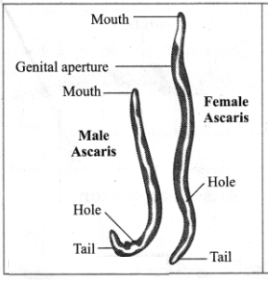
Sketch, labell and classify: Roundworm

Answer


Image
Classification:
Kingdom: Animalia
Division: Non-Chordata
Phylum: Aschelminthes
Example: Ascaris (Roundworm)

Need a full question paper?

Generate a complete, print-ready paper with questions like this in minutes — across 16+ boards, with answer keys.
Start Generating Free

Similar questions

Balance the following equation stepwise.
$NaOH _{(aq)} + H_2SO_{4(aq)} \rightarrow Na_2SO_{4(aq)} +H_2O_{(l)}.$
A rainbow is the combined effect (an exhibition) of the refraction, dispersion, and total internal reflection of light (taken together). (Practice Activity Sheet – 1)
(OR)
With a neat labelled diagram, explain how the formation of rainbow occurs.
Explain with diagram step-by-step energy conversion in Solar thermal power plant.
What types of benefit and harm occur to human from animals of phylum Arthropoda?
A four carbons atoms containing neutral organic compound $X$ reacts with sodium metal to evolve a gas which burns with 'pop' sound. Another four carbon atoms containing carbon compound reacts with sodium hydrogen carbonate to evolve a gas which turns lime water milky. When compounds $X$ and $Y$ are heated together in the presence of a little of concentrated sulphuric acid, then a new compound $Z$ is formed.
  1. What is compound $X?$ Also write its formula.
  2. What is compound $Y?$ Also write its formula.
  3. What is compound $Z?$ Also write its formula.
  4. What type of smell is given by compound $Z?$
  5. What is the general name of compounds like $Z?$
  6. What is the general name of the reaction which which takes place between $X$ and $Y$ to form $Z?$
What is a synapse? What happens at the synapse between two neurons? How are the messages carried across a synapse? Explain with the help of a labelled diagram.
State the functions of the following hormones:
  1. Thyroxine.
  2. Adrenaline.
  3. Growth hormone.
Write on significant space missions carried out by man.
An object is placed at a distance of 10cm from a concave mirror of focal length 20cm.
  1. Draw a ray diagram for the formation of image.
  2. Calculate the image distance.
  3. State two characteristics of the image formed.
When a moist slice of bread was kept aside for a few days then some organism grew on it to form a white cottony mass which later turned black. When this slice of bread was observed through a magnifying glass, then fine thread-like projections and thin stems having bulb-like structures at the top were seen.
  1. What is the common name and scientific name of the organism which grew on the moist slice of bread?
  2. How did this organism grow on the moist slice of bread automatically?
  3. What are the fine, thread-like projections on the surface of slice of bread known as?
  4. What name is given to the knob-like structures and what do they contain?
  5. What is the name of this method of reproduction?
  6. Name one unicellular organism which reproduces by this method.
  7. Name tow non-flowering plants which reproduce by this method.