MCQ
Sodium chloride easily dissolves in water. This is because
  • A
    It is a covalent compound
  • B
    Salt reacts with water
  • C
    It is a white substance
  • Its ions are easily solvated

Answer

Correct option: D.
Its ions are easily solvated
(d) Sodium chloride is electrovalent compound so it dissolves in water which is a polar solvent.

Need a full question paper?

Generate a complete, print-ready paper with questions like this in minutes — across 16+ boards, with answer keys.
Start Generating Free

Similar questions

What would be the concentration of ${H_2}S{O_4}$ necessary to precipitate $BaS{O_4}$ from a solution of $0.01\,M\,B{a^{2 + }}$ions ($K_sp=$ $1.0 \times {10^{ - 9}}$ )
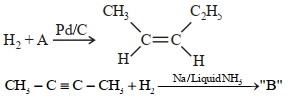
In the given reactions identify $A$ and $B$.
In which of the following transformations, the bond order has increased and the magnetic behaviour has changed
Ethyl alcohol on heating with conc. ${H_2}S{O_4}$ gives
When $100 \ mL$ of $1.0 \ M \ HCl$ was mixed with $100 \ mL$ of $1.0 \ M \ NaOH$ in an insulated beaker at constant pressure, a temperature increase of $5.7^{\circ} C$ was measured for the beaker and its contents (Expt. $1$). Because the enthalpy of neutralization of a strong acid with a strong base is a constant $\left(-57.0 \ kJ \ mol ^{-1}\right)$, this experiment could be used to measure the calorimeter constant. In a second experiment (Expt. $2$), $100 \ mL$ of $2.0 \ M$ acetic acid $\left(K_a=2.0 \times 10^{-5}\right)$ was mixed with $100 \ mL$ of $1.0 M \ NaOH$ (under identical conditions to Expt. $1$) where a temperature rise of $5.6^{\circ} C$ was measured.

(Consider heat capacity of all solutions as $4.2 J g ^{-1} K ^{-1}$ and density of all solutions as $1.0 \ g mL ^{-1}$ )

$1.$ Enthalpy of dissociation (in $kJ mol ^{-1}$ ) of acetic acid obtained from the Expt. $2$ is

$(A)$ $1.0$ $(B)$ $10.0$ $(C)$ $24.5$ $(D)$ $51.4$

$2.$ The $pH$ of the solution after Expt. $2$ is

$(A)$ $2.8$ $(B)$ $4.7$ $(C)$ $5.0$ $(D)$ $7.0$

Give the answer question $1$ and $2.$
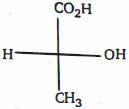
How many representations of lactic acid are possible in Fischer projection $(d $ & $l)$ ?
Which of the following statements is incorrect ?
An organic compound contains $C$, $H$ and $O$ in the proportion of $6 : 1 : 8$ by weight, respectively. Its vapour density is $30$. Its molecular formula will be
Consider the imaginary equilibrium $4A + 5B$ $\rightleftharpoons$ $ 4X + 6Y$ The equilibrium constant ${K_c}$ has the unit
The bond order in ${N_2}$ molecule is