Question
Solid targets of different elements are bombarded by highly energetic electron beams. The frequency $(f)$ of the characteristic $X-$ rays emitted from different targets varies with atomic number $Z$ as

Answer

$\lambda \propto \frac{1}{{{Z^2}}} \Rightarrow \frac{c}{\nu } \propto \frac{1}{{{Z^2}}}$

$\Rightarrow \nu \propto {Z^2}$

Need a full question paper?

Generate a complete, print-ready paper with questions like this in minutes — across 16+ boards, with answer keys.

Start Generating Free

Similar questions

An electron in an electron microscope with initial velocity $v_{0} \hat{ i }$ enters a region of a stray transverse electric field $E_{0} \hat{ j }$. The time taken for the change in its de-Broglie wavelength from the initial value of $\lambda$ to $\lambda / 3$ is proportional to
Three vessels of equal capacity have gases at the same temperature and pressure. The first vessel contains helium (monoatomic), the second contains fluorine (diatomic) and the third contains sulfur hexafluoride (polyatomic). The correct statement, among the following is
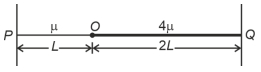
Two uniform strings of mass per unit length $\mu$ and $4 \mu$, and length $L$ and $2 L$, respectively, are joined at point $O$, and tied at two fixed ends $P$ and $Q$, as shown in the figure. The strings are under a uniform tension $T$. If we define the frequency $v_0=\frac{1}{2 L} \sqrt{\frac{T}{\mu}}$, which of the following statement($s$) is(are) correct?

$(A)$ With a node at $O$, the minimum frequency of vibration of the composite string is $v_0$

$(B)$ With an antinode at $O$, the minimum frequency of vibration of the composite string is $2 v_0$

$(C)$ When the composite string vibrates at the minimum frequency with a node at $O$, it has $6$ nodes, including the end nodes

$(D)$ No vibrational mode with an antinode at $O$ is possible for the composite string
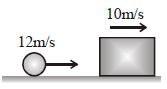
A light particle moving horizontally with a speed of $12\  m/s$ strikes a very heavy block moving in the same direction at $10\  m/s$. The collision is one-dimensional and elastic. After the collision, the particle will
A point electric dipole placed at the origin has a potential given by $V(r, \theta)=\frac{p \cos \theta}{4 \pi \varepsilon_0 r^2}$, where $\theta$ is the angle made by the position vector with the direction of the dipole. Then,
An antenna behaves as resonant circuit only when its length is
Angle of deviation $(\delta $) by a prism (refractive index = $\mu $ and supposing the angle of prism $A$ to be small) can be given by
The gap between the plates of a parallel plate capacitor of area $A$ and distance between plates $d$, is filled with a dielectric whose permittivity varies linearly from ${ \varepsilon _1}$ at one plate to ${ \varepsilon _2}$ at the other. The capacitance of capacitor is
Four particles, each of mass $M$ and equidistant from each other, move along a circle of radius $R$ under the action of their mutual gravitational attraction. The speed of each particle is
When a positive $q$ charge is taken from lower potential to a higher potential point, then its potential energy will