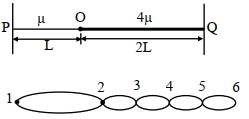
Two uniform strings of mass per unit length $\mu$ and $4 \mu$, and length $L$ and $2 L$, respectively, are joined at point $O$, and tied at two fixed ends $P$ and $Q$, as shown in the figure. The strings are under a uniform tension $T$. If we define the frequency $v_0=\frac{1}{2 L} \sqrt{\frac{T}{\mu}}$, which of the following statement($s$) is(are) correct?
$(A)$ With a node at $O$, the minimum frequency of vibration of the composite string is $v_0$
$(B)$ With an antinode at $O$, the minimum frequency of vibration of the composite string is $2 v_0$
$(C)$ When the composite string vibrates at the minimum frequency with a node at $O$, it has $6$ nodes, including the end nodes
$(D)$ No vibrational mode with an antinode at $O$ is possible for the composite string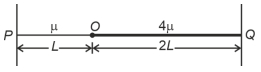
IIT 2024, Advanced


Download our appand get started for free
Experience the future of education. Simply download our apps or reach out to us for more information. Let's shape the future of learning together!No signup needed.*
Similar Questions
- 1The frequency of transverse vibrations in a stretched string is $200 Hz$. If the tension is increased four times and the length is reduced to one-fourth the original value, the frequency of vibration will be .... $Hz$View Solution
- 2A train whistling at constant frequency is moving towards a station at a constant speed $V$ . The train goes past a stationary observer on the station. The frequency $n'$ of the sound as heard by the observer is plotted as a function of time $t$ (Fig.) . Identify the expected curveView Solution
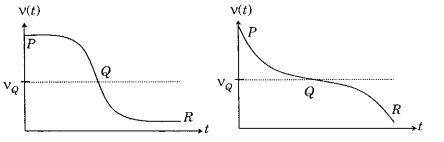
- 3Two loudspeakers $M$ and $N$ are located $20 \mathrm{~m}$ apart and emit sound at frequencies $118 \mathrm{~Hz}$ and $121 \mathrm{~Hz}$, respectively. $A$ car is initially at a point $P, 1800 \mathrm{~m}$ away from the midpoint $Q$ of the line $M N$ and moves towards $Q$ constantly at $60 \mathrm{~km} / \mathrm{hr}$ along the perpendicular bisector of $M N$. It crosses $Q$ and eventually reaches a point $R, 1800(m$ away from $Q$. Let $v(t)$ represent the beat frequency measured by a person sitting in tlie car at time $t$. Let $v_P, v_Q$ and $v_R$ be the beat frequencies measured at locations $P . Q$ and $R$, respectively. The speed of sound in air is $330 \mathrm{~m} \mathrm{~s}^{-1}$. Which of the following statement($s$) is(are) true regarding the sound heard by the person?View Solution
($A$) $v_P+v_R=2 v_Q$
($B$) The rate of change in beat frequency is maximum when the car passes through $Q$
($C$) The plot below represents schematically the variation of beat frequency with time
(image)
($D$) The plot below represents schematically the variation of beat frequency with time
(image)
- 4A man is standing on a railway platform listening to the whistle of an engine that passes the man at constant speed without stopping. If the engine passes the man at time ${t_0}$. How does the frequency $f$ of the whistle as heard by the man changes with timeView Solution
- 5A closed pipe of length $10 \,cm$ has its fundamental frequency half that of the second overtone of an open pipe. The length of the open pipe ......... $cm$View Solution
- 6The frequency of a tuning fork is $256\, Hz$. The velocity of sound in air is $344\, ms^{-1}$. The distance travelled (in $meters$) by the sound during the time in which the tunning fork complete $32$ vibrations isView Solution
- 7A wave is represented by the equation $y = 7\sin \{ \pi (2t - 2x)\} $ where $x$ is in metres and $t$ in seconds. The velocity of the wave is ..... $m/s$View Solution
- 8View SolutionDoppler shift in frequency does not depend upon
- 9The equation of a transverse wave is given by $y = 100\,\sin \pi (0.04z - 2t)$ where $y$ and $z$ are in $cm$ and $t$ is in seconds. The frequency of the wave in $Hz$ isView Solution
- 10A person is observing two trains one coming towards him and other leaving with the same speed $4\, m/s$. If their whistling frequencies are $240\, Hz$ each, then the number of beats per second heard by the person will be:(if velocity of sound is $320\, m/s$)View Solution