Question
Solve for x and y:
7(y + 3) - 2(x + 2) = 14,
4(y - 2) + 3(x - 3) = 2

Answer

The given equations are: 7(y + 3) - 2(x + 2) = 14 4(y - 2) + 3(x - 3) = 2 7(y + 3) - 2(x + 2) = 14⇒ 7y + 21 - 2x - 4 = 14
⇒ 7y - 2x = 14 + 4 - 21
⇒ -2x + 7y = -3 ...(1)
4(y - 2) + 3(x - 3) = 2⇒ 4y - 8 + 3x - 9 = 2
⇒ 4y + 3x = 2 + 8 + 9
⇒ 3x + 4y = 19 ...(2)
Multiply (1) by 4 and (2) by 7, we get
-8x + 28y = -12 ...(3)
21x + 28y = 133 ...(4)
Subtracting (3) and (4), we get
29x = 145
x = 5
Substituting x = 5 in (1), we get
-2 × 5 + 7y = -3
⇒ 7y = -3 + 10
⇒ 7y = 7
⇒ y = 1
$\therefore$ Solution is x = 5 and y = 1

Need a full question paper?

Generate a complete, print-ready paper with questions like this in minutes — across 16+ boards, with answer keys.
Start Generating Free

Similar questions

A chemist has one solution containing 50% acid and a second one containing 25% acid. How much of each should be used to make 10 litres of a 40% acid solution?
A kite is flying at a height of 75m from the level~round, a ched to a string inclined at 60° to the hori ontal. Find th length of the string, assuming that there is no slack in it.$\big[\text{Take}\sqrt{3}=1.732\big]$
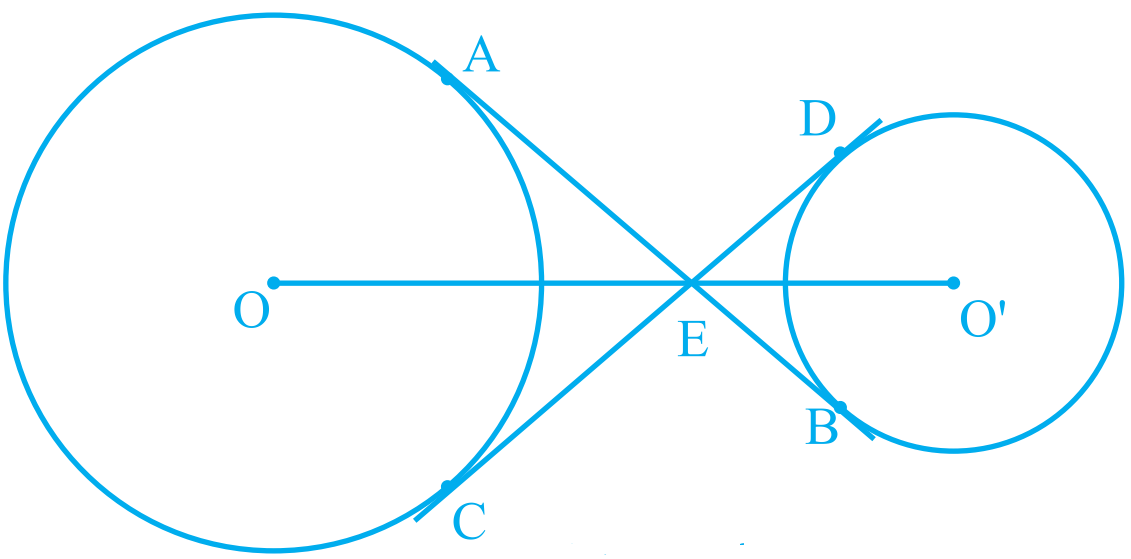
In Figure, the common tangent, AB and CD to two circles with centres O and O' intersect at E. Prove that the points O, E, O' are collinear.
State the basic proportionality theorem.
On a square cardboard sheet of area $784\ cm^2,$ four congruent circular plates of maximum size are placed such that each circular plate touches the other two plates and each side of the square sheet is tangent to two circular plates. Find the area of the square sheet not covered by the circular plates.
Solve the following systems of equations by using the method of cross multiplication:
$6x - 5y - 16 = 0,$
$7x - 13y + 10 = 0$
If $A(-3,5), B(-2,-7), C(1,-8)$ and $D(6,3)$ are the vertices of a quadrilateral $A B C D$, find its area.
The sum of a natural number and its reciprocal is $\frac{65}{8}.$ Find the number.
Prove analytically that the line segment joining the middle points of two sides of a triangle is equal to half of the third side.
Prove the following trigonometric identities.
Given that: $(1+\cos\alpha)(1+\cos\beta)(1+\cos\gamma)=(1-\cos\alpha)(1-\cos\alpha)(1-\cos\beta)(1-\cos\gamma)$
Show that one of the values of each member of this equality is $\sin\alpha\sin\beta\sin\gamma.$