Question
State the basic proportionality theorem.

Answer

If a line is drawn parallel to one side of a triangle to intersect the other two sides in distinct point, then the other sides are divided in the same ratio.

Need a full question paper?

Generate a complete, print-ready paper with questions like this in minutes — across 16+ boards, with answer keys.

Start Generating Free

Similar questions

The production yield per hectare of wheat of some farms of a village are given in the following table:
Production yield (in kg/ha)
40-45
45-50
50-55
55-60
60-65
65-70
70-75
75-80
80-85
Number of farms
1
9
15
18
40
26
16
14
10
Draw a less than type ogive and a more than type ogive for this data.
Seven times a two-digit number is equal to four times the number obtained by reversing the digits. If the difference between the digits is 3. Find the number.
$\triangle\text{ABC}\sim\triangle\text{DEF}$ such that $\text{ar}(\triangle\text{ABC})=64\text{cm}^2$ and $\text{ar}(\triangle\text{DEF})=169\text{cm}^2.$ If BC = 4cm, find EF.
The rain water from a 22m × 20m roof drains into a cylindrical vessel of diameter 2m and height 3.5m. If the rain water collected from the roof fills $\frac{4}{5}\text{th}$ of the cylindrical vessel, then find the rainfall in centimetre.
Find the values of k for which the given quadratic equation has real and distinct roots:
$9x^2 + 3kx + 4 = 0$
The radii of the circular bases of a frustum of a right circular cone are 12cm and 3cm and the height is 12cm. Find the total surface area and the volume of the frustum.
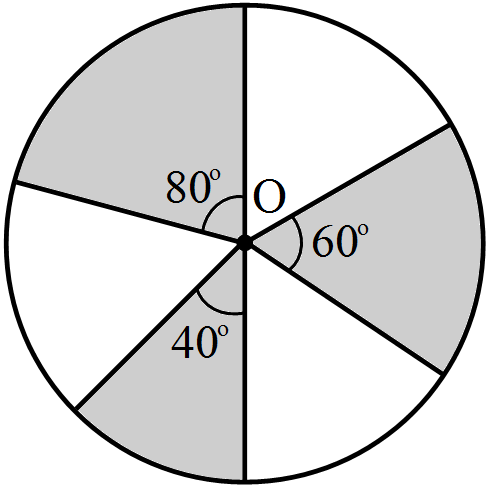
In the given figure, three sectors of a circle of radius 7cm, making angles of 60°, 80° and 40° at the centre are shaded. Find the area of the shaded region.
Solve the following quadratic equations by factorization:
$\frac{\text{a}}{\text{x}-\text{b}}+\frac{\text{b}}{\text{x}-\text{a}}=2$
The sides of certain triangles are given below. Determine them are right triangles:
$(\text{a} - 1)\text{cm},2\sqrt{\text{a}}\text{ cm},(\text{a} + 1)\text{cm}.$
Prove that the area of the semicircle drawn on the hypotenuse of a right angled triangle is equal to the sum of the areas of the semicircles drawn on the other two sides of triangle.