Question
Solve for x and y:
$\text{4x}-\text{3y}=8,$
$\text{6x}-\text{y}=\frac{29}{3}$

Answer

The given equations are: $\text{4x}-\text{3y}=8\ \dots(1)$ $\text{6x}-\text{y}=\frac{29}{3}\ \dots(2)$ Multiply (1) by 2 and 2 by 3 $\text{4x}-\text{3y}=8\ \dots(3)$ $\text{18x}-\text{3y}=29\ \dots(4)$Subtracting (3) from (4), we get
$\text{14x}=21$ $\Rightarrow\text{x}=\frac{21}{14}=\frac{3}{2}$Substitution $\text{x}=\frac{3}{2}$ in (1), we get
$2\times\frac{3}{2}-\text{3y}=8$ $\Rightarrow6-\text{3y}=8$ $-\text{3y}=2$ $\Rightarrow\text{y}=\frac{-2}{3}$$\therefore$ Solution is $\text{x}=\frac{3}{2}$ and $\text{y}=\frac{-2}{3}$

Need a full question paper?

Generate a complete, print-ready paper with questions like this in minutes — across 16+ boards, with answer keys.
Start Generating Free

Similar questions

Find the number of all three digit natural numbers which are divisible by 9.
Prove that:
$
\frac{\sin \theta-\cos \theta}{\sin \theta+\cos \theta}+\frac{\sin \theta+\cos \theta}{\sin \theta-\cos \theta}=\frac{2}{2 \sin ^2 \theta-1}
$
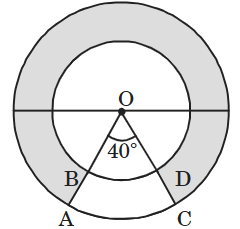
In the given figure, find the area of the shaded region, enclosed between two concentric circles of radii $7 \ cm$ and $14 \ cm$ where $\angle \text{AOC}=40^{\circ}. ($Use $\left.\pi=\frac{22}{7}\right)$
Image
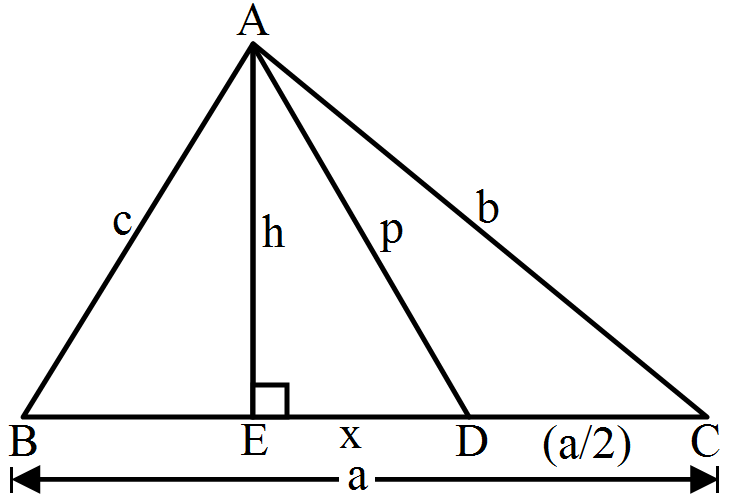
In the given figure, D is the midpoint of side BC and $\text{AE}\perp\text{BC}.$ If BC = a, AC = b, AB = c, ED = x, AD = p and AE = h, prove that.
$(\text{b}^2-\text{c}^2)=2\text{ax}$
A person rowing at the rate of 5km/ h in still water, takes thrice as much time in going 40km upstream as in going 40km downstream. Find the speed of the stream.
Find a point which is equidistant from the point $A(-5, 4)$ and $B(-1, 6)$. How many such points are there?
Two dice are thrown at the same time. Find the probability of getting:
  1. Same number on both dice.
  2. Different numbers on both dice.
The largest possible sphere is carved out of a wooden solid cube of side 7 cm . Find the volume of the wood left. [Use $\pi=\frac{22}{7}$ ]
The wheel of a motor cycle is of radius 35cm. How many revolutions per minute must the wheel make so as to keep a speed of 66km/ h?
A cylindrical tub of radius 5cm and length 9.8cm is full of water. A solid in the form of a right circular cone mounted on a hemisphere is immersed in the tub. If the radius of the hemisphere is immersed in the tub. If the radius of the hemi-sphere is 3.5cm and height of the cone outside the hemisphere is 5cm, find the volume of the water left in the tube.