Question
Solve for x and y:
$\frac{\text{x}}{\text{a}}+\frac{\text{y}}{\text{b}}=2,$
$\text{ax}-\text{by}=\text{a}^2-\text{b}^2$

Answer

$\frac{x}{a}+\frac{y}{b}=2$
$\frac{b x+a y}{a b}=2 b x+a y=2 a b \ldots$
$a x-b y=\left(a^2-b^2\right) \ldots(2)$
Multiplying (1) by b and (2) by a
$\Rightarrow b^2 x+\text { bay }=2 a b^2 \ldots(3)$
$\Rightarrow a^2 x-b a y=a\left(a^2-b^2\right) \ldots(4) \text { Adding (3)and (4), we get } b^2 x+a^2 x=2 a b^2+a\left(a^2-b^2\right) x\left(b^2+a^2\right)=2 a b^2+a^3-a b^2 x\left(b^2\right.$
$\left.+a^2\right)=a b^2+a^3 x\left(b^2+a^2\right)=a\left(b^2+a^2\right)$
$x=\frac{a\left(b^2+a^2\right)}{\left(b^2+a^2\right)}=a \text { Putting } x=a \text { in (1), we get } b \times a+a y=2 a b a y=2 a b-a b a$ $y=a b \text { or } y=b$
$\therefore$ Solution is $x=a, y=b$

Need a full question paper?

Generate a complete, print-ready paper with questions like this in minutes — across 16+ boards, with answer keys.
Start Generating Free

Similar questions

A cylindrical road roller made of iron is 1 m long, Its internal diameter is 54 cm and the thickness of the iron sheet used in making the roller is 9 cm . Find the mass of the roller, if $1 cm^3$ of iron has 7.8 gm mass. (use $\pi=3.14$ )
Find the roots of the following quadratic equation (if they exist) by the method of completing the square.
$2\text{x}^2+\text{x}+4=0$
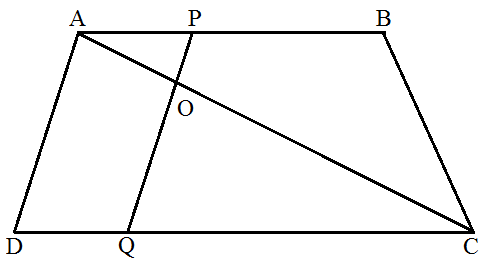
if AB || DC and AC and PQ intersect each other at the point O, prove that OA × CQ = OC × AP
Solve the following quadratic equations by factorization:
$\frac{\text{x}+1}{\text{x}-1}+\frac{\text{x}-2}{\text{x}+2}=4-\frac{2\text{x}+3}{\text{x}-2},$ $\text{x}\neq1,-2,2$
Draw a triangle ABC in which BC = 6cm, CA = 5cm and AB = 4cm. Construct a triangle similar to it and of scale factor $\frac{5}{3}.$
Solve graphically the system of linear equations:
4x - 3y + 4 = 0,
4x + 3y - 20 = 0.
Find the area bounded by these lines and x-axis.
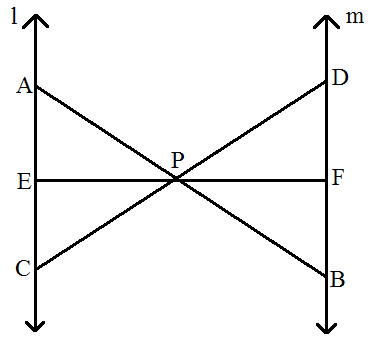
$\text{l}\parallel\text{m}$ and line segments AB, CD and EF are concurrent at point P. Proved that $\frac{\text{AE}}{\text{BF}}=\frac{\text{AC}}{\text{BD}}=\frac{\text{CE}}{\text{FD}}.$
The base of an isosceles triangle measures 80cm and its area is $360cm^2$. Find the perimeter of the triangle.
If $BD$ and $QM$ are medians of triangles $\text{ABC}$ and $\text{PQR},$ respectively, where $\triangle ABC \sim \triangle PQR$ prove that $\frac{A B}{P Q}=\frac{B D}{Q M}$.
A train, travelling at a uniform speed for 360km, would have taken 48 minutes less to travel the same distance if its speed were 5km/hr more. Find the original speed of the train.