Question
Solve for $x$ :
$
\frac{x-2}{x-3}+\frac{x-4}{x-5}=\frac{10}{3} ; x \neq 3,5
$

Answer

Consider the equation:
$\begin{array}{l}\frac{x-2}{x-3}+\frac{x-4}{x-5}=\frac{10}{3} \\\Rightarrow \frac{(x-2)(x-5)+(x-4)(x-3)}{(x-3)(x-5)}=\frac{10}{3} \\
\Rightarrow \frac{x^2-5 x-2 x+10+x^2-3 x-4 x+12}{x^2-3 x-5 x+15}=\frac{10}{3}\end{array}$
$\begin{array}{l}\Rightarrow \frac{2 x^2-14 x+22}{x^2-8 x+15}=\frac{10}{3} \\\Rightarrow 3\left(2 x^2-14 x+22\right)=10\left(x^2-8 x+15\right) \\\Rightarrow 6 x^2-42 x+66=10 x^2-80 x+150 \\\Rightarrow 10 x^2+150-6 x^2-66-80 x+42 x=0 \\4 x^2-38 x+84=0 \\2\left(2 x^2-19 x+42\right)=0 \\2 x^2-19 x+42=0\end{array}$
Splitting the middle term,
$\begin{array}{l}2 x^2-12 x-7 x+42=0 \\2 x(x-6)-7(x-6)=0 \$x-6)(2 x-7)=0 \\x-6=0 \quad \text { or } 2 x-7=0 \\x=6 \quad \text { or } \quad x=\frac{7}{2}\end{array}$

Need a full question paper?

Generate a complete, print-ready paper with questions like this in minutes — across 16+ boards, with answer keys.
Start Generating Free

Similar questions

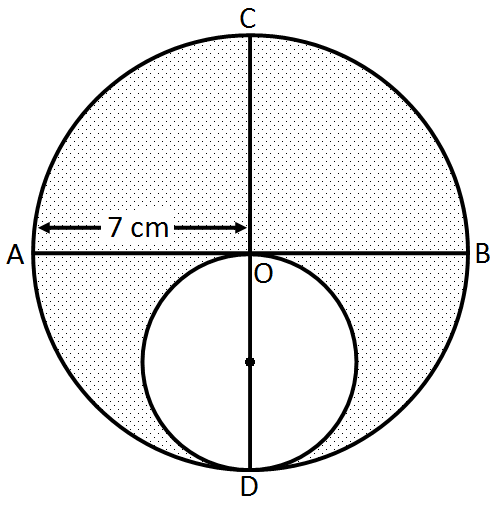
In the following figure, AB and CD are two diameters of a circle perpendicular to each other and OD is the diameter of the smaller circle. If OA = 7cm, find the area of the shaded region.
A solid is in the shape of a hemisphere surmounted by a cone. If the radius of hemisphere and base radius of cone is 7 cm and height of cone is 3.5 cm, find the volume of the solid. (Take $\pi=\frac{22}{7}$ )
Prove the following trigonometric identities.
$(\text{cosec }\theta-\sec\theta)(\cot\theta-\tan\theta)=(\text{cosec }\theta+\sec\theta)(\sec\theta\text{ cosec }\theta-2)$
A building is in the form of a cylinder surmounted by a hemispherical dome. The base diameter of the dome is equal to $\frac{2}{3}$ of the total height of the building. Find the height of the building, if it contains $67 \frac{1}{21} m^3$ of air.
The length of a rectangular field is three times its breadth. If the area of the field by 147 sq metres, find the length of the field.
A two-digit number is obtained by either multiplying the sum of the digits by 8 and then subtracting 5 or by multiplying the difference of the digits by 16 and then adding 3. Find the number.
If 1 and -2 are two zeros of the polynomial ($x^3 - 4x^2 - 7x + 10)$, find its third zero.
Evaluate the following:
Using the formula, $\tan2\text{A}=\frac{2\tan\text{A}}{1-\tan^2\text{A}},$ Find the value of $\tan60^\circ,$ it being given that $\tan30^\circ=\frac{1}{\sqrt{3}}.$
If the points A(2, 3), B(4, k) and C(6, -3) are collinear, find the value of k.
A train covered a certain distance at a uniform speed. If it were $6 \ km/h$ faster, it would have taken $4$ hours less than the scheduled time. And, if the train were slower by $6 \ km/h,$ it would have taken $6$ hours more than the scheduled time. Find the length of the journey.