Question 15 Marks
Two taps running together can fill a tank in $3 \frac{1}{13}$ hours. If one tap takes 3 hours more than the other to fill the tank, then how much time will each tap take to fill the tank?
AnswerLet in $x$ one pipe fills the cistern.
Other pipe will fill in $(x+3)$ hours
Time taken by both pipes, running together
$=3 \frac{1}{13} \text { hours }=\frac{40}{13} \text { Hours } x$
Cistern filled by one pipe in 1 hour $=\frac{1}{x}$
Cistern filled by other pipe in 1 hour $=\frac{1}{x+3}$
Cistern filled by both pipes, running together for
$\begin{array}{l}1 \text { hour }=\frac{1}{x}+\frac{1}{x+3} \\\therefore \frac{1}{x}+\frac{1}{x+3}=\frac{13}{40} \\\Rightarrow \frac{2 x+3}{x^2+3 x}=\frac{13}{40}\end{array}$
$\begin{array}{l}\Rightarrow 13 x^2+39 x=80 x+120 \\\Rightarrow 13 x^2-41 x-120=0 \\\Rightarrow 13 x^2-65 x+24 x-120=0 \\
\Rightarrow 13 x(x-5)+24(x-5)=0 \\\Rightarrow(x-5)(13 x+24)=0 \\\Rightarrow x-5=0 \text { or } 13 x+24=0 \\\Rightarrow x=5 \text { or } x=-\frac{24}{13}\end{array}$
As time cannot be negative.
Time taken by one pipe to fill cistern $=5$ hours
Time taken by other pipe to fill cistern
$=5+3=8 \text { hours }$
View full question & answer→Question 25 Marks
Solve for $x$ :
$\frac{1}{x+1}+\frac{3}{5 x+1}=\frac{5}{x+4}, x \neq-1,-\frac{1}{5},-4$
Answer
$\begin{array}{l}\frac{1}{x+1}+\frac{3}{5 x+1}=\frac{5}{x+4}, x \neq-1,-\frac{1}{5},-4 \\ \Rightarrow \frac{5 x+1+3 x+3}{(x+1)(5 x+1)}=\frac{5}{x+4} \\ \Rightarrow(x+4)(8 x+4)=5(x+1)(5 x+1) \\ \Rightarrow(x+4)(8 x+4)=5(x+1)(5 x+1) \\ \Rightarrow 8 x^2+32 x+4 x+16=5\left(5 x^2+x+5 x+1\right)\end{array}$
$\begin{array}{l}\Rightarrow 8 x^2+36 x+16=25 x^2+30 x+5 \\ \Rightarrow 17 x^2-6 x-11=0 \\ \Rightarrow 17 x^2-17 x+11 x-11=0 \\ \Rightarrow 17 x(x-1)+11(x-1)=0 \\ \Rightarrow(17 x+11)(x-1)=0 \\ \Rightarrow 17 x+11=0 \text { or } x-1=0 \\ \Rightarrow x=-\frac{11}{17} \text { or } x=1\end{array}$
View full question & answer→Question 35 Marks
A motor boat whose speed is $24 km / h$ in still water takes 1 hour more to 32 km upstream than to return downstream to the same spot. Find the speed of the stream.
AnswerLet speed of stream $=x km / h$
Speed of boat in still water $=24 km / h$
Speed of boat downstream $=(24+x) km / h$
Speed of boat upstream $=(24-x) km / h$
Distance $=32 km$
From Question,
$\begin{array}{l}\frac{32}{24-x}-\frac{32}{24+x}=1 \\\Rightarrow \frac{32[24+x-(24-x)]}{(24-x)(24+x)}=1 \\\Rightarrow \frac{32[2 x]}{576-x^2}=1\end{array}$
$\Rightarrow \frac{64 x}{576-x^2}=1$
$\begin{array}{l}\Rightarrow 64 x=576-x^2 \\\Rightarrow x^2+64 x-576=0\end{array}$
Splitting the middle term,
$\begin{array}{l}\Rightarrow x^2+72 x-8 x-576=0 \\\Rightarrow x(x+72)-8(x+72)=0 \\\Rightarrow(x-8)(x+72)=0 \\\Rightarrow(x-8)=0 \quad \text { or } \quad(x+72)=0 \\\Rightarrow x=8 \quad \text { or } \quad x=-72\end{array}$
Speed of stream cannot be negative.
Therefore, Speed of stream is $8 km / h$
View full question & answer→Question 45 Marks
Solve for $x$ :
$\frac{1}{x+1}+\frac{2}{x+2}=\frac{4}{x+4}, x \neq-1,-2,-4$
AnswerL.C.M of all the denominators is . Multiply throughout by the L.C.M we get,
$\begin{array}{l}(x+1)(x+2)(x+4) \$x+1)(x+2)(x+4)\left(\frac{1}{x+1}+\frac{2}{x+2}\right) \\=(x+1)(x+2)(x+4)\left(\frac{4}{x+4}\right) \$x+2)(x+4)+2(x+1)(x+4) \\=4(x+1)(x+2) \$x+4)(x+2+2 x+2) \\=4\left(x^2+2 x+x+2\right)\end{array}$
$\begin{array}{l}(x+4)(3 x+4)=4 x^2+12 x+8 \\3 x^2+4 x+12 x+16=4 x^2+12 x+8 \\x^2-4 x-8=0\end{array}$
Now,
$\begin{array}{l}x=\frac{-b \pm \sqrt{b^2-4 a c}}{2 a}=\frac{4 \pm \sqrt{16+32}}{2} \\=\frac{4 \pm \sqrt{48}}{2} \\x=\frac{4 \pm 4 \sqrt{3}}{2}\end{array}$
Or, $x=2 \pm 2 \sqrt{3}$
View full question & answer→Question 55 Marks
If $\alpha$ and $\beta$ are the zeros of the polynomial $f(x)=x^2-6 x+k$, find the value of k for $\alpha^2+\beta^2=40$.
AnswerGiven $f(x)=x^2-6 x+k$
$\therefore a=1, b=-6, c=k$
And $\alpha^2+\beta^2=40$
Sum of roots
$\begin{array}{l}(\alpha+\beta)=\left(\frac{-b}{a}\right)=\frac{-(-6)}{1}=6 \$\alpha \times \beta)=\frac{c}{a}=\frac{k}{1}=k\end{array}$
We have,
$\begin{array}{l}(\alpha+\beta)^2=\left(\alpha^2+\beta^2\right)+2 \alpha \beta \\\Rightarrow(6)^2=(40)+2 k \\\Rightarrow 36=(40)+2 k \\\Rightarrow 36-40=2 k \\\Rightarrow 2 k=-4 \\\Rightarrow k=-2\end{array}$
View full question & answer→Question 65 Marks
Solve for $x$ :
$\frac{2}{x+1}+\frac{3}{2(x-2)}=\frac{23}{5 x}, x \neq 0,-1,2$
AnswerSolving for $x$,
$\begin{array}{l}\Rightarrow \frac{2}{x+1}+\frac{3}{2(x-2)}=\frac{23}{5 x} \\\Rightarrow \frac{4(x-2)+3(x+1)}{2(x+1)(x-2)}=\frac{23}{5 x} \\\Rightarrow \frac{4 x-8+3 x+3}{2\left(x^2+x-2 x-2\right)}=\frac{23}{5 x} \\\Rightarrow \frac{7 x-5}{2\left(x^2-x-2\right)}=\frac{23}{5 x}\end{array}$
Cross multiplying both sides,
$\begin{array}{l}\Rightarrow 5 x(7 x-5)=46\left(x^2-x-2\right) \\\Rightarrow 35 x^2-25 x=46 x^2-46 x-92\end{array}$
Re-arranging the terms,
$\Rightarrow 11 x^2-21 x-92=0$
Solving the above quadratic equation by splitting the middle term,
$\begin{array}{l}\Rightarrow 11 x^2-44 x+23 x-92=0 \\\Rightarrow 11 x(x-4)+23(x-4)=0 \\\Rightarrow(11 x+23)(x-4)=0\end{array}$
Hence $x=4 \quad$ and $x=-\frac{23}{11}$
View full question & answer→Question 75 Marks
The numerator of a fraction is 3 less than its denominator. If 2 is added to both the numerator and the denominator, then the sum of the new fraction and original fraction is $\frac{29}{20}$. Find the original fraction.
AnswerLet the denominator be $x$.
Now since numerator of the fraction is 3 less than its denominator,
Therefore numerator is $x-3$.
And if 2 is added to both numerator and denominator,
New fraction is
$\frac{x-3+2}{x+2}=\frac{x-1}{x+2}$
Sum of original and new fraction is $\frac{29}{20}$,
Hence, $\frac{x-3}{x}+\frac{x-1}{x+2}=\frac{29}{20}$.
$\begin{array}{l}\Rightarrow \frac{(x-3)(x+2)+x(x-1)}{x(x+2)}=\frac{29}{20} \\\Rightarrow \frac{x^2-3 x+2 x-6+x^2-x}{x(x+2)}=\frac{29}{20}\end{array}$
$\begin{array}{l}\Rightarrow \frac{2 x^2-2 x-6}{x(x+2)}=\frac{29}{20} \\\Rightarrow 20\left(2 x^2-2 x-6\right)=29 x(x+2) \\\Rightarrow 40 x^2-40 x-120=29 x^2+58 x \\\Rightarrow 40 x^2-29 x^2-40 x-58 x-120=0 \\\Rightarrow 11 x^2-98 x-120=0\end{array}$
Now solving this quadratic equation by splitting the middle term,
$\Rightarrow 11 x^2-110 x+12 x-120=0$
$\begin{array}{l}\Rightarrow 11 x(x-10)+12(x-10)=0 \\\Rightarrow(11 x+12)(x-10)=0\end{array}$
Hence, $x=10$ or $x=\frac{-12}{11}$
Since $x$ can only be a whole number, hence denominator is 10 .
And the numerator is $(x-3)=7$.
Hence, the original fraction is $\frac{7}{10}$.
View full question & answer→Question 85 Marks
A motorboat whose speed in still water is $18 km / h$, takes 1 hour more to go 24 km upstream than to return downstream to the same spot. Find the speed of the stream.
AnswerLet us suppose that the speed of the stream is $x$ $km / h$.
Speed of motorboat in still water is $18 km / h$
Speed of motor boat upstream will be $(18-x) km / h$
Speed of motor boat downstream will be $(18+x) km / h$
Distance travelled by the motorboat on one side is
$\begin{array}{l}\frac{24}{18-x}-\frac{24}{18+x}=1 \\24\left[\frac{1}{18-x}-\frac{1}{18+x}\right]=1 \\24\left[\frac{(18+x)-(18-x)}{(18-x)(18+x)}\right]=1 \\\frac{18+x-18+x}{(18-x)(18+x)}=\frac{1}{24} \\\frac{2 x}{(18-x)(18+x)}=\frac{1}{24} \\48 x=(18-x)(18+x)\end{array}$
$\begin{array}{l}48 x=324+18 x-18 x-x^2 \\x^2+48 x-324=0 \\x^2+54 x-6 x-324=0 \\x(x+54)-6(x+54)=0 \$x+54)(x-6)=0 \\x+54=0 \text { or } x-6=0 \\x=-54 \text { or } x=6\end{array}$
Speed cannot be negative so -54 will not be considered.
Thus the speed of the stream is $6 km / h$.
View full question & answer→Question 95 Marks
Solve for $x$ :
$
\frac{x-2}{x-3}+\frac{x-4}{x-5}=\frac{10}{3} ; x \neq 3,5
$
AnswerConsider the equation:
$\begin{array}{l}\frac{x-2}{x-3}+\frac{x-4}{x-5}=\frac{10}{3} \\\Rightarrow \frac{(x-2)(x-5)+(x-4)(x-3)}{(x-3)(x-5)}=\frac{10}{3} \\
\Rightarrow \frac{x^2-5 x-2 x+10+x^2-3 x-4 x+12}{x^2-3 x-5 x+15}=\frac{10}{3}\end{array}$
$\begin{array}{l}\Rightarrow \frac{2 x^2-14 x+22}{x^2-8 x+15}=\frac{10}{3} \\\Rightarrow 3\left(2 x^2-14 x+22\right)=10\left(x^2-8 x+15\right) \\\Rightarrow 6 x^2-42 x+66=10 x^2-80 x+150 \\\Rightarrow 10 x^2+150-6 x^2-66-80 x+42 x=0 \\4 x^2-38 x+84=0 \\2\left(2 x^2-19 x+42\right)=0 \\2 x^2-19 x+42=0\end{array}$
Splitting the middle term,
$\begin{array}{l}2 x^2-12 x-7 x+42=0 \\2 x(x-6)-7(x-6)=0 \$x-6)(2 x-7)=0 \\x-6=0 \quad \text { or } 2 x-7=0 \\x=6 \quad \text { or } \quad x=\frac{7}{2}\end{array}$
View full question & answer→Question 105 Marks
Sum of the areas of two squares is $400 \text {cm}^2$. If the difference of their perimeters is 16, find the sides of the two squares.
AnswerLet us assume the side of first square to be x cm and for the second one be $y cm$.
Hence, the area of square $1=x^2$ and, the area of square $2=y^2$
Similarly, the perimeter of square $1=4 x$ and, the perimeter of square $2=4 y$
According to the question,
$x^2+y^2=400$and, $4 x-4 y=16$
Dividing both sides by 4
$\begin{array}{l}x-y=4 \\\Rightarrow x=y+4\end{array}$
Substituting the value of x in equation (1),
$\begin{array}{l}(y+4)^2+y^2=400 \\\Rightarrow y^2+16+8 y+y^2=400 \\\Rightarrow 2 y^2+8 y-384=0 \\\Rightarrow y^2+4 y-192=0\end{array}$
Splitting up the middle term,
$\begin{array}{l}\Rightarrow y^2+16 y-12 y-192=0 \\\Rightarrow y(y+16)-12(y+16)=0 \\\Rightarrow(y-12)(y+16)=0 \\\Rightarrow y=-16 \text { or } y=12\end{array}$
As we know that y cannot be negative, hence, $y=12$.
Now substituting the value of y in (2),
$x=y+4=12+4=16$
Hence, side of square $1=16 cm$ and, side of square
$2=12 cm$
View full question & answer→Question 115 Marks
Solve the following for $x$ :
$\frac{1}{2 a+b+2 x}=\frac{1}{2 a}+\frac{1}{b}+\frac{1}{2 x}$
Answer
$\begin{array}{l}\frac{1}{2 a+b+2 x}=\frac{1}{2 a}+\frac{1}{b}+\frac{1}{2 x} \\ \frac{1}{2 a+b+2 x}-\frac{1}{2 x}=\frac{1}{2 a}+\frac{1}{b} \\ \Rightarrow \frac{2 x-2 a-b-2 x}{(2 x)(2 a+b+2 x)}=\frac{(2 a+b)}{2 a b} \\ \Rightarrow \frac{-(2 a+b)}{(2 x)(2 a+b+2 x)}=\frac{(2 a+b)}{2 a b} \\ \Rightarrow-2 a b=(2 x)(2 a+b+2 x) \\ \Rightarrow-2 a b=4 a x+2 b x+4 x^2 \\ \Rightarrow 4 x^2+2 b x+4 a x+2 a b=0 \\ \Rightarrow 2 x(2 x+b)+2 a(2 x+b)=0\end{array}$
$\begin{array}{l}\Rightarrow(2 x+2 a)(2 x+b)=0 \\2 x+2 a=0 \Rightarrow x=-a\end{array}$
And $2 x+b=0 \Rightarrow x=\frac{-b}{2}$
Hence, $\quad x=-a, \frac{-b}{2}$
View full question & answer→Question 125 Marks
A motor boat whose speed is $20 km / h$ in still water, takes 1 hour more to go 48 km upstream to the same spot. Find the speed of the stream.
AnswerLet the speed of the stream be $x km / h$,
Let the distance of the spot be $d=48 km$,
Speed of boat in upstream will be $km / h$
Speed of boat in downstream will be $(20-x) km / h$Difference in time taken by the boat in upstream and downstream is 1 hr
$\begin{array}{l}\therefore \frac{d}{20-x}-\frac{d}{20+x}=1 \\\Rightarrow \frac{48}{20-x}-\frac{48}{20+x}=1 \\\Rightarrow \frac{48(20+x-20+x)}{(20-x)(20+x)}=1 \\\Rightarrow 96 x=400-x^2 \\\Rightarrow x^2+96 x-400=0 \\\Rightarrow x^2+100 x-4 x-400=0 \\\Rightarrow x(x+100)-4(x+100)=0 \\\Rightarrow(x+100)(x-4)=0 \\x=4 \text { or }-100\end{array}$
Speed of stream cannot be negative
Hence speed of the stream is $4 km / h$
View full question & answer→Question 135 Marks
The difference of the squares of two numbers is 180. The square of the smaller number is 8 times the greater number. Find the two numbers.
AnswerLet the greater number be $x$.
The square of the smaller number is 8 times of the greater number $=8 x$
Given, the difference of squares of two numbers is 180 .
$\begin{array}{l}\therefore x^2-8 x=180 \\\Rightarrow x^2-8 x-180=0 \\\Rightarrow x^2-18 x+10 x-180=0 \\\Rightarrow x(x-18)+10(x-18)=0 \\\Rightarrow(x-18)(x+10)=0 \\\Rightarrow(x-18)=0 \text { or }(x+10)=0 \\\Rightarrow x=18 \text { or } x=-10\end{array}$
Since, number cannot be negative.
So, $x=18$
Now, square of smaller number
$=8 x=8 \times 18=144$
$\therefore$ smaller number $=\sqrt{144}=12$
Hence, smaller number is 12 and greater number is 18 .
View full question & answer→Question 145 Marks
A 2 -digit number is such that the product of its digits is 24. If 18 is subtracted from the number, the digits interchange their places. Find the number.
AnswerLet the ten's digit be x and one's digit be $y$.
The number will be $10 x+y$.
Given, product of digits is 24
$\begin{array}{l}\therefore \quad x y=24 \\\text { or } y=\frac{24}{x} \quad \quad \ldots \ldots(i)\end{array}$
Given that when 18 is subtracted to the number, the digits interchange their places.
$\begin{array}{l}\therefore \quad 10 x+y-18=10 y+x \\\text { or } 9 x-9 y=18 \quad \quad \ldots \ldots(ii)\end{array}$
Substituting $y$ from eq (i) in eq (ii), we get
$\begin{array}{l}9 x-9\left(\frac{24}{x}\right)=18 \\\text { or, } x-\frac{24}{x}=2 \\\text { or, } x^2-24-2 x=0 \\\text { or, } x^2-2 x-24=0 \\\text { or, } x^2-6 x+4 x-24=0 \\\text { or, } x(x-6)+4(x-6)=0 \\\text { or, }(x+6)(x+4)=0 \\\text { or, } x-6=0 \text { and } x+4=0 \\\text { or, } x=6 \text { and } x=-4\end{array}$
Since, the digit cannot be negative,
$\text { so, } x=6$
Substiting $x=6$ in eq (i), we get
$y=\frac{24}{6}=4$
$\therefore$ The number $=10(6)+4=60+4=64$
View full question & answer→Question 155 Marks
It can take 12 hours to fill a swimming pool using two pipes. If the pipe of larger diameter is used for four hours and the pipe of smaller diameter for 9 hours, only half of the pool can be filled. How long would it take for each pipe to fill the pool separately?
AnswerLet there are two pipes $A$ and $B$ and diametre of A is larger than B. Now suppose that, pipe A takes ' $x$ ' hours and pipe B takes ' $y$ ' hours to fill the pool separately.
In 1 hour, pipe A can fill the pool $=\frac{1}{x}$
In 1 hour, pipe B can fill the pool $=\frac{1}{y}$
If both pipes are together then they take 12 hours to fill the pool.
If they are together then in 1 hour they fill the pool :
$\frac{1}{x}+\frac{1}{y}=\frac{1}{12} \quad \quad \ldots \ldots(i)$
Now, In 4 hours pipe A can fill the pool is $=\frac{4}{x}$ In 9 hours pipe B can fill the pool $=\frac{9}{y}$ then they fill half of the pool, so
$\frac{4}{x}+\frac{9}{y}=\frac{1}{2} \quad \quad \ldots \ldots(ii)$
Now, Let $\frac{1}{x}= P$ and $\frac{1}{y}= Q$.
Put in equations (i) and (ii), then
$P+Q=\frac{1}{12}$
$\Rightarrow 12 P+12 Q=1 \quad \quad \ldots \ldots(iii)$
and $\quad 4 P+9 Q=\frac{1}{2}$
$\Rightarrow 8 P+18 Q=1 \quad \quad \ldots \ldots(iv)$
By solving equations (iii) and (iv),
Equation (iii) multiplied by 2 and equation (iv) multiplied by 3 and substract
$\Rightarrow-30 Q =-1$
$\Rightarrow Q =\frac{1}{30}$
Now, put value of $Q$ in equation (iii), we get
$P=\frac{1}{20}$
So, $x=\frac{1}{P}=20$
and $\quad y =\frac{1}{ Q }=30$
Hence, pipe A would takes 20 hours and the pipe B would take 30 hours separately.
View full question & answer→Question 165 Marks
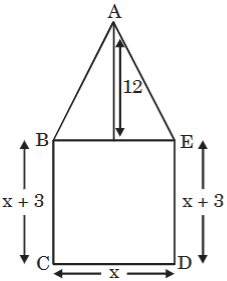
A rectangular park is to be designed whose breadth is 3 m less than its length. Its area is to be 4 square metres more than the area of a park that has already been made in the shape of an isosceles triangle with its base as the breadth of the rectangular park and of altitude 12 m. Find the length and breadth of the park.
Question 175 Marks
Two water taps together can fill a tank in $9 \frac{3}{8}$ hours. The tap of larger diameter takes 10 hours less than the smaller one to fill the tank separetely. Find the time in which each tap can separately fill the tank.
AnswerLet the smaller tap fill the tank in $x$ hours.
Then the larger tap fills it in $(x-10) hrs$.
Time taken by both to fill tank $=\frac{75}{8} hrs$.
Part filled by smaller tap in $1 hr .=\frac{1}{x}$
Part filled by larger tap in $1 hr =\frac{1}{(x-10)}$
Part filled by both taps in $1 hr =\frac{8}{75}$
$\begin{array}{l}\therefore \frac{1}{x}+\frac{1}{(x-10)}=\frac{8}{75} \\\Rightarrow \frac{x-10+x}{x(x-10)}=\frac{8}{75} \\\Rightarrow \frac{2 x-10}{x^2-10 x}=\frac{8}{75} \\\Rightarrow 150 x-750=8 x^2-80 x \\\Rightarrow 8 x^2-230 x+750=0 \\\Rightarrow 4 x^2-115 x+375=0 \\\Rightarrow 4 x^2-100 x-15 x+375=0 \\\Rightarrow 4 x-(x-25)-15(x-25)=0 \\\Rightarrow(x-25)(4 x-15)=0\end{array}$
$\Rightarrow x=25, \frac{15}{4}$
$\therefore$ Smaller tap takes 25 hrs .
$\therefore$ Larger tap takes $(25-10)=15 hrs$.
View full question & answer→Question 185 Marks
The sum of the areas of two squares is $640 m^2$. If the difference of their perimeters is 64 m, find the sides of the square.
Answer$\Rightarrow$ Let side of first square be $x$ and that of another be $y$.
In $I ^{\text {st }}$ Case,
sum of areas $=640$
$x^2+y^2=640 \quad \quad \ldots \ldots(i)$
$\text {II}{ }^{\text {nd }}$ Case,
Difference of their perimeters $=64$
$\begin{array}{l}4 x-4 y=64 \\\Rightarrow 4(x-y)=64\end{array}$
$\begin{array}{l}\Rightarrow x-y=\frac{64}{4}=16 \\\Rightarrow x=16+y \quad \quad \ldots \ldots(ii)\end{array}$
putting the value of $x$ in equation (i), we get
$\begin{array}{l}(16+y)^2+y^2=640 \\256+y^2+32 y+y^2=640 \\\Rightarrow 2 y^2+32 y-640+256=0 \\\Rightarrow 2 y^2+32 y-384=0 \\\Rightarrow y^2+16 y-192=0 \\\Rightarrow y^2+24 y-8 y-192=0 \\\Rightarrow y^2+24 y-8 y-192=0 \\\Rightarrow y(y+24)-8(y+24)=0 \\\Rightarrow(y+24)(y-8)=0 \\\Rightarrow y+24=0 \Rightarrow y=-24(\text { Not Possible }) \\\text { and } y-8=0 \Rightarrow y=8\end{array}$
putting the value of $y$ in equation. (ii), we get
$x=16+8=24$
$\therefore$ side of first square $=24 m$
and side of second square $=16 m$
View full question & answer→Question 195 Marks
Solve for x :
$\frac{1}{2 a+b+2 x}=\frac{1}{2 a}+\frac{1}{b}+\frac{1}{2 x} ; x \neq 0, x \neq \frac{-2 a-b}{2}, a, b \neq 0$
Answer
$\begin{array}{l}\frac{1}{2 a+b+2 x}=\frac{1}{2 a}+\frac{1}{b}+\frac{1}{2 x} \\\Rightarrow \frac{1}{2 a+b+2 x}-\frac{1}{2 x}=\frac{1}{2 a}+\frac{1}{b} \\\frac{2 x-(2 a+b+2 x)}{(2 a+b+2 x) 2 x}=\frac{b+2 a}{(2 a) b} \\\Rightarrow \frac{2 x-2 a-b-2 x}{(2 a+b+2 x) 2 x}=\frac{b+2 a}{2 a b} \\\Rightarrow \frac{-(b+2 a)}{(2 a+b+2 x) 2 x}=\frac{(b+2 a)}{2 a b} \\\Rightarrow-a b=(2 a+b+2 x) x \\\Rightarrow-a b=2 a x+b x+2 x^2 \\\Rightarrow 2 x^2+2 a x+b x+a b=0 \\\Rightarrow 2 x(x+a)+b(x+a) 0 \\\Rightarrow(x+a)(2 x+b)=0 \\\Rightarrow x+a=0 \quad a n d \quad 2 x+b=0 \\\text { or } \quad x=-a \quad \text { or } \quad x=\frac{-b}{2}\end{array}$
Hence, $x=-a$ and $x=\frac{-b}{2}$
View full question & answer→Question 205 Marks
Find the values of $k$ for which the quadratic equation $(k+4) x^2+(k+1) x+1=0$ has equal roots. Also find these roots.
AnswerIt is given that the quadratic equation has equal roots, so its discriminant will be zero.
$\therefore D=b^2-4 a c=0$
Compare given quadratic equation with standard form of quadratic equation $a x^2+b x+c=0$,
$\begin{array}{l}a=k+4, b=k+1, c=1 \\\Rightarrow(k+1)^2-4 \times(k+4) \times(1)=0 \\\Rightarrow k^2+2 k+1-4 k-16=0\end{array}$
(Using $(a+b)^2=a^2+2 a b+b^2$ )
$
\Rightarrow k^2-2 k-15=0$
Splitting the middle term,
$\begin{array}{l}\Rightarrow k^2-5 k+3 k-15=0 \\\Rightarrow k(k-5)+3(k-5)=0 \\\Rightarrow(k+3)(k-5)=0 \\\Rightarrow k=-3 \text { or } k=5\end{array}$
Substitute, $k=5$ in
$\begin{array}{l}(k+4) x^2+(k+1) x+1=0 \\\Rightarrow 9 x^2+6 x+1=0\end{array}$
$\begin{array}{l}\Rightarrow(3 x+1)^2=0 \\
\Rightarrow x=\frac{-1}{3}, \frac{-1}{3}\end{array}$
Substitute, $k=-3$ in
$\begin{array}{l}(k+4) x^2+(k+1) x+1=0 \\x^2-2 x+1=0 \\\Rightarrow(x-1)^2=0 \\\Rightarrow x=1,1\end{array}$
Hence, the equal root of the given quadratic equation is either 1 or $\frac{-1}{3}$.
View full question & answer→