Question
Solve graphically : 5x – 3y ≤ 0

Answer

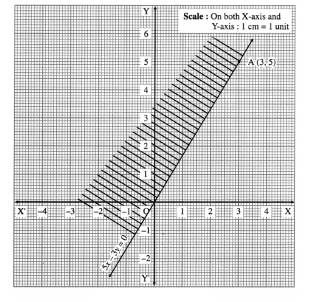
Consider the line whose equation is 5x – 3y = 0. The constant term is zero, therefore this line is passing through the origin. ∴ one point on the line is the origin O = (0, 0). To find the other point, we can give any value of x and get the corresponding value of y. Put x = 3, we get 15 – 3y = 0, i.e. y = 5 ∴ A ≡ (3, 5) is another point on the line. Draw the line OA. To find the solution set, we cannot check 0(0, 0), as it is already on the line. We can check any other point which is not on the line. Let us check the point (1, -1). When x = 1, y = -1 then 5x – 3y = 5 + 3 = 8 which is neither less nor equal to zero. ∴ 5x – 3y ≰ 0 in this case. Hence (1, -1) will not lie in the required region. Therefore, the required region is the upper side which is shaded in the graph.
Image

This is the solution set of 5x – 3y ≤ 0.

Need a full question paper?

Generate a complete, print-ready paper with questions like this in minutes — across 16+ boards, with answer keys.

Start Generating Free

Similar questions

Prove that the least perimeter of an isosceles triangle in which a circle of radius r can be inscribed is $6\sqrt{3}\text{ r}$.
Verify Rolle's theorem of the following function on the indicated interval
$\text{f}(\text{x})=\log(\text{x}^2+2)-\log3\text{ on }[-1,1]$
Solve the following differential equation
$\cos\text{x }\frac{\text{dy}}{\text{dx}}-\cos2\text{x}=\cos3\text{x}$
The probability that a student entering a university will graduate is 0.4. Find the probability that out of 3 students of the university.
  1. none will graduate.
  2. only one will graduate.
  3. all will graduate.
Solve the following systems of homogeneous linear equations by matrix method:
$3x - y + 2z = 0$
$4x + 3y + 3z = 0$
$5x + 7y + 4z =0$
Show that the four points A, B, C and D with the position vectors $\vec{\text{a}},\ \vec{\text{b}},\ \vec{\text{c}}$ and $\vec{\text{d}}$ respectively are coplanar if and only if $3\vec{\text{a}}-2\vec{\text{b}}+\vec{\text{c}}-2\vec{\text{d}}=\vec0$.
Find the intervals in which the following functions are increasing or decreasing.
$f(x) = 5x^3 - 15x^2 - 120x + 3$.
Find the shortest distance between the following pairs of parallel lines whose equations are:$\vec{\text{r}}=\big(\hat{\text{i}}+2\hat{\text{j}}+3\hat{\text{k}}\big)+\lambda\big(\hat{\text{i}}-\hat{\text{j}}+\hat{\text{k}}\big)$ and $\vec{\text{r}}=\big(2\hat{\text{i}}-\hat{\text{j}}-\hat{\text{k}}\big)+\mu\big(-\hat{\text{i}}+\hat{\text{j}}-\hat{\text{k}}\big)$
Evaluvate the following intregals:
$\int\frac{5\cos\text{x}+6}{2\cos\text{x}+\sin\text{x}+3}\ \text{dx}$
Find the points on the curve $y^2 = 2x^3$ at which the slope of the tangent is $3.$