Questions

Solve the Following Question.(5 Marks)

Take a timed test

54 questions · self-marked practice — reveal the answer and mark yourself.

Question 15 Marks
A firm manufacturing two types of electrical items A and B, can make a profit of ₹ 20/- per unit of A and ₹ 30/- per unit of B. Both A and B make use of two essential components a motor and a transformer. Each unit of A requires 3 motors and 2 transformers and each units of B requires 2 motors and 4 transformers. The total supply of components per month is restricted to 210 motors and 300 transformers. How many units of A and B should the manufacture per month to maximize profit? How much is the maximum profit?
Answer
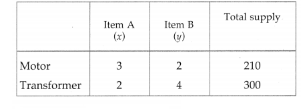
Let the firm manufactures x units of item A and y units of item B. Firm can make profit of ₹ 20 per unit of A and ₹ 30 per unit of B. Hence, the total profit is z = ₹ (20x + 30y). This is the objective function which is to be maximized. The constraints are as per the following table :

Image

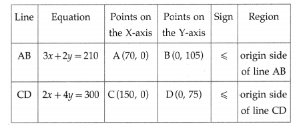
From the table, the constraints are 3x + 2y ≤ 210, 2x + 4y ≤ 300 Since, number of items cannot be negative, x ≥ 0, y ≥ 0. Hence, the mathematical formulation of given LPP is : Maximize z = 20x + 30y, subject to 3x + 2y ≤ 210, 2x + 4y ≤ 300, x ≥ 0, y ≥ 0. We draw the lines AB and CD whose equations are 3x + 2y = 210 and 2x + 4y = 300 respectively.
Image

The feasible region is OAPDO which is shaded in the graph. The vertices of the feasible region are O (0, 0), A (70, 0), P and D (0, 75). P is the point of intersection of the lines 2x + 4y = 300 … (1) and 3x + 2y = 210 … (2) Multiplying equation (2) by 2, we get 6x + 4y = 420 Subtracting equation (1) from this equation, we get ∴ 4x = 120 ∴ x = 30 Substituting x = 30 in (1), we get 2(30) + 4y = 300 ∴ 4y = 240 ∴ y = 60 ∴ P is (30, 60) The values of the objective function z = 20x + 30y at these vertices are z(O) = 20(0) + 30(0) = 0 + 0 = 0 z(A) = 20(70) + 30(0) = 1400 + 0 = 1400 z(P) = 20(30) + 30(60) = 600 + 1800 = 2400 z(D) = 20(0) + 30(75) = 0 + 2250 = 2250 ∴ z has the maximum value 2400 when x = 30 and y = 60. Hence, the firm should manufactured 30 units of item A and 60 units of item B to get the maximum profit of ₹ 2400.
View full question & answer
Question 25 Marks
A firm manufactures two products A and B on which profit earned per unit ₹3/- and ₹4/- respectively. Each product is processed on two machines M1 and M2. The product A requires one minute of processing time on M1 and two minute of processing time on M2, B requires one minute of processing time on M1 and one minute of processing time on M2. Machine M1 is available for use for 450 minutes while M2 is available for 600 minutes during any working day. Find the number of units of product A and B to be manufactured to get the maximum profit.
Answer
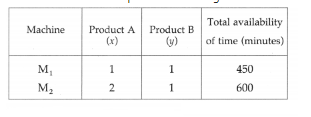
Let the firm manufactures x units of product A and y units of product B. The profit earned per unit of A is ₹3 and B is ₹ 4. Hence, the total profit is z = ₹ (3x + 4y). This is the linear function which is to be maximized. Hence, it is the objective function. The constraints are as per the following table :

Image

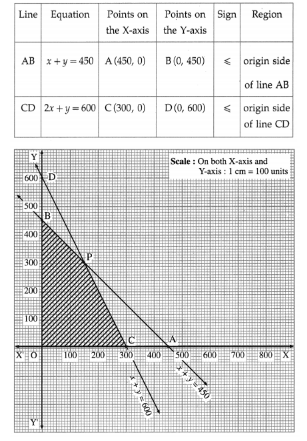
From the table, the constraints are x + y ≤ 450, 2x + y ≤ 600 Since, the number of gift items cannot be negative, x ≥ 0, y ≥ o. ∴ the mathematical formulation of LPP is, Maximize z = 3x + 4y, subject to x + y ≤ 450, 2x + y ≤ 600, x ≥ 0, y ≥ 0. Now, we draw the lines AB and CD whose equations are x + y = 450 and 2x + y — 600 respectively.

Image

The feasible region is OCPBO which is shaded in the graph. The vertices of the feasible region are O(0, 0), C(300, 0), P and B (0, 450). P is the point of intersection of the lines 2x + y = 600 … (1) and x + y = 450 … (2) On subtracting, we get ∴ x = 150 Substituting x = 150 in equation (2), we get 150 + y = 450 ∴ y = 300 ∴ P = (150, 300) The values of the objective function z = 3x + 4y at these vertices are z(O) = 3(0) + 4(0) = 0 + 0 = 0 z(C) = 3(300) + 4(0) = 900 + 0 = 900 z(P) = 3(150) + 4(300) = 450 + 1200 = 1650 z(B) = 3(0) + 4(450) = 0 + 1800 = 1800 ∴ z has the maximum value 1800 when x = 0 and y = 450 Hence, the firm gets maximum profit of ₹ 1800 if it manufactures 450 units of product B and no unit product A.

View full question & answer
Question 35 Marks
A person makes two types of gift items A and B requires the services of a cutter and a finisher. Gift item A requires 4 hours of cutter’s time and 2 hours of finisher’s time. B requires 2 hours of cutter’s time and 4 hours of finisher’s time. The cutter and finisher have 208 hours and 152 hours available times respectively every month. The profit of one gift item of type A is ₹ 75/- and on gift item B is ₹ 125/-. Assuming that the person can sell all the gift items produced, determine how many gift items of each type should he make every month to obtain the best returns?
Answer
Let x: number of gift item A y: number of gift item B As numbers of the items are never negative x ≥ 0; y ≥ 0

Image

Total time required for the cutter = 4x + 2y Maximum available time 208 hours ∴ 4x+ 2y ≤ 208 Total time required for the finisher 2x +4y Maximum available time 152 hours 2x + 4y ≤ 152 Total Profit is 75x + 125y ∴ L.P.P. of the above problem is Minimize z = 75x + 125y Subject to 4x+ 2y ≤ 208 2x + 4y ≤ 152 x ≥ 0; y ≥ 0 Graphical solution

Image

Corner points Now, Z at x = (75x + 125y) O(0, 0) = 75 × 0 + 125 × 0 = 0 A(52,0) = 75 × 52 + 125 × 0 = 3900 B(44, 16) = 75 × 44 + 125 × 16 = 5300 C(0, 38) = 75 × 0 + 125 × 38 = 4750 A person should make 44 items of type A and 16 Uems of type Band his returns are ₹ 5,300.
View full question & answer
Question 45 Marks
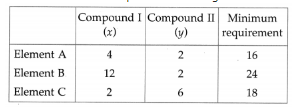
A chemical company produces a chemical containing three basic elements A, B, C so that it has at least 16 liters of A, 24 liters of B and 18 liters of C. This chemical is made by mixing two compounds I and II. Each unit of compound I has 4 liters of A, 12 liters of B, 2 liters of C. Each unit of compound II has 2 liters of A, 2 liters of B and 6 liters of C. The cost per unit of compound I is ₹ 800/- and that of compound II is ₹ 640/-. Formulate the problem as L.P.P. and solve it to minimize the cost.
Answer
Let the company buy x units of compound I and y units of compound II. Then the total cost is z = ₹(800x + 640y). This is the objective function which is to be minimized. The constraints are as per the following table :

Image

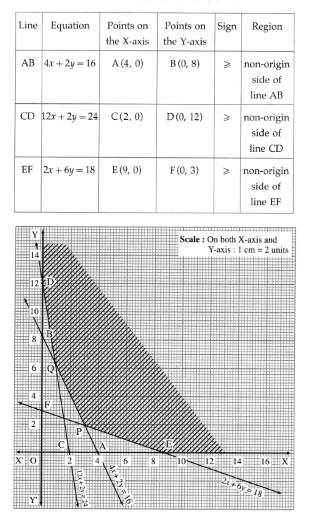
From the table, the constraints are 4x + 2y ≥ 16, 12x + 2y ≥ 24, 2x + 6y ≥ 18. Also, the number of units of compound I and compound II cannot be negative. ∴ x ≥ 0, y ≥ 0. ∴ the mathematical formulation of given LPP is Minimize z = 800x + 640y, subject to 4x + 2y ≥ 16, 12x + 2y ≥ 24, 2x + 6y ≥ 18, x ≥ 0, y ≥ 0. First we draw the lines AB, CD and EF whose equations are 4x + 2y = 16, 12x + 2y = 24 and 2x + 6y = 18
Image

The feasible region is shaded in the graph. The vertices of the feasible region are E(9, 0), P, Q, and D(0, 12). P is the point of intersection of the lines 2x + 6y = 18 … (1) and 4x + 2y = 16 … (2) Multiplying equation (1) by 2, we get 4x + 12y = 36 Subtracting equation (2) from this equation, we get 10y = 20 ∴ y = 2 ∴ from (1), 2x + 6(2) = 18 ∴ 2x = 6 ∴ x = 3 ∴ P = (3, 2) Q is the point of intersection of the lines 12x + 2y = 24 … (3) and 4x + 2y = 16 … (2) On subtracting, we get 8x = 8 ∴ x = 1 ∴ from (2), 4(1) + 2y = 16 ∴ 2y = 12 ∴ y = 6 ∴ Q = (1, 6) The values of the objective function z = 800x + 640y at these vertices are z(E) = 800(9)+ 640(0) =7200 + 0 = 7200 z(P) = 800(3) + 640(2) = 2400 + 1280 = 3680 z(Q) = 800(1) + 640(6) =800 + 3840 =4640 z(D) = 800(0) + 640(12) = 0 + 7680 = 7680 ∴ the minimum value of z is 3680 at the point (3, 2). Hence, the company should buy 3 units of compound I and 2 units of compound II to have the minimum cost of ₹ 3680.

View full question & answer
Question 55 Marks
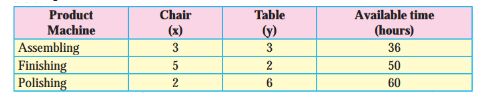
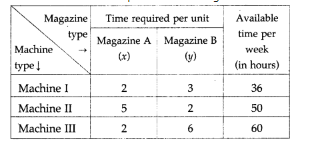
A company produces mixers and food processors. Profit on selling one mixer and one food processor is ₹ 2,000/- and ₹ 3,000/- respectively. Both the products are processed through three Machines A, B, C. The time required in hours by each product and total time available in hours per week on each machine are as follows :

Image

How many mixers and food processors should be produced to maximize the profit?

Answer
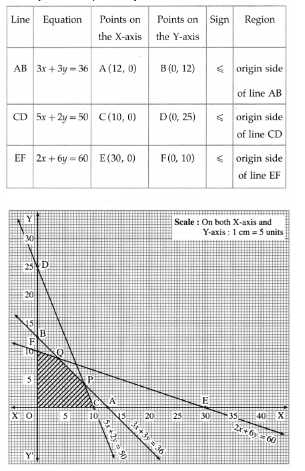
Let the company produce x mixers and y food processors. Then the total profit is z = ₹ (2000x + 3000y) This is the objective function which is to be maximized. From the given table in the problem, the constraints are 3x + 3y ≤ 36, 5x + 2y ≤ 50, 2x + 6y ≤ 60 Also, the number of mixers and food processors cannot be negative, ∴ x ≥ 0, y ≥ 0. ∴ the mathematical formulation of given LPP is Maximize z = 2000x + 3000y, subject to 3x + 3y ≤ 36, 5x + 2y ≤ 50, 2x + 6y ≤60, x ≥ 0, y ≥ 0. First we draw the lines AB, CD and EF whose equations are 3x + 3y = 36, 5x + 2y = 50 and 2x + 6y = 60 respectively.

Image

The feasible region is OCPQFO which is shaded in the graph. The vertices of the feasible region are O(0, 0), C(10, 0), P, Q and F(0,10). P is the point of intersection of the lines 3x + 3y = 36 … (1) and 5x + 2y = 50 … (2) Multiplying equation (1) by 2 and equation (2) by 3, we get 6x + 6y = 72 15x + 6y = 150 On subtracting, we get 9x = 78

$\therefore x=\frac{26}{3}$ $\begin{aligned} & \therefore \text { from }(1), 3\left(\frac{26}{3}\right)+3 y=36 \\ & \therefore 3 y=10 \\ & \therefore y=\frac{10}{3} \\ & \therefore P=\left(\frac{26}{3}, \frac{10}{3}\right)\end{aligned}$

Q is the point of intersection of the lines 3x + 3y = 36 … (1) and 2x + 6y = 60 … (3) Multiplying equation (1) by 2, we get 6x + 6y = 72 Subtracting equation (3), from this equation, we get 4x = 12 ∴ x = 3 ∴ from (1), 3(3) + 3y = 36 ∴ 3y = 27 ∴ y = 9 ∴ Q = (3, 9) The values of the objective function z = 2000x + 3000y at these vertices are z(O) = 2000(0) + 3000(0) = 0 + 0 = 0 z(C) = 2000(10) + 3000(0) = 20000 + 0 = 20000

$z(P)=2000\left(\frac{26}{3}\right)+3000\left(\frac{10}{3}\right)=\frac{52000}{3}+\frac{30000}{3}=\frac{82000}{3}$

z(Q) = 2000(3) + 3000(9) = 6000 + 27000 = 33000 z(F) = 2000(0) + 3000(10) = 30000 + 0 = 30000 ∴ the maximum value of z is 33000 at the point (3, 9). Hence, 3 mixers and 9 food processors should be produced in order to get the maximum profit of ₹ 33,000.

View full question & answer
Question 65 Marks
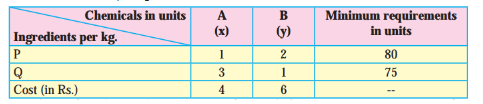
A factory produced two types of chemicals A and B. The following table gives the units of ingredients P and Q (per kg) of chemicals A and B as well as minimum requirements of P and Q and also cost per kg. chemicals A and B :

Image

Find the number of units of chemicals A and B should be produced so as to minimize the cost.

Answer
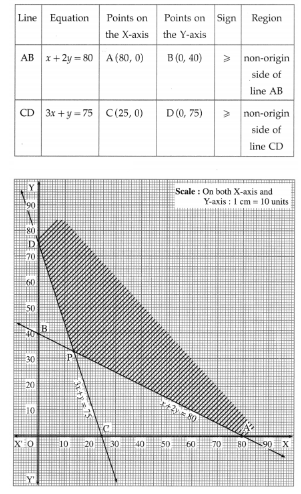
Let the factory produce x units of chemical A and y units of chemical B. Then the total cost is z = ₹ (4x + 6y). This is the objective function which is to be minimized. From the given table, the constraints are x + 2y ≥ 80, 3x + y ≥ 75. Also, the number of units x and y of chemicals A and B cannot be negative. ∴ x ≥ 0, y ≥ 0. ∴ the mathematical formulation of given LPP is Minimize z = 4x + 6y, subject to x + 2y ≥ 80, 3x + y ≥ 75, x ≥ 0, y ≥ 0. First we draw the lines AB and CD whose equations are x + 2y = 80 and 3x + y = 75 respectively.

Image

The feasible region is shaded in the graph. The vertices of the feasible region are A (80, 0), P and D (0, 75). P is the point of intersection of the lines x + 2y = 80 … (1) and 3x + y = 75 … (2) Multiplying equation (2) by 2, we get 6x + 2 y = 150 Subtracting equation (1) from this equation, we get 5x = 70 ∴ x = 14 ∴ from (2), 3(14) + y = 75 ∴ 42 + y = 75 ∴ y = 33 ∴ P = (14, 33) The values of the objective function z = 4x + 6y at these vertices are z(a) = 4(80)+ 6(0) =320 + 0 = 320 z(P) = 4(14)+ 6(33) = 56+ 198 = 254 z(D) = 4(0) + 6(75) = 0 + 450 = 450 ∴ the minimum value of z is 254 at the point (14, 33). Hence, 14 units of chemical A and 33 units of chemical B are to be produced in order to have the j minimum cost of ₹ 254.

View full question & answer
Question 75 Marks
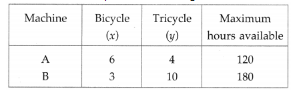
A company manufactures bicycles and tricycles, each of which must be processed through two machines A and B. Maximum availability of Machine A and B is respectively 120 and 180 hours. Manufacturing a bicycle requires 6 hours on Machine A and 3 hours on Machine B. Manufacturing a tricycles requires 4 hours on Machine A and 10 hours on Machine B. If profits are ₹180/- for a bicycle and ₹220/- for a tricycle. Determine the number of bicycles and tricycles that should be manufactured in order to maximize the profit.
Answer
Let x bicycles and y tricycles are to be manu¬factured. Then the total profit is z = ₹ (180x + 220y) This is a linear function which is to be maximized. Hence, it is the objective function. The constraints are as per the following table :

Image

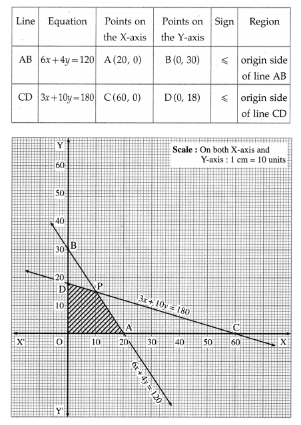
From the table, the constraints are 6x + 4y ≤ 120, 3x +10y ≤ 180 Also, the number of bicycles and tricycles cannot be i negative. ∴ x ≥ 0, y ≥ 0. Hence, the mathematical formulation of given LPP is : Maximize z = 180x + 220y, subject to 6x + 4y ≤ 120, 3x + 10y ≤ 180, x ≥ 0, y ≥ 0. First we draw the lines AB and CD whose equations are 6x + 4y = 120 and 3x + 10y = 180 respectively.

Image

The feasible region is OAPDO which is shaded in the graph. The vertices of the feasible region are O(0, 0), A(20, 0) P and D(0, 18). P is the point of intersection of the lines 3x + 10y = 180 … (1) and 6x + 4y = 120 … (2) Multiplying equation (1) by 2, we get 6x + 20y = 360 Subtracting equation (2) from this equation, we get 16y = 240 ∴ y = 15 ∴ from (1), 3x + 10(15) = 180 ∴ 3x = 30 ∴ x = 10 ∴ P = (10, 15) The values of the objective function z = 180x + 220y at these vertices are z(O) = 180(0) + 220(0) = 0 + 0 = 0 z(a) = 180(20) + 220(0) = 3600 + 0 = 3600 z(P) = 180(10) + 220(15) = 1800 + 3300 = 5100 z(D) = 180(0) +220(18) = 3960 ∴ the maximum value of z is 5100 at the point (10, 15). Hence, 10 bicycles and 15 tricycles should be manufactured in order to have the maximum profit of ₹ 5100.

View full question & answer
Question 85 Marks
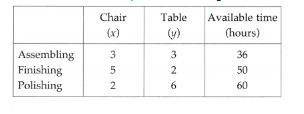
We first draw the lines processed on three machines : Assembling, Finishing and Polishing. The time required for each product in hours and availability of each machine is given by following table:

Image

Formulate the above problem as L.P.P. Solve it graphically to get maximum profit.

Answer
Let the number of chairs and tables made by the carpenter be x and y respectively. The profits are ₹ 140 per chair and ₹ 210 per table. ∴ total profit z = ₹ (140x + 210y) This is the objective function which is to be maximized. The constraints are as per the following table :

Image

From the table, the constraints are

$3 x+3 y \leq 36,5 x+2 y \leq 50,2 x+6 y \leq 60$

The number of chairs and tables cannot be negative. ∴ x ≥ 0, y ≥ 0 Hence, the mathematical formulation of given LPP is : Maximize z = 140x + 210y, subject to

$3 x+3 y \leq 36,5 x+2 y \leq 50,2 x+6 y \leq 60, x \geq 0, y \geq 0$

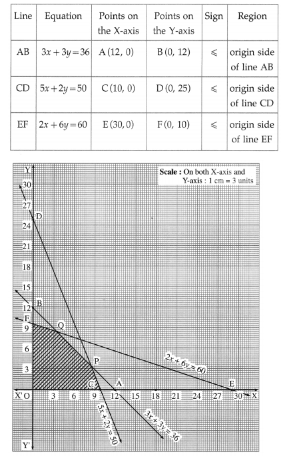
We first draw the lines AB, CD and EF whose equations are 3x + 3y = 36, 5x + 2y = 50 and 2x + 6y = 60 respectively.

Image

The feasible region is OCPQFO which is shaded in the graph. The vertices of the feasible region are O (0, 0), C (10, 0), P, Q and F (0, 10). P is the point of intersection of the lines 5x + 2y = 50 … (1) and 3x + 3y = 36 … (2) Multiplying equation (1) by 3 and equation (2) by 2, we get 15x + 6y = 150 6x + 6y = 72 On subtracting, we get 26

$9 x=78 \therefore x=\frac{26}{3}$

Substituting $x=\frac{26}{3}$ in (2), we get

$3\left(\frac{26}{3}\right)+3 y=36$

$3 y=10 y=\frac{10}{3}$

Q is the point of intersection of the lines 3x + 3y = 36 … (2) and 2x + 6y = 60 … (3) Multiplying equation (2) by 2, we get 6x + 6 y = 72 Subtracting equation (3) from this equation, we get 4x = 12 ∴ x = 3 Substituting x = 3 in (2), we get 3(3) + 3y = 36 ∴ 3y = 27 ∴ y = 9 ∴ Q is (3, 9). Hence, the vertices of the feasible region are O (0, 0),

$C(10,0), \mathrm{P}\left(\frac{26}{3}, \frac{10}{3}\right), \mathrm{Q}(3,9)$ and $\mathrm{F}(0,10)$.

The values of the objective function z = 140x + 210y at these vertices are z(O) = 140(0) + 210(0) = 0 + 0 = 0 z(C) = 140 (10) + 210(0) = 1400 + 0 = 1400

$z(\mathrm{P})=140\left(\frac{26}{3}\right)+210\left(\frac{10}{3}\right)=\frac{3640+2100}{3}=\frac{5740}{3}=1913.33$

z(Q) = 140(3) + 210(9) = 420 + 1890 = 2310 z(F) = 140(0) + 210(10) = 0 + 2100 = 2100 ∴ z has maximum value 2310 when x = 3 and y = 9 Hence, the carpenter should make 3 chairs and 9 tables to get the maximum profit of ₹ 2310.

View full question & answer
Question 95 Marks
Maximize z = 4x + 2y subject to 3x + y ≥ 27, x + y ≥ 21, x + 2y ≥ 30; x ≥ 0, y ≥ 0
Answer
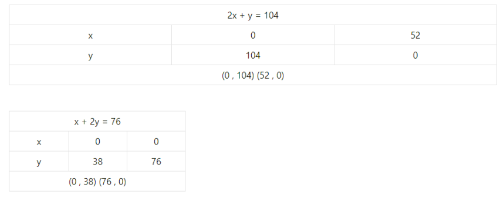
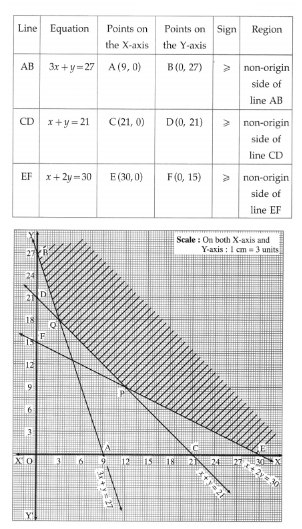
We first draw the lines AB, CD and EF whose equations are 3x + y = 27, x + y = 21, x + 2y = 30 respectively.

Image

The feasible region is XEPQBY which is shaded in the graph. The vertices of the feasible region are E (30,0), P, Q and B (0,27). P is the point of intersection of the lines x + 2y = 30 … (1) and x + y = 21 … (2) On subtracting, we get y = 9 Substituting y = 9 in (2), we get x + 9 = 21 ∴ x = 12 ∴ P is (12, 9) Q is the point of intersection of the lines x + y = 21 … (2) and 3x + y = 27 … (3) On subtracting, we get 2x = 6 ∴ x = 3 Substituting x = 3 in (2), we get 3 + y = 21 ∴ y = 18 ∴ Q is (3, 18). The values of the objective function z = 4x + 2y at these vertices are z(E) = 4(30) + 2(0) = 120 + 0 = 120 z(P) = 4(12) + 2(9) = 48 + 18 = 66 z(Q) = 4(3) + 2(18) = 12 + 36 = 48 z(B) = 4(0) + 2(27) = 0 + 54 = 54 ∴ z has minimum value 48, when x = 3 and y = 18.

View full question & answer
Question 105 Marks
Maximize z = 60x + 50y subject to x + 2y ≤ 40, 3x + 2y ≤ 60, x ≥ 0, y ≥ 0
Answer
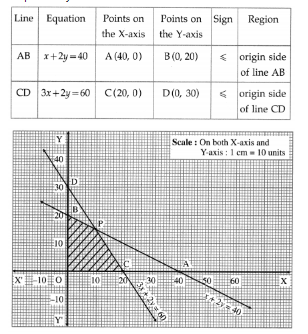
We first draw the lines AB and CD whose equations are x + 2y = 40 and 3x + 2y = 60 respectively.

Image

The feasible region is OCPBO which is shaded in the graph. The vertices of the feasible region are O (0, 0), C (20, 0), P and B (0, 20). P is the point of intersection of the lines. 3x + 2y = 60 … (1) and x + 2y = 40 … (2) On subtracting, we get 2x = 20 ∴ x = 10 Substituting x = 10 in (2), we get 10 + 2y = 40 ∴ 2y = 30 ∴ y = 15 ∴ P is (10, 15) The values of the objective function z = 60x + 50y at these vertices are z(O) = 60(0) + 50(0) = 0 + 0 = 0 z(C) = 60(20) + 50(0) = 1200 + 0 = 1200 z(P) = 60(10) + 50(15) = 600 + 750 = 1350 z(B) = 60(0) + 50(20) = 0 + 1000 = 1000 . ∴ z has maximum value 1350 at x = 10, y = 15.

View full question & answer
Question 115 Marks
Maximize $z=4 x_1+3 x_2$ subject to $3 x_1+x_2 \leq 15,3 x_1+4 x_2 \leq 24, x_1 \geq 0, x_2 \geq 0$
Answer
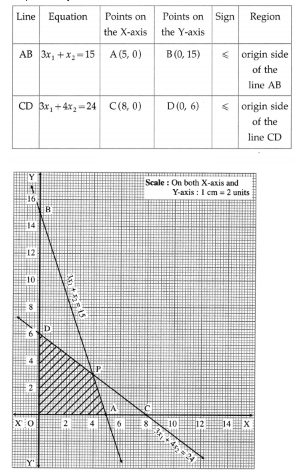
We first draw the lines $A B$ and $C D$ whose equations are $3 x_1+x_2=15$ and $3 x_1+4 x_2=24$

respectively.

Image

The feasible region is OAPDO which is shaded in the graph. The Vertices of the feasible region are 0(0, 0), A(5, 0), P and D(0, 6). P is the point of intersection of lines.

$\begin{aligned} & 3 x_1+4 x_2=24 \ldots(1) \\ & \text { and } 3 x_1+x_2=15 \ldots(2)\end{aligned}$

On subtracting, we get

$3 x_2=9 \therefore x_2=3$

Substituting $x_2=3$ in $(2)_{\text {r }}$, get

$3 x_1+3=15$

$\therefore 3 x_1=12 \therefore x_1=4 \therefore P$ is $(4,3)$

The values of objective function $z=4 x_1+3 x_2$ at these vertices are

z(O) = 4(0) + 3(0) = 0 + 0 = 0 z(a) = 4(5) + 3(0) = 20 + 0 = 20 z(P) = 4(4) + 3(3) = 16 + 9 = 25 z(D) = 4(0) + 3(6) = 0 + 18 = 18 ∴ z has maximum value 25 when x = 4 and y = 3.

View full question & answer
Question 125 Marks
Solve each of the following L.P.P. : Maximize z = 2x + 3y subject to x – y ≥ 3, x ≥ 0, y ≥ 0
Answer
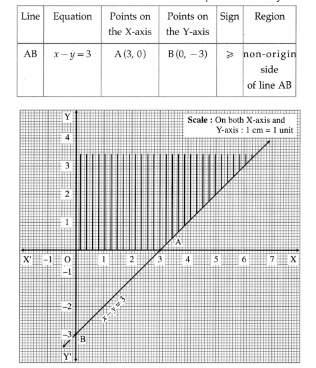
First we draw the lines AB whose equation is x – y = 3.

Image

The feasible region is shaded which is unbounded. Therefore, the value of objective function can be in- j creased indefinitely. Hence, this LPP has unbounded solution.

View full question & answer
Question 135 Marks
Solve each of the following L.P.P. : Maximize z = 6x + 10y subject to 3x + 5y ≤ 10, 5x + 3y ≤ 15, x ≥ 0, y ≥ 0
Answer
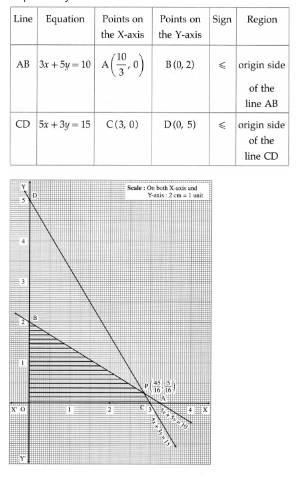
First we draw the lines AB and CD whose equations are 3x + 5y = 10 and 5x + 3y = 15 respectively.

Image

The feasible region is OCPBD which is shaded in the graph. The vertices of the feasible region are 0(0, 0), C(3, 0), P and B (0, 2). P is the point of intersection of the lines 3x + 5y = 10 … (1) and 5x + 3y = 15 … (2) Multiplying equation (1) by 5 and equation (2) by 3, we get 15x + 25y = 50 15x + 9y = 45 On subtracting, we get

$16 y=5 \therefore y=\frac{5}{16}$

Substituting $y=\frac{5}{16}$ in equation (1), we get

$3 x+\frac{25}{16}=10 \therefore 3 x=10-\frac{25}{16}=\frac{135}{16}$

$\therefore x=\frac{45}{16} \therefore P \equiv\left(\frac{45}{16}, \frac{5}{16}\right)$

The values of objective function z = 6x + 10y at these vertices are z(O) = 6(0) + 10(0) = 0 + 0 = 0 z(C) = 6(3) + 10(0) = 18 + 0 = 18

$z(P)=6\left(\frac{45}{16}\right)+10\left(\frac{5}{10}\right)=\frac{270}{16}+\frac{50}{16}=\frac{320}{16}=20$

z(B) = 6(0) + 10(2) = 0 + 20 = 20

The maximum value of $z$ is 20 at $P\left(\frac{45}{16}, \frac{5}{16}\right)$ and $B(0,2)$ two consecutive vertices.

∴ z has maximum value 20 at each point of line segment PB where B is (0, 2) and P is

$\left(\frac{45}{16}, \frac{5}{16}\right)$

Hence, there are infinite number of optimum solutions.

View full question & answer
Question 145 Marks
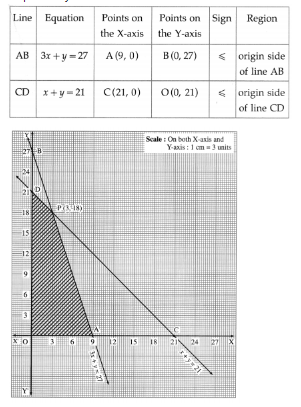
Solve each of the following L.P.P. : Maximize z = 4x + 2y subject to 3x + y ≥ 27, x + y ≥ 21 Question is modified. Maximize z = 4x + 2y subject to 3x + y ≤ 27, x + y ≤ 21, x ≥ 0, y ≥ 0
Answer
First we draw the lines AB and CD whose equations are 3x + y = 27 and x + y = 21 respectively.

Image

The feasible region is OAPDO which is shaded region in the graph. The vertices of the feasible region are 0(0, 0), A (9, 0), P and D(0, 21). P is the point of intersection of lines 3x + y = 27 … (1) and x + y = 21 … (2) On substracting, we get 2x = 6 ∴ x = 3 Substituting x = 3 in equation (1), we get 9 + y = 27 ∴ y = 18 ∴ P = (3, 18) The values of the objective function z = 4x + 2y at these vertices are z(O) = 4(0) + 2(0) = 0 + 0 = 0 z(a) = 4(9) + 2(0) = 36 + 0 = 36 z(P) = 4(3) + 2(18) = 12 + 36 = 48 z (D) = 4(0) + 2(21) = 0 + 42 = 42 ∴ 2 has minimum value 48 when x = 3, y = 18.

View full question & answer
Question 155 Marks
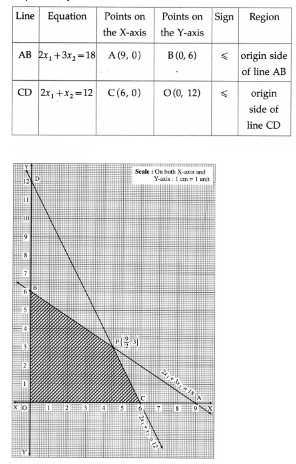
Solve each of the following L.P.P. : Maximize z = 5x1 + 6x2 subject to 2x1 + 3x2 ≤ 18, 2x1 + x2 ≤ 12, x1 ≥ 0, x2 ≥ 0
Answer
First we draw the lines AB and CD whose equations are 2x1 + 3x2 = 18 and 2x1 + x2 = 12 respectively.

Image

The feasible region is OCPBO which is shaded in the graph. The vertices of the feasible region are O(0, 0), C(6, 0), P and B (0,6). P is the point of intersection of the lines

$\begin{aligned} & 2 x_1+3 x_2=18 \ldots(1) \\ & \text { and } 2 x_1+x_2=12\end{aligned}$

On subtracting, we get

$2 x_2=6 \therefore x_2=3$

Substituting $x_2=3$ in (2), we get

$\begin{aligned} & 2 x_1+3=12 \therefore x_2=9 \\ & \therefore P \text { is }\left(\frac{9}{2}, 3\right)\end{aligned}$

The values of objective function $z=5 x_1+6 x_2$ at these vertices are

z(O) = 5(0) + 6(0) = 0 + 0 = 0 z(C) = 5(6) + 6(0) = 30 + 0 = 30

$z(P)=5\left(\frac{9}{2}\right)+6(3)=\frac{45}{2}+18=\frac{45+36}{2}=\frac{81}{2}=40.5$

z(B) = 5(0) + 6(3) = 0 + 18 = 18

Maximum value of $z$ is 40.5 when $x_1=9 / 2, y=3$.

View full question & answer
Question 205 Marks
A manufacturer produces two items A and B. Both are processed on two machines I and II. A needs 2 hours on machine I and 2 hours on machine II. B needs 3 hours on machine I and 1 hour on machine II. If machine I can run maximum 12 hours per day and II for 8 hours per day, construct a problem in the form of inequations and find its feasible solution graphically.
View full question & answer
Question 215 Marks
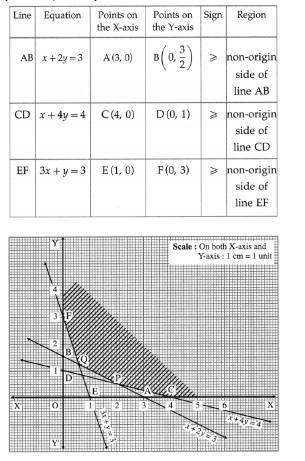
Minimize : z = 6x + 21y subject to x + 2y ≥ 3, x + 4y ≥ 4, 3x + y ≥ 3, x ≥ 0, y ≥ 0.
Answer
First we draw the lines AB, CD and EF whose equations are x + 2y = 3, x + 4y = 4 and 3x + y = 3 respectively

Image

The feasible region is XCPQFY which is shaded in the graph. The vertices of the feasible region are C (4, 0), P, Q and F(0, 3). P is the point of intersection of the lines x + 4y = 4 and x + 2y = 3 On subtracting, we get

$2 y=1 \therefore y=\frac{1}{2}$

Substituting $y=\frac{1}{2}$ in $x+2 y=3$, we get

$x+2\left(\frac{1}{2}\right)=3$

∴ x = 2

$\therefore P=\left(2, \frac{1}{2}\right)$

Q is the point of intersection of the lines x + 2y = 3 … (1) and 3x + y = 3 ….(2) Multiplying equation (1) by 3, we get 3x + 6y = 9 Subtracting equation (2) from this equation, we get 5y = 6

$\begin{aligned} & \therefore y=\frac{6}{5} \\ & \therefore \text { from }(1), x+2\left(\frac{6}{5}\right)=3 \\ & \therefore x=3-\frac{12}{5}=\frac{3}{5} \\ & Q \equiv\left(\frac{3}{5}, \frac{6}{5}\right)\end{aligned}$

The values of the objective function z = 6x + 21y at these vertices are z(C) = 6(4) + 21(0) = 24

$\begin{aligned} & z(P)=6(2)+21\left(\frac{1}{2}\right) \\ & =12+10.5=22.5 \\ & z(Q)=6\left(\frac{3}{5}\right)+21\left(\frac{6}{5}\right)\end{aligned}$

$=\frac{18}{5}+\frac{126}{5}=\frac{144}{5}=28.8$

2 (F) = 6(0) + 21(3) = 63

$\therefore z$ has minimum value 22.5 , when $x=2$ and $y=\frac{1}{2}$.

View full question & answer
Question 225 Marks
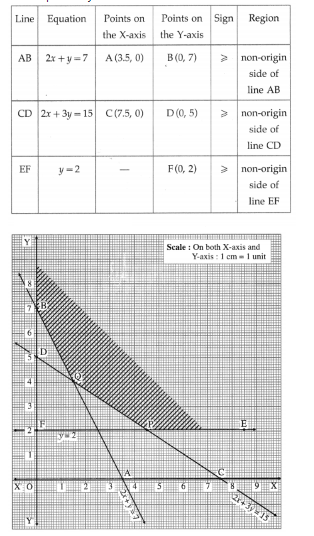
Minimize : z = 8x + 10y subject to 2x + y ≥ 7, 2x + 3y ≥ 15, y ≥ 2, x ≥ 0, y ≥ 0.
Answer
First we draw the lines AB, CD and EF whose equations are 2x + y = 7, 2x + 3y = 15 and y = 2 respectively.

Image

The feasible region is EPQBY which is shaded in the graph. The vertices of the feasible region are P, Q and B(0,7). P is the point of intersection of the lines 2x + 3y = 15 and y = 2. Substituting y – 2 in 2x + 3y = 15, we get 2x + 3(2) = 15 ∴ 2x = 9 ∴ x = 4.5 ∴ P = (4.5, 2) Q is the point of intersection of the lines 2x + 3y = 15 … (1) and 2x + y = 7 … (2) On subtracting, we get 2y = 8 ∴ y = 4 ∴ from (2), 2x + 4 = 7 ∴ 2x = 3 ∴ x = 1.5 ∴ Q = (1.5, 4) The values of the objective function z = 8x + 10y at these vertices are z(P) = 8(4.5) + 10(2) = 36 + 20 = 56 z(Q) = 8(1.5) + 10(4) = 12 + 40 = 52 z(B) = 8(0) +10(7) = 70 ∴ z has minimum value 52, when x = 1.5 and y = 4

View full question & answer
Question 235 Marks
Minimize : z = 7x + y subject to 5x + y ≥ 5, x + y ≥ 3, x ≥ 0, y ≥ 0.
Answer
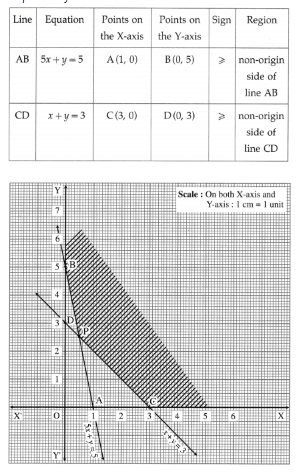
First we draw the lines AB and CD whose equations are 5x + y = 5 and x + y = 3 respectively.

Image

The feasible region is XCPBY which is shaded in the graph. The vertices of the feasible region are C (3, 0), P and B (0, 5). P is the point of the intersection of the lines 5x + y = 5 and x + y = 3 On subtracting, we get

$4 x=2 \therefore x=\frac{1}{2}$

Substituting $x=\frac{1}{2}$ in $x+y=3$, we get

$\frac{1}{2}+y=3$

$\therefore y=\frac{5}{2} \therefore P=\left(\frac{1}{2}, \frac{5}{2}\right)$

The values of the objective function z = 7x + y at these vertices are z(C) = 7(3) + 0 = 21 z(B) = 7(0) + 5 = 5 ∴ z has minimum value 5, when x = 0 and y = 5.

View full question & answer
Question 245 Marks
Maximize : z = 3x + 5y subject to x + 4y ≤ 24, 3x + y ≤ 21, x + y ≤ 9, x ≥ 0, y ≥ 0 also find maximum value of z.
Answer
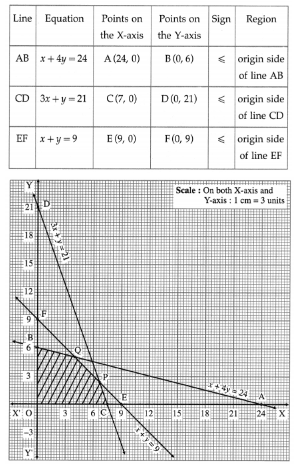
First we draw the lines AB, CD and EF whose equations are x + 4y = 24, 3x + y = 21 and x + y = 9 respectively.

Image

The feasible region is OCPQBO which is shaded in the graph. The vertices of the feasible region are O (0, 0), C (7, 0), P, Q and B (0, 6). P is the point of intersection of the lines 3x + y = 21 … (1) and x + y = 9 … (2) On subtracting, we get 2x = 12 ∴ x = 6 Substituting x = 6 in equation (2), we get 6 + y = 9 ∴ y = 3 ∴ P = (6, 3) Q is the point of intersection of the lines x + 4y = 24 … (3) and x + y = 9 … (2) On subtracting, we get 3y = 15 ∴ y = 5 Substituting y = 5 in equation (2), we get x + 5= 9 ∴ x = 4 ∴ Q = (4, 5) ∴ the corner points of the feasible region are 0(0,0), C(7, 0), P (6, 3), Q (4, 5) and B (0, 6). The values of the objective function 2 = 3x + 5y at these corner points are z(O) = 3(0)+ 5(0) = 0 + 0 = 0 z(C) = 3(7) + 5(0) = 21 + 0 = 21 z(P) = 3(6) + 5(3) = 18 + 15 = 33 z(Q) = 3(4) + 5(5) = 12 + 25 = 37 z(B) = 3(0)+ 5(6) = 0 + 30 = 30 ∴ z has maximum value 37, when x = 4 and y = 5.

View full question & answer
Question 255 Marks
Maximize : z = 10x + 25y subject to 0 ≤ x ≤ 3, 0 ≤ y ≤ 3, x + y ≤ 5 also find maximum value of z.
Answer
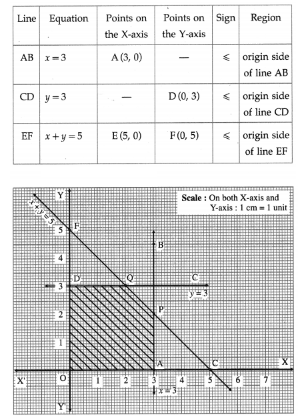
First we draw the lines AB, CD and EF whose equations are x = 3, y = 3 and x + y = 5 respectively.

Image

The feasible region is OAPQDO which is shaded in the i graph. The vertices of the feasible region are O (0, 0), A (3, 0), P, Q and D(0, 3). t P is the point of intersection of the lines x + y = 5 and x = 3. Substituting x = 3 in x + y = 5, we get 3 + y = 5 ∴ y = 2 ∴ P is (3, 2) Q is the point of intersection of the lines x + y = 5 and y = 3 Substituting y = 3 in x + y = 5, we get x + 3 = 5 ∴ x = 2 ∴ Q is (2, 3) The values of the objective function z = 10x + 25y at these vertices are z(O) = 10(0) + 25(0) = 0 + 0 = 0 z(a) = 10(3) + 25(0) = 30 + 0 = 30 z(P) = 10(3) + 25(2) = 30 + 50 = 80 z(Q) = 10(2) + 25(3) = 20 + 75 = 95 z(D) = 10(0)+ 25(3) = 0 + 75 = 75 ∴ z has maximum value 95, when x = 2 and y = 3.

View full question & answer
Question 265 Marks
Maximize : z = 7x + 11y subject to 3x + 5y ≤ 26 5x + 3y ≤ 30, x ≥ 0, y ≥ 0.
Answer
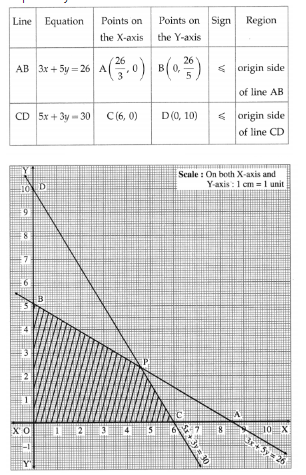
First we draw the lines AB and CD whose equations are 3x + 5y = 26 and 5x + 3y = 30 respectively.

Image

The feasible region is OCPBO which is shaded in the graph.

The vertices of the feasible region are $O(0,0), C(6,0), p$ and $B\left(0, \frac{26}{5}\right)$

The vertex P is the point of intersection of the lines 3x + 5y = 26 … (1) and 5x + 3y = 30 … (2) Multiplying equation (1) by 3 and equation (2) by 5, we get 9x + 15y = 78 and 25x + 15y = 150 On subtracting, we get

$16 x=72 \therefore x=\frac{72}{16}=\frac{9}{2}=4.5$

∴ z has maximum value 59, when x = 4.5 and y = 2.5.

View full question & answer
Question 275 Marks
Maximize : z = 4x + 6y subject to 3x + 2y ≤ 12, x + y ≥ 4, x, y ≥ 0.
Answer
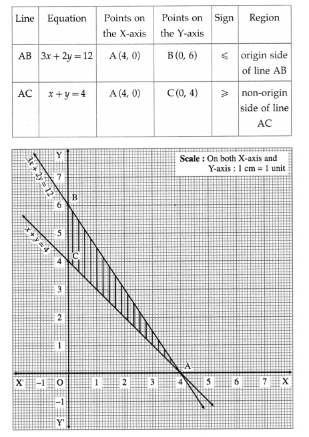
First we draw the lines AB and AC whose equations are 3x + 2y = 12 and x + y = 4 respectively.

Image

The feasible region is the ∆ABC which is shaded in the graph. The vertices of the feasible region (i.e. corner points) are A (4, 0), B (0, 6) and C (0, 4). The values of the objective function z = 4x + 6y at these vertices are z(a) = 4(4) + 6(0) = 16 + 0 = 16 z(B) = 4(0)+ 6(6) = 0 + 36 = 36 z(C) = 4(0) + 6(4) = 0 + 24 = 24 ∴ has maximum value 36, when x = 0, y = 6.

View full question & answer
Question 285 Marks
Maximize : z = 11x + 8y subject to x ≤ 4, y ≤ 6, x + y ≤ 6, x ≥ 0, y ≥ 0.
Answer
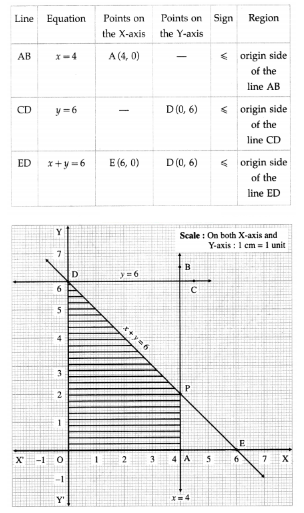
First we draw the lines AB, CD and ED whose equations are x = 4, y = 6 and x + y = 6 respectively.

Image

The feasible region is shaded portion OAPDO in the graph. The vertices of the feasible region are O (0, 0), A (4, 0), P and D (0, 6) P is point of intersection of lines x + y = 6 and x = 4. Substituting x = 4 in x + y = 6, we get 4 + y = 6 ∴ y = 2 ∴ P is (4, 2). ∴ the corner points of feasible region are O (0, 0), A (4, 0), P(4, 2) and D(0 ,6). The values of the objective function z = 11x + 8y at these vertices are z (O) = 11(0) + 8(0) = 0 + 0 = 0 z(a) = 11(4) + 8(0) = 44 + 0 = 44 z (P) = 11(4) + 8(2) = 44 + 16 = 60 z (D) = 11(0) + 8(2) = 0 + 16 = 16 ∴ z has maximum value 60, when x = 4 and y = 2.

View full question & answer
Question 295 Marks
The company makes concrete bricks made up of cement and sand. The weight of a concrete brick has to be least 5 kg. Cement costs ₹ 20 per kg. and sand costs of ₹ 6 per kg. strength consideration dictate that a concrete brick should contain minimum 4 kg. of cement and not more than 2 kg. of sand. Form the L.P.P. for the cost to be minimum.
Answer
Let the company use $x_1 \mathrm{~kg}$ of cement and $\mathrm{x}_2 \mathrm{~kg}$ of sand to make concrete bricks.

Cement costs ₹ 20 per kg and sand costs ₹ 6 per kg.

$\therefore$ the total cost $c=₹\left(20 x_1+6 x_2\right)$

This is a linear function which is to be minimized. Hence, it is the objective function

Total weight of brick $=\left(x_1+x_2\right) \mathrm{kg}$

Since the weight of concrete brick has to be at least 5 kg,

$\therefore x_1+x_2 \geq 5$

Since concrete brick should contain minimum 4 kg of cement and not more than 2 kg of sand,

$x_1 \geq 4$ and $0 \leq x_2 \leq 2$

Hence, the given LPP can be formulated as :

Minimize $c=20 x_1+6 x_2$, subject to

$x_1+x_2 \geq 5, x_1 \geq 4,0 \leq x_2 \leq 2$

View full question & answer
Question 305 Marks
If John drives a car at a speed of 60 kms/hour he has to spend ₹ 5 per km on petrol. If he drives at a faster speed of 90 kms/hour, the cost of petrol increases to ₹ 8 per km. He has ₹ 600 to spend on petrol and wishes to travel the maximum distance within an hour. Formulate the above problem as L.P.P.
Answer
Let John travel xl km at a speed of 60 km/ hour and x1 km at a speed of 90 km/hour.

Therefore, time required to travel a distance of $\mathrm{x}_1 \mathrm{~km}$ is $\frac{x_1}{60}$ hours and the time required to

travel a distance of

$\mathrm{x}_2 \mathrm{~km}$ is $\frac{x_2}{90}$ hours.

$\therefore$ total time required to travel is $\left(\frac{x_1}{60}+\frac{x_2}{90}\right)$ hours.

Since he wishes to travel the maximum distance within an hour,

$\frac{z_1}{60}+\frac{x_2}{90} \leq 1$

He has to spend ₹ 5 per km on petrol at a speed of 60 km/hour and ₹ 8 per km at a speed of 90 km/hour. ∴ the total cost of travelling is ₹ (5x1 + 8x2) Since he has ₹ 600 to spend on petrol, 5x1 + 8x2 ≤ 600 Since distance is never negative, x1 ≥ 0, x2 ≥ 0. Total distance travelled by John is z. = (x1 + x2) km. This is the linear function which is to be maximized. Hence, it is objective function. Hence, the given LPP can be formulated as : Maximize z = x1 + x2, subject to

$\frac{x_1}{60}+\frac{x_2}{90} \leq 1,5 x_1+8 x_2 \leq 600, x_1 \geq 0, x_2 \geq 0$

View full question & answer
Question 315 Marks
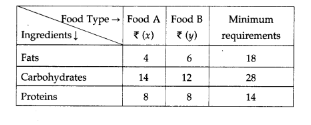
A doctor has prescribed two different units of foods A and B to form a weekly diet for a sick person. The minimum requirements of fats, carbohydrates and proteins are 18, 28, 14 units respectively. One unit of food A has 4 units of fats. 14 units of carbohydrates and 8 units of protein. One unit of food B has 6 units of fat, 12 units of carbohydrates and 8 units of protein. The price of food A is ₹ 4.5 per unit and that of food B is ₹ 3.5 per unit. Form the L.P.P. so that the sick person’s diet meets the requirements at a minimum cost.
Answer
Let the diet of sick person include x units of food A and y units of food B. Then x ≥ 0, y ≥ 0. The prices of food A and B are ₹ 4.5 and ₹ 3.5 per unit respectively. Therefore, the total cost is z = ₹ (4.5x + 3.5y) This is the linear function which is to be minimized. Hence, it is objective function. The constraints are as per the following table :

Image

From the table, the sick person’s diet will include (4x + 6y) units of fats, (14x + 12y) units of carbohydrates and (8x + 8y) units of proteins. The minimum requirements of these ingredients are 18 units, 28 units and 14 units respectively. Therefore, the constraints are 4x + 6y ≥ 18, 14x + 12y ≥ 28, 8x + 8y ≥ 14. Hence, the given LPP can be formulated as Minimize z = 4.5x + 3.5y, subject to 4x + 6y ≥ 18, 14x + 12y ≥ 28, 8x + 8y ≥ 14, x ≥ 0, y ≥ 0.

View full question & answer
Question 325 Marks
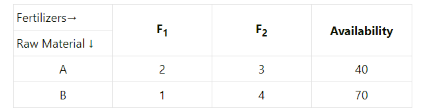
A company manufactures two types of fertilizers F1 and F2. Each type of fertilizer requires two raw materials A and B. The number of units of A and B required to manufacture one unit of fertilizer F1 and F2 and availability of the raw materials A and B per day are given in the table below :

Image

By selling one unit of F1 and one unit of F2, company gets a profit of ₹ 500 and ₹ 750 respectively. Formulate the problem as L.P.P. to maximize the profit.

Answer
Let the company manufactures x units of fertilizers F1 and y units of fertilizers F1. Then the total profit to the company is z = ₹(500x + 750y). This is a linear function that is to be maximized. Hence, it is an objective function.

Image

The raw material A required for x units of Fertilizers F1 and y units of Fertilizers F2 is 2x + Since the maximum availability of A is 40, we have the first constraint as 2x + 3y ≤ 40. Similarly, considering the raw material B, we have x + 4y ≤ 70. Since, x and y cannot be negative, we have, x ≥ 0, y ≥ 0. Hence, the given LPP can be formulated as: Maximize z = 500x + 750y, subject to 2x + 3y ≤ 40, x + 4y ≤ 70, x ≥ 0, y ≥ 0.

View full question & answer
Question 335 Marks
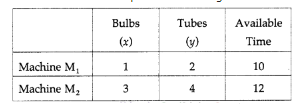
A manufacture produces bulbs and tubes. Each of these must be processed through two machines M1 and M2. A package of bulbs require 1 hour of work on Machine M1 and 3 hours of work on M2. A package of tubes require 2 hours on Machine M1 and 4 hours on Machine M2. He earns a profit of ₹ 13.5 per package of bulbs and ₹ 55 per package of tubes. Formulate the LLP to maximize the profit, if he operates the machine M1, for atmost 10 hours a day and machine M2 for atmost 12 hours a day.
Answer
Let the number of packages of bulbs produced by manufacturer be x and packages of tubes be y. The manufacturer earns a profit of ₹ 13.5 per package of bulbs and ₹ 55 per package of tubes. Therefore, his total profit is p = ₹ (13.5x + 55y) This is a linear function which is to be maximized. Hence, it is the objective function. The constraints are as per the following table :

Image

From the table, the total time required for Machine M1 is (x + 2y) hours and for Machine M2 is (3x + 4y) hours. Given Machine M1 and M2 are available for atmost 10 hours and 12 hours a day respectively. Therefore, the constraints are x + 2y ≤ 10, 3x + 4y ≤ 12. Since, x and y cannot be negative, we have, x ≥ 0, y ≥ 0. Hence, the given LPP can be formulated as : Maximize p = 13.5x + 55y, subject to x + 2y ≤ 10, 3x + 4y ≤ 12, x ≥ 0, y ≥ 0.

View full question & answer
Question 345 Marks
A printing company prints two types of magazines A and B. The company earns ₹ 10 and ₹ 15 on magazines A and B per copy. These are processed on three machines I, II, III. Magazine A requires 2 hours on Machine I, 5 hours on Machine II and 2 hours on Machine III. Magazine B requires 3 hours on Machine I, 2 hours on Machine II and 6 hours on Machine III. Machines I, II, III are available for 36, 50, 60 hours per week respectively. Formulate the L.P.P. to determine weekly production of A and B, so that the total profit is maximum.
Answer
Let the company prints x magazine of type A and y magazine of type B. Profit on sale of magazine A is ₹ 10 per copy and magazine B is ₹ 15 per copy. Therefore, the total earning z of the company is z = ₹ (10x + 15y). This is a linear function which is to be maximized. Hence, it is the objective function. The constraints are as per the following table:

Image

From the table, the total time required for Machine I is (2x + 3y) hours, for Machine II is (5x + 2y) hours and for Machine III is (2x + 6y) hours. The machines I, II, III are available for 36,50 and 60 hours per week. Therefore, the constraints are 2x + 3y ≤ 36, 5x + 2y ≤ 50, 2x + 6y ≤ 60. Since x and y cannot be negative. We have, x ≥ 0, y ≥ 0. Hence, the given LPP can be formulated as : Maximize z = 10x + 15y, subject to 2x + 3y ≤ 36, 5x + 2y ≤ 50, 2x + 6y ≤ 60, x ≥ 0, y ≥ 0.

View full question & answer
Question 355 Marks
A company manufactures two types of chemicals A and B. Each chemical requires two types of raw material P and Q. The table below shows number of units of P and Q required to manufacture one unit of A and one unit of B and the total availability of P and Q.

Image

The company gets profits of ₹350 and ₹400 by selling one unit of A and one unit of B respectively. (Assume that the entire production of A and B can be sold). How many units of the chemicals A and B should be manufactured so that the company get maximum profit? Formulate the problem as L.P.P. to maximize the profit.

Answer
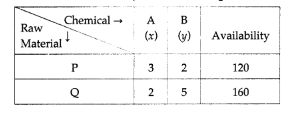
Let the company manufactures x units of chemical A and y units of chemical B. Then the total profit f to the company is p = ₹ (350x + 400y). This is a linear function which is to be maximized. Hence, it is the objective function. The constraints are as per the following table:

Image

The raw material P required for x units of chemical A and y units of chemical B is 3x + 2y. Since, the maximum availability of P is 120, we have the first constraint as 3x + 2y ≤ 120. Similarly, considering the raw material Q, we have : 2x + 5y ≤ 160. Since, x and y cannot be negative, we have, x ≥ 0, y ≥ 0. Hence, the given LPP can be formulated as : Maximize p = 350x + 400y, subject to 3x + 2y ≤ 120, 2x + 5y ≤ 160, x ≥ 0, y ≥ 0.

View full question & answer
Question 365 Marks
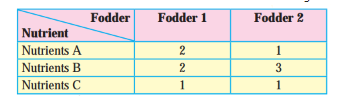
In a cattle breading firm, it is prescribed that the food ration for one animal must contain 14, 22 and 1 units of nutrients A, B and C respectively. Two different kinds of fodder are available. Each unit of these two contains the following amounts of these three nutrients :

Image

The cost of fodder 1 is ₹3 per unit and that of fodder ₹ 2, Formulate the L.P.P. to minimize the cost.

Answer
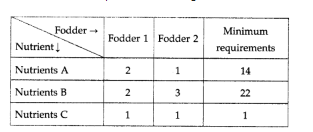
Let x units of fodder 1 and y units of fodder 2 be prescribed. The cost of fodder 1 is ₹ 3 per unit and cost of fodder 2 is ₹ 2 per unit. ∴ total cost is z = 3x + 2y This is the linear function which is to be minimized. Hence it is the objective function. The constraints are as per the following table :

Image

From table fodder contains (2x + y) units of nutrients A, (2x + 3y) units of nutrients B and (x + y) units of nutrients C. The minimum requirements of these nutrients are 14 units, 22 units and 1 unit respectively. Therefore, the constraints are 2x + y ≥ 14, 2x + 3y ≥ 22, x + y ≥ 1 Since, number of units (i.e. x and y) cannot be negative, we have, x ≥ 0, y ≥ 0. Hence, the given LPP can be formulated as Minimize z = 3x + 2y, subject to 2x + y ≥ 14, 2x + 3y ≥ 22, x + y ≥ 1, x ≥ 0, y ≥ 0.

View full question & answer
Question 375 Marks
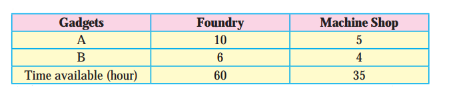
A manufacturing firm produces two types of gadgets A and B, which are first processed in the foundry and then sent to machine shop for finishing. The number of man hours of labour required in each shop for production of A and B per unit and the number of man hours available for the firm are as follows :

Image

Profit on the sale of A is ₹ 30 and B is ₹ 20 per units. Formulate the L.P.P. to have maximum profit.

Answer
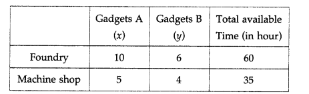
Let the number of gadgets A produced by the firm be x and the number of gadgets B produced by the firm be y. The profit on the sale of A is ₹ 30 per unit and on the sale of B is ₹ 20 per unit. ∴ total profit is z = 30x + 20y. This is a linear function which is to be maximized. Hence it is the objective function. The constraints are as per the following table :

Image

From the table total man hours of labour required for x units of gadget A and y units of gadget B in foundry is (10x + 6y) hours and total man hours of labour required in machine shop is (5x + 4y) hours. Since, maximum time avilable in foundry and machine shops are 60 hours and 35 hours respectively. Therefore, the constraints are 10x + 6y ≤ 60, 5x + 4y ≤ 35. Since, x and y cannot be negative, we have x ≥ 0, y ≥ 0. Hence, the given LPP can be formulated as : Maximize z = 30x + 20y, subject to 10x + 6y ≤ 60, 5x + 4y ≤ 35, x ≥ 0, y ≥ 0.

View full question & answer
Question 385 Marks
A furniture dealer deals in tables and chairs. He has Rs.1,50,000 to invest and a space to store at most 60 pieces. A table costs him Rs.1500 and a chair Rs.750. Construct the inequations and find the feasible solution.Question is modified A furniture dealer deals in tables and chairs. He has ₹ 15,000 to invest and a space to store at most 60 pieces. A table costs him ₹ 150 and a chair ₹ 750. Construct the inequations and find the feasible solution.
Answer
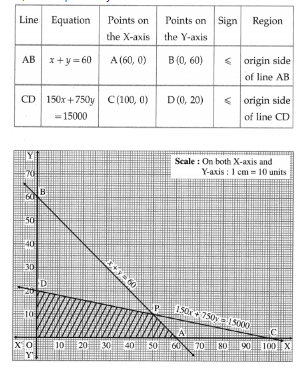
Let x be the number of tables and y be the number of chairs. Then x ≥ 0, y ≥ 0. The dealer has a space to store at most 60 pieces. ∴ x + y ≤ 60 Since, the cost of each table is ₹ 150 and that of each chair is ₹ 750, the total cost of x tables and y chairs is 150x + 750y. Since the dealer has ₹ 15,000 to invest, 150x + 750y ≤ 15,000 Hence the system of inequations are x + y ≤ 60, 150x + 750y ≤ 15000, x ≥ 0, y ≥ 0. First we draw the lines AB and CD whose equations are x + y = 60 and 150x + 750y = 15,000 respectively.

Image

The feasible solution is OAPDO. which is shaded in the graph.

View full question & answer
Question 395 Marks
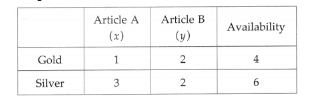
A company produces two types of articles A and B which requires silver and gold. Each unit of A requires 3 gm of silver and 1 gm of gold, while each unit of B requires 2 gm of silver and 2 gm of gold. The company has 6 gm of silver and 4 gm of gold. Construct the inequations and find the feasible solution graphically.
Answer
Let the company produces x units of article A and y units of article B. The given data can be tabulated as:

Image

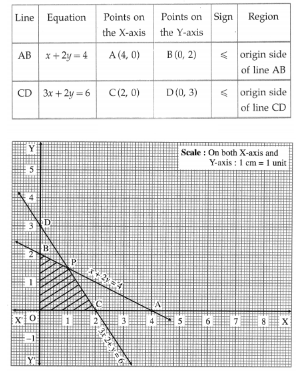
Inequations are : x + 2y ≤ 4 and 3x + 2y ≤ 6 x and y are number of items, x ≥ 0, y ≥ 0 First we draw the lines AB and CD whose equations are x + 2y = 4 and 3x + 2y = 6 respectively.

Image

The feasible solution is OCPBO. which is shaded in the graph.
View full question & answer
Question 405 Marks
Find the feasible solution of the following inequations graphically.x – 2y ≤ 2, x + y ≥ 3, -2x + y ≤ 4, x ≥ 0, y ≥ 0
Answer
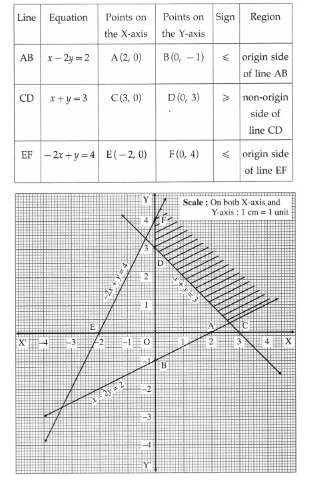
First we draw the lines AB, CD and EF whose equations are x – 2y = 2, x + y = 3 and -2x + y = 4 respectively.

Image

The feasible solution is shaded in the graph.
View full question & answer
Question 415 Marks
Find the feasible solution of the following inequations graphically.0 ≤ x ≤ 3, 0 ≤ y ≤ 3, x + y ≤ 5, 2x + y ≥ 4
Answer
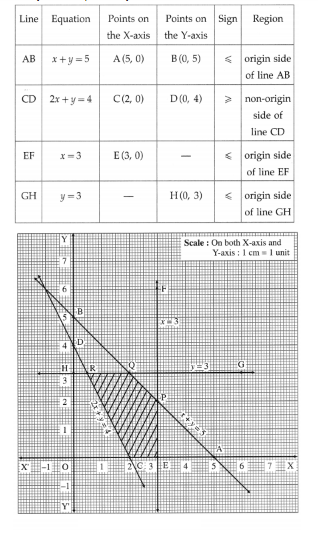
First we draw the lines AB, CD, EF and GH whose equations are x + y = 5, 2x + y = 4, x = 3 and y = 3 respectively.

Image

The feasible solution is CEPQRC. which is shaded in the graph.

View full question & answer
Question 425 Marks
Find the feasible solution of the following inequations graphically.x + 4y ≤ 24, 3x + y ≤ 21, x + y ≤ 9, x ≥ 0, y ≥ 0.
Answer
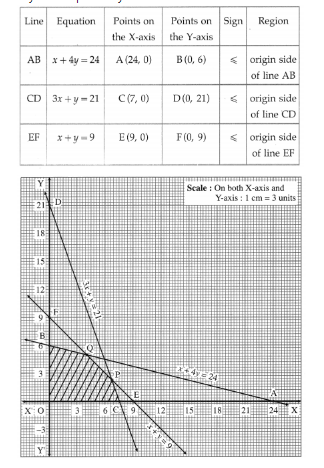
First we draw the lines AB, CD and EF whose equations are x + 4y = 24, 3x + y = 21 and x + y = 9 respectively.

Image

The feasible solution is OCPQBO. which is shaded in the graph.

View full question & answer
Question 435 Marks
Find the feasible solution of the following inequations graphically.3x + 4y ≥ 12, 4x + 7y ≤ 28, y ≥ 1, x ≥ 0
Answer
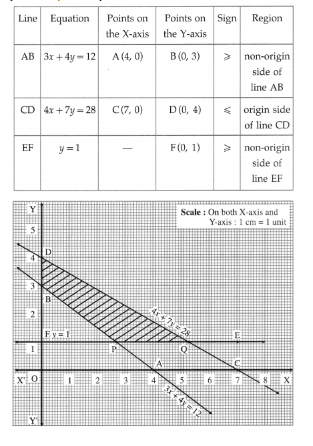
First we draw the lines AB, CD and EF whose equations are 3x + 4 y = 12, 4x + 7y = 28 and y = 1 respectively.

Image

The feasible solution is PQDBP. which is shaded in the graph.

View full question & answer
Question 445 Marks
Find the feasible solution of the following inequations graphically.2x + 3y ≤ 6, x + y ≥ 2, x ≥ 0, y ≥ 0
Answer
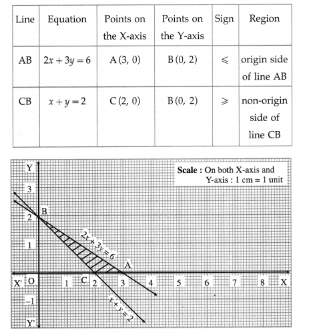
First we draw the lines AB and CB whose equations are 2x + 3y = 6 and x + y = 2 respectively.

Image

The feasible solution is ∆ABC which is shaded in the graph.

View full question & answer
Question 455 Marks
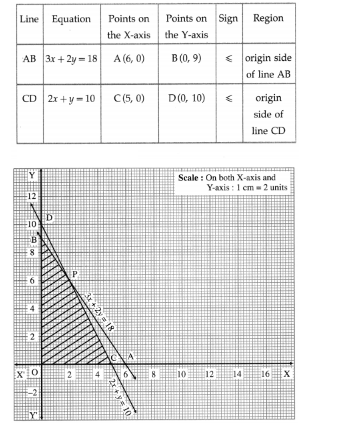
Find the feasible solution of the following inequations graphically : 3x + 2y ≤ 18, 2x + y ≤ 10, x ≥ 0, y ≥ 0
Answer
First we draw the lines AB and CD whose equations are 3x + 2y = 18 and 2x + y = 10 respectively

Image

The feasible solution is OCPBO which is shaded in the graph.

View full question & answer
Question 465 Marks
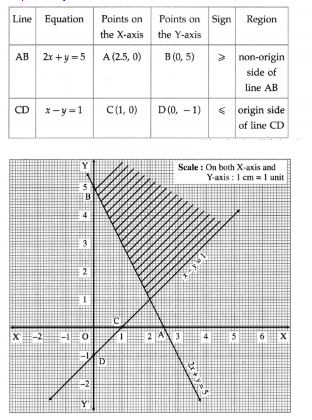
Solve graphically :2x + y ≥ 5 and x – y ≤ 1
Answer
First we draw the lines AB and CD whose equations are 2x + y = 5 and x – y = 1 respectively.

Image

The solution set of the given system of inequations is shaded in the graph. CategoriesClass 12

View full question & answer
Question 475 Marks
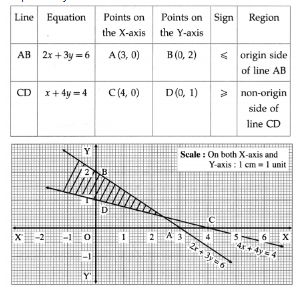
Solve graphically : 2x + 3y ≤ 6 and x + 4y ≥ 4
Answer
First we draw the lines AB and CD whose equations are 2x + 3y = 6 and x + 4y = 4 respectively.

Image

The solution set of the given system of inequalities is shaded in the graph.
View full question & answer
Question 485 Marks
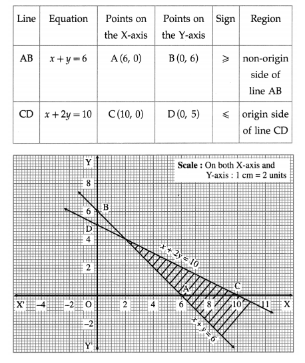
Solve graphically : x + y ≥ 6 and x + 2y ≤ 10
Answer
First we draw the lines AB and CD whose equations are x + y = 6 and x + 2y = 10 respectively.

ImageThe solution set of the given system of inequalities is shaded in the graph.
View full question & answer
Question 495 Marks
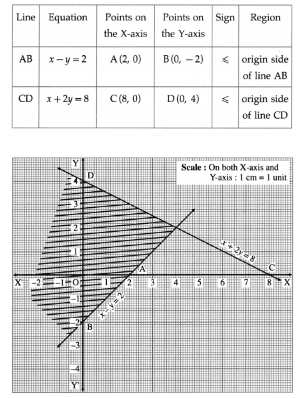
Solve graphically :x – y ≤ 2 and x + 2y ≤ 8
Answer
First we draw the lines AB and CD whose equations are x – y = 2 and x + 2y = 8 respectively.

Image

The solution set of the given system of inequalities is shaded in the graph.
View full question & answer
Question 505 Marks
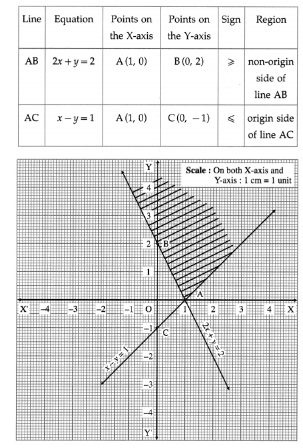
Solve graphically :2x + y ≥ 2 and x – y ≤ 1
Answer
First we draw the lines AB and AC whose equations are 2x + y = 2 and x – y = 1 respectively

Image

The solution set of the given system of inequalities is shaded in the graph.
View full question & answer
Question 515 Marks
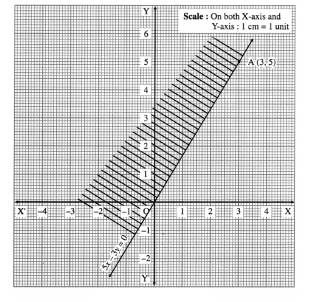
Solve graphically : 5x – 3y ≤ 0
Answer
Consider the line whose equation is 5x – 3y = 0. The constant term is zero, therefore this line is passing through the origin. ∴ one point on the line is the origin O = (0, 0). To find the other point, we can give any value of x and get the corresponding value of y. Put x = 3, we get 15 – 3y = 0, i.e. y = 5 ∴ A ≡ (3, 5) is another point on the line. Draw the line OA. To find the solution set, we cannot check 0(0, 0), as it is already on the line. We can check any other point which is not on the line. Let us check the point (1, -1). When x = 1, y = -1 then 5x – 3y = 5 + 3 = 8 which is neither less nor equal to zero. ∴ 5x – 3y ≰ 0 in this case. Hence (1, -1) will not lie in the required region. Therefore, the required region is the upper side which is shaded in the graph.

Image

This is the solution set of 5x – 3y ≤ 0.

View full question & answer
Question 525 Marks
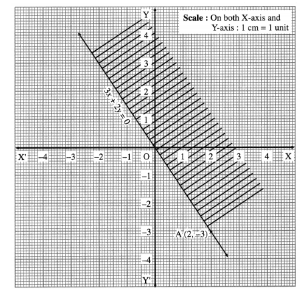
Solve graphically :3x + 2y ≥ 0
Answer
Consider the line whose equation is 3x + 2y = 0. The constant term is zero, therefore this line is passing through the origin. ∴ one point on the line is O ≡ (0, 0). To find the another point, we can give any value of x and get the corresponding value of y. Put x = 2, we get 6 + 2y = 0 i.e. y = – 3 ∴ A = (2, -3) is another point on the line. Draw the line OA. To find the solution set, we cannot check (0, 0) as it is already on the line. We can check any other point which is not on the line. Let us check the point (1, 1)

Image

When x = 1, y = 1, then 3x + 2y = 3 + 2 = 5 which is greater than zero. ∴ 3x + 2y > 0 in this case. Hence (1, 1) lies in the required region. Therefore, the required region is the upper side which is shaded in the graph. This is the solution set of 3x + 2y ≥ 0.

View full question & answer
Question 535 Marks
Solve graphically :2x – 5y ≥ 10
Answer
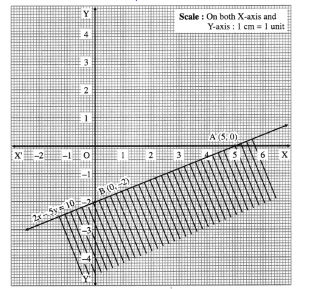
Consider the line whose equation is 2x – 5y = 10. To find the points of intersection of this line with the coordinate axes. Put y = 0, we get 2x = 10, i.e. x = 5. ∴ A = (5, 0) is a point on the line. Put x = 0, we get -5y = 10, i.e. y = -2 ∴ B = (0, -2) is another point on the line.

Image

Draw the line AB joining these points. This line J divide the plane in two parts. 1. Origin side 2. Non-origin side To find the solution set, we have to check the position of the origin (0, 0) with respect to the line. When x = 0, y = 0, then 2x – 5y = 0 which is neither greater nor equal to 10. ∴ 2x – 5y ≱ 10 in this case. Hence (0, 0) will not lie in the required region. Therefore, the given inequality is the non-origin side, which is shaded in the graph. This is the solution set of 2x – 5y ≥ 10.

View full question & answer
Question 545 Marks
Solve graphically :x + 2y ≤ 6
Answer
Consider the line whose equation is x + 2y = 6. To find the points of intersection of this line with the coordinate axes. Put y = 0, we get x = 6. ∴ A = (6, 0) is a point on the line. Put x = 0, we get 2y = 6, i.e. y = 3 ∴ B = (0, 3) is another point on the line.

Image

Draw the line AB joining these points. This line divide the line into two parts. 1. Origin side 2. Non-origin side To find the solution set, we have to check the position of the origin (0, 0) with respect to the line. When x = 0, y = 0, then x + 2y = 0 which is less than 6. ∴ x + 2y ≤ 6 in this case. Hence, origin lies in the required region. Therefore, the given inequality is the origin side which is shaded in the graph. This is the solution set of x + 2y ≤ 6.

View full question & answer