Question
Solve graphically that the following system of equation has infinitely many solutions:
$2x + 3y = 6$
$4x + 6y = 12$

Answer

So we have $2x + 3y = 6$ and $4x + 6y = 12.$
Now, $2x + 3y = 5$
$\text{x}=\frac{6-3\text{y}}{2}$
When $y = 0$ then,$ x = 3$ when $y = 2$ then, $x = 0$
$x$
$0$
$3$
$y$
$2$
$0$
Now, 4x + 6y = 12
$\text{x}=\frac{12-6\text{y}}{4}$
When $y = 0$, then $x = 3$ When $y = 2$, then $x = 0$
Thus, we have the following table giving points on the line $4x + 6y = 12$​​​​​​​
$x$
$0$
$3$
$y$
$2$
$0$
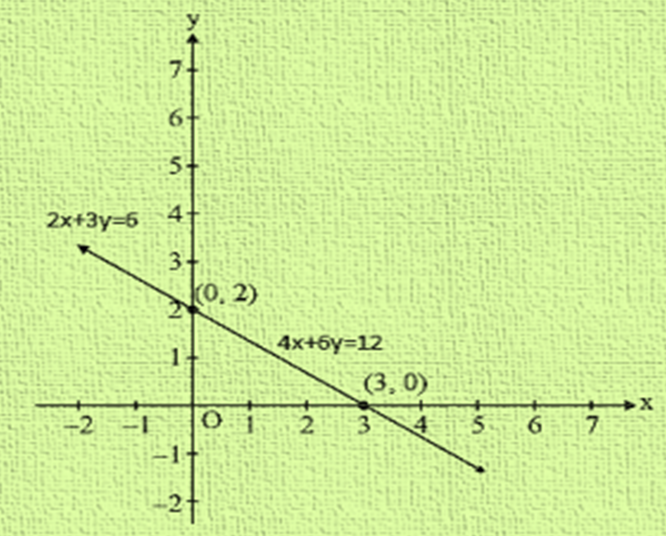
Graph of the equation $2x + 3y = 6$ and $4x + 6y = 12$​​​​​​​

Thus the graphs of the two equations are coincident. Hence, the system of equations has infinitely many solutions.

Need a full question paper?

Generate a complete, print-ready paper with questions like this in minutes — across 16+ boards, with answer keys.
Start Generating Free

Similar questions

A right angled triangle whose sides are $3\ cm, 4\ cm$ and $5\ cm$ is revolved about the sides containing the right angle in two ways. Find the difference in volumes of the two cones so formed. Also, find their curved surfaces.
A footpath of uniform width runs all around the inside of a rectangular field $54\ m$ long and $35\ m$ wide. If the area of the path is $420m^2$., find the width of the path.
Solve the following quadratic equation:
$\frac{1}{\text{2x}-3}+\frac{1}{\text{x}-5}=1\frac{1}{9},$ $\text{x}\neq\frac{3}{2},\ 5$
Very-Short-Answer Question:
If $(a - b)$, a and $(a + b)$ are zeros of the polynomial $2 x^3-6 x^2+5 x-7$, write the value of a.
A bag contains $4$ red, $5$ black and $6$ white balls. A ball is drawn from the bag at random. Find the probability that the ball drawn is:
  1. White.
  2. Red.
  3. Not black.
  4. Red or white.
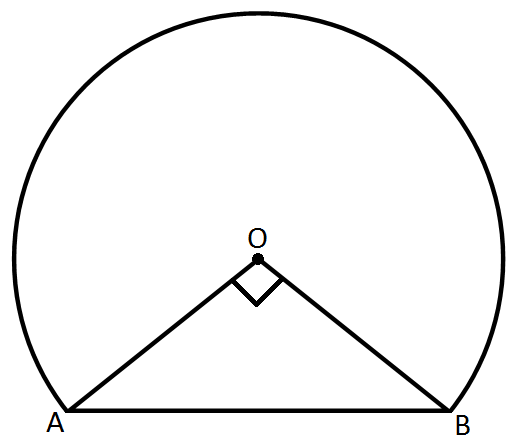
In the following figure, shows the cross-section of railway tunnel. The radius $OA$ of the circular part is $2\ m$. If $\angle\text{AOB}=90^\circ,$ calculate
  1. The height of the tunnel
  2. The perimeter of the cross-section
  3. The area of the cross-section.
Find all the zeros of $(x^4 + x^3 - 23x^2 - 3x + 60),$ if it is given that two of its zeros are $\sqrt3$ and $-\sqrt3.$
Calculate the mode from the following data:
Monthly salary (in Rs)
No. of employees
$0-5000$
$90$
$5000-1000$
$150$
$10000-15000$
$100$
$15000-20000$
$80$
$20000-25000$
$70$
$25000-30000$
$10$
The path of a train a is given by the equation $3x + 4y - 12 = 0$ and the path of another train $B$ is given by the equation $6x + 8y - 48 = 0.$ Represent this situation graphically.
Find the missing frequency (p) for the following distribution whose mean is 7.68.
x 3 5 7 9 11 13
f 6 8 15 P 8 4