Question
Solve graphically :x + 2y ≤ 6
Answer

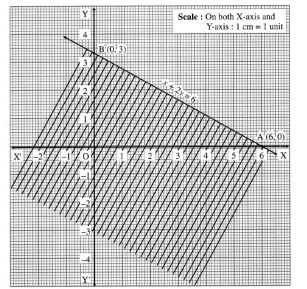
Consider the line whose equation is x + 2y = 6. To find the points of intersection of this line with the coordinate axes. Put y = 0, we get x = 6. ∴ A = (6, 0) is a point on the line. Put x = 0, we get 2y = 6, i.e. y = 3 ∴ B = (0, 3) is another point on the line.

Image

Draw the line AB joining these points. This line divide the line into two parts. 1. Origin side 2. Non-origin side To find the solution set, we have to check the position of the origin (0, 0) with respect to the line. When x = 0, y = 0, then x + 2y = 0 which is less than 6. ∴ x + 2y ≤ 6 in this case. Hence, origin lies in the required region. Therefore, the given inequality is the origin side which is shaded in the graph. This is the solution set of x + 2y ≤ 6.

Need a full question paper?

Generate a complete, print-ready paper with questions like this in minutes — across 16+ boards, with answer keys.

Start Generating Free

Similar questions

Differentiate the following functions with respect to x:
$\frac{\text{x}^2(1-\text{x}^2)}{\cos2\text{x}}$
If $\text{A}=\begin{bmatrix}4&2\\-1&-1 \end{bmatrix},$ prove that (A - 2I)(A - 3I) = 0
Prove that the function $\text{f(x)}=\begin{cases}\frac{\sin\text{x}}{\text{x}},&\text{x}<0\\\text{x}+1,&\text{x}\geq0\end{cases}$ is everywhere continuous.
Verify Rolle's theorem for the following function on the indicated intervals$f(x) = x(x^- 4)^2$ on the interval $[0, 4]$
If $\text{xy}\log(\text{x}+\text{y})=1,$ prove that $\frac{\text{dx}}{\text{dx}}=-\frac{\text{y}(\text{x}^2\text{y}+\text{x}+\text{y})}{\text{x}(\text{xy}^2+\text{x}+\text{y})}$
Write the set of values of 'a' for which $\text{f}(\text{x})=\log_\text{a}\text{x}$ is decreasing in its domain.
Show that the three lines with direction cosines $\frac{12}{13},\frac{-3}{13},\frac{-4}{13},\frac{4}{13},\frac{12}{13},\frac{3}{13},\frac{3}{13},\frac{-4}{13},\frac{12}{13}$ are mutually perpendicular.
An insurance company insured $3000$ scooters, $4000$ cars and $5000$ trucks. The probabilities of the accident involving a scooter, a car and a truck are $0.02, 0.03$ and $0.04$ respectively. One of the insured vehicles meet with an accident. Find the probability that it is a,
  1. Scooter.
  2. Car.
  3. Truck.
Evaluate the following intregals: $\int\frac{1}{\sqrt{3}\sin\text{x}+\cos\text{x}}\ \text{dx}$
A and B take turns in throwing two dice, the first to throw $10$ being awarded the prize, show that if A has the first throw, their chance of winning are in the ratio $12 : 11.$