Question
Solve $\left(x^2+\frac{1}{x^2}\right)-3\left(x-\frac{1}{x}\right)-2=0$

Answer

$\left(x^2+\frac{1}{x^2}\right)-3\left(x-\frac{1}{x}\right)-2=0$
Let $x-\frac{1}{x}=\mathrm{y}$
squaring on both sides
$ \begin{aligned} & \left(x-\frac{1}{x}\right)^2=\mathrm{y}^2 \\ & x^2+\frac{1}{x^2}-2=y^2 \\ & \Rightarrow x^2+\frac{1}{x^2}=y^2+2 \\ & \mathrm{~m}^2+2-3(\mathrm{~m})-2=0 \\ & \mathrm{~m}^2-3 \mathrm{~m}=0 \\ & \mathrm{~m}(\mathrm{~m}-3)=0 \\ & \mathrm{~m}=0 \text { and } \mathrm{m}-3=0 \\ & x-\frac{1}{x}=0 \text { or } x-\frac{1}{x}=3 \\ & \frac{x^2-1}{x}=0 \text { or } \frac{x^2-1}{x}=3 \\ & =\mathrm{x}^2-1=0 \text { or } \mathrm{x}^2-1=3 \mathrm{x} \\ & \mathrm{x}^2=1 \text { or } \mathrm{x}^2-3 \mathrm{x}-1=0 \end{aligned} $
$\begin{aligned} & x=\sqrt{1} \text { or } x=\frac{-(-3) \pm \sqrt{(-3)^2-4(1)(-1)}}{2(1)} \\ & x= \pm 1 \text { or }=x=\frac{3 \pm \sqrt{13}}{2}\end{aligned}$

Need a full question paper?

Generate a complete, print-ready paper with questions like this in minutes — across 16+ boards, with answer keys.
Start Generating Free

Similar questions

Find the equation of the line perpendicular to the line joining the points $A (1,2)$ and $B (6,7)$ and passing through the point which divides the line segment AB in the ratio $3: 2$.
If the sum of two smaller sides of a right – angled triangle is 17cm and the perimeter is 30cm, then find the area of the triangle.
A man has a choice to invest in hundred-rupee shares of two firms at Rs 120 or at Rs 132. The first firm pays a dividend of 5% per annum and the second firm pays a dividend of 6% per annum. Find:
(i) which company is giving a better return.
(ii) if a man invests Rs 26,400 with each firm, how much will be the difference between the annual returns from the two firms.
An aeroplane at an altitude of 200 m observes the angles of depression of opposite points on the two banks of a river to be 45° and 60°. Find the width of the river. 
The point P is the foot of perpendicular from $A (−5, 7)$ to the line whose equation is $2x – 3y + 18 = 0$. Determine :
(i) the equation of the line $AP$
(ii) the co-ordinates of$ P.$
Solve, using formula :$x^2+x-(a+2)(a+1)=0$
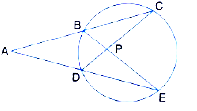
In the given figure, AC = AE Show that:
(i) CP = EP
(ii) BP = DP

 
In a cyclic – quadrilateral PQRS, angle PQR = 135°. Sides SP and RQ produced meet at point A : whereas sides PQ and SR produced meet at point B.
If ∠A : ∠B = 2 : 1; find angles A and B.
Meera borrowed $Rs.35,000$ at $12.5\%$ p.a. simple interest for $3$ years. She immediately gave it to Archana at $12\%$ p.a. compound interest compounded annually. Find Meera's loss or gain at the end of $3$ years.
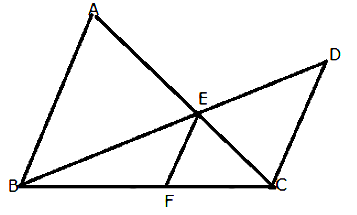
In the given figure, AB ∥ EF ∥ DC ; AB = 67.5 cm, DC = 40.5 cm and AE = 52.5 cm.

(i) Name the three pairs of similar triangles.
(ii) Find the lengths of EC and EF.